
Contents 22 sections
- Why Do Marketplace Customer Questions Matter?
- What Types of Questions Come in on Marketplaces?
- How Do You Answer Customer Questions Quickly?
- How Are Canned Replies Written?
- How Do You Collect Questions Across Multiple Marketplaces and Stores?
- How Are Response Time and Quality Measured?
- What Are Example Canned Replies by Question Type?
- How Do You Answer Negative or Difficult Questions?
- How Do You Plan Team and Shifts for Question Management?
- Why Do Stock and Price Questions Need Extra Attention?
- Example Scenarios in Marketplace Question Management
- What Are Common Mistakes in Marketplace Question Management?
- How Do You Keep Answers Consistent and On-Brand?
- How Do You Turn Customer Questions into Product and Catalog Improvements?
- When Should You Use Automation and When a Human Reply?
- How Does Response Time Affect Store Performance?
- Which Phrases Should Be Avoided in Answers?
- Marketplace Question Management Checklist
- How Do You Manage Marketplace Questions with Faprika?
- Summary: Five Principles to Remember in Question Management
- Frequently Asked Questions
- Frequently Asked Questions (FAQ)
How are marketplace customer questions managed? They are managed by collecting questions from all marketplaces and stores in a single list, preparing canned replies for frequent questions and measuring response time. A fast, accurate answer is the cheapest way to win a customer who is about to decide to buy.
In this guide we explain why customer questions matter on marketplaces, the question types, ways to answer quickly, how to write canned replies, how to solve the problem when you have multiple marketplaces and stores, and how to measure answer quality and speed. Marketplace rules change from time to time; always check the current rules of your own channel.
Why Do Marketplace Customer Questions Matter?
A customer who asks a question about a product on a marketplace is usually making their final decision before buying: Will the size fit? When will it ship? Is the colour as in the photo? The answer shapes that decision.
- Direct impact on sales: If the reply is late, the customer may go to another seller.
- Visibility impact: On most marketplaces, answered questions are also visible to other buyers on the product page; a good answer also pre-empts the next customer's question.
- Store score impact: Marketplaces often also evaluate the seller on criteria such as response time and rate.
- Return reduction impact: A clear answer prevents wrong expectations and lowers the risk of returns.
- Customer trust: A fast and polite reply increases trust in the store.
What Types of Questions Come in on Marketplaces?
Most questions received on a marketplace fall into a few groups. Knowing the groups lets you organize canned replies and owners accordingly.
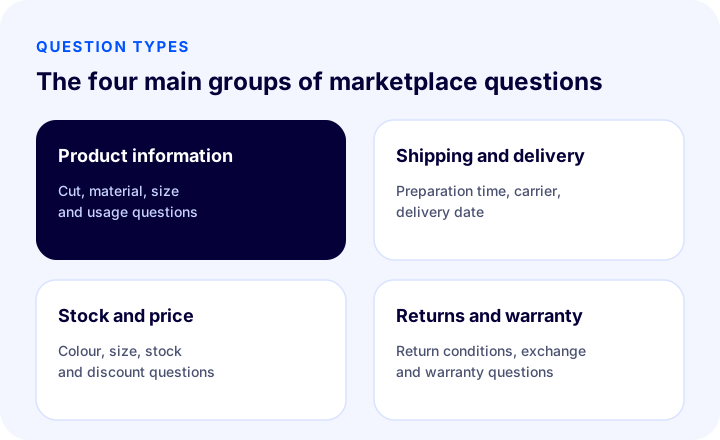
| Question type | Example | Answer source |
|---|---|---|
| Product information | "Is the fit narrow?", "What is it made of?" | Product card and size chart |
| Shipping and delivery | "When will it be handed to the carrier?" | Carrier agreement and preparation time |
| Stock and price | "Is there another colour?", "Is it on sale?" | Stock and price information |
| Returns and warranty | "How do I return it?" | Return policy |
| Order status | "Where is my order?" | Order and shipment tracking |
How Do You Answer Customer Questions Quickly?
The way to answer quickly is to collect questions in one place, keep answers to frequent questions ready and decide who looks at which question. When the three work together, response time drops to minutes.
- Collect questions on one screen. Logging in to each marketplace's panel separately wastes time and causes missed questions.
- Write canned replies. Answer frequent questions well once, then reuse the answer.
- Assign an owner. Make it clear who is on duty in each shift.
- Prioritize. Answer first the question of a customer who is about to buy.
- Set a time target. For example, set a goal of replying within a certain time during working hours.
How Are Canned Replies Written?
A good canned reply is short, clear and polite; it answers the customer's question directly and states the next step if needed. In every reply, design variable details such as the product name and customer name so that they are filled in automatically.
| Reply element | What should it look like? |
|---|---|
| Greeting | With the customer's name, short and polite |
| Answer | Direct answer to the question in the first sentence |
| Detail | One sentence of extra information if needed |
| Pointer | If needed, point to the relevant product feature or size chart |
| Closing | Thanks and a note that you are ready to help |
An example shipping reply could be: "Hello [customer name], your [product name] order is prepared and handed to the carrier on the day it is confirmed. If you have any other questions, we will be happy to help." The parts in square brackets are meant to illustrate variables that fill in automatically for each question; the notation in the system you use may differ.
- Do not put harsh or defensive phrases in the reply.
- Do not commit to uncertain information (stock, delivery date).
- Do not write in the reply any redirections the marketplace prohibits (for example, moving the customer off the platform).
- Keep every canned reply up to date regularly; a reply containing outdated or wrong information does harm.
How Do You Collect Questions Across Multiple Marketplaces and Stores?
If you sell on more than one marketplace and with more than one store, questions arrive scattered and some are missed. The solution is to collect all questions on one screen and show next to each which marketplace and which store it came from.
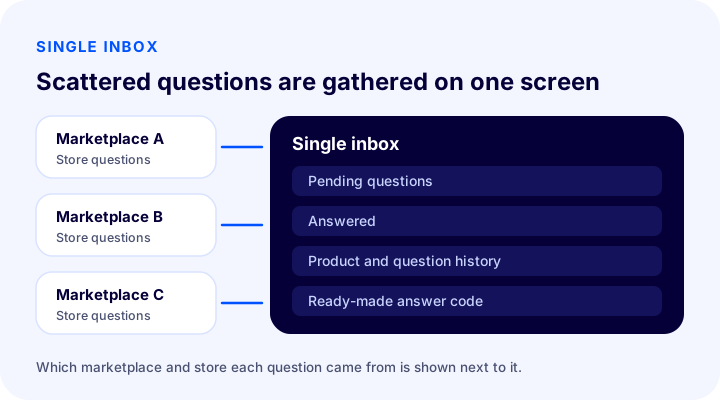
| Situation | Managing panels separately | Single inbox |
|---|---|---|
| Tracking questions | You log in to each panel separately | All in one list |
| Reply speed | Switching between panels takes time | Quick reply from the same screen |
| Missed questions | High risk | Tracking with status tabs |
| Ready-made answer | Written separately in each panel | Written once, used everywhere |
| Product and stock information | You have to check another system | Question and product on the same screen |
How Are Response Time and Quality Measured?
The success of question management is measured by three indicators: average response time, the number of unanswered questions and conversion to an order after the answer. If these are not improving, the process or the team plan should be reviewed.
| Indicator | What does it tell you? | Improvement |
|---|---|---|
| Average response time | Speed | Set up a shift and notification system |
| Number of unanswered questions | Missed opportunity | Do an end-of-day check using the status tabs |
| Most frequent questions | Missing information on the product page | Add it to the product description and image |
| Customer satisfaction | Quality of the answer | Review the canned replies |
Moving the most frequent questions onto the product page pays off twice: customers learn the answer without asking, and you are spared from answering the same question again and again. That is why the question list is also a list of product description improvements.
Okumanızı öneririzE-Ticaret İçin Ürün Açıklaması Nasıl Yazılır?What Are Example Canned Replies by Question Type?
If canned replies are grouped by question type, the team finds the right answer quickly. The examples below are only meant to show the structure; adapt them to your own products and policies.
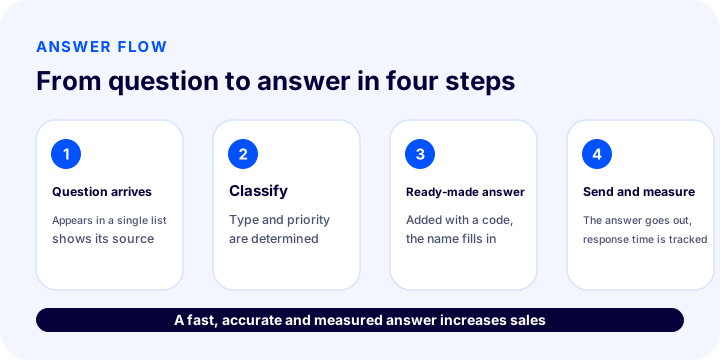
| Question | Example reply structure |
|---|---|
| When will it be handed to the carrier? | "Hello, your order is prepared and handed to the carrier on the day it is confirmed." |
| Is the fit narrow? | "Our product has a standard fit; we recommend choosing according to the values in the size chart." |
| Is there another colour? | "It is currently on sale in the colours listed; you can see new colours on the product page when they are added." |
| How do I return it? | "Return conditions follow the marketplace's return process; details are in the order details." |
| Is it in stock? | "We have stock in the sizes and colours shown on the product page." |
In all replies, take care not to commit to uncertain information. Saying "it is shipped" instead of "it will definitely arrive tomorrow" lowers the risk of complaints because delivery time is outside your control.
How Do You Answer Negative or Difficult Questions?
Not every question is polite; some customers ask while complaining about a delay, the product or the price. In difficult questions, tone matters as much as speed: a calm, solution-oriented and non-defensive answer protects both the customer and the page where the question remains visible.
- Apologize, do not blame. Even if the fault is not yours, acknowledge the trouble the customer has experienced.
- Offer a solution. Give a concrete step such as "You can submit your request from the order details."
- Verify the information. Check the order and shipping information before replying.
- Do not argue. The reply may be publicly visible; stay calm.
- Escalate. Pass complex situations to an authorized person.
How Do You Plan Team and Shifts for Question Management?
Answering questions should not be left to one person's memory; it should be clear who looks at which store's questions, and at what time. Even in a small business, a simple arrangement noticeably improves response time.
| Task | Recommended person responsible | Note |
|---|---|---|
| Daily question tracking | Customer service | Morning, noon and evening check rounds |
| Updating canned replies | Customer service manager | Monthly review |
| Product information questions | Product or catalog owner | Answers technical questions |
| Shipping and order questions | Operations | Verifies order status |
| Reporting | Manager | Response time and question types |
Measure the hours when questions peak (usually evenings and weekends) and plan the shifts accordingly; a team sitting idle at peak hours is the team that misses the most questions.
Why Do Stock and Price Questions Need Extra Attention?
Stock and price information changes constantly; fixed information written into a canned reply goes out of date quickly. That is why, for stock and price questions, the answer should be given by checking the product's current status.
- Do not fix stock status in a canned reply; check the product card.
- For price and campaign questions, verify the current price on the product page.
- If stock and product information appear on the same screen as the question, the answer is both fast and accurate.
- For products whose stock changes often, direct the questions to "according to the current information on the product page".
Example Scenarios in Marketplace Question Management
Scenario 1: The same product on three marketplaces
A seller sells the same product on three marketplaces. Questions land in three separate panels and one is missed. After switching to a single inbox, all questions appear in the same list, pending ones are tracked from the status tab and no question is missed.
Scenario 2: The same question keeps coming
The question "Is the fit narrow?" comes dozens of times every day. The seller adds the size chart and fit information to the product page; a week later the frequency of the same question has dropped noticeably.
Scenario 3: Peak load during a campaign period
During a campaign period the number of questions rises. The team works with canned replies, puts extra shifts in the busy hours and keeps response time on target; as a result, campaign traffic turns into orders.
What Are Common Mistakes in Marketplace Question Management?
The most common mistakes are answering questions late and rewriting every question from scratch. Both reduce sales and the team's efficiency.
| Mistake | Consequence | Solution |
|---|---|---|
| Answering questions late | The customer goes to another seller | Single screen and time target |
| Writing every reply from scratch | Lost time, inconsistent answers | Canned reply library |
| Copy-paste replies | A cold, indifferent impression | Personalize the customer and product name |
| Giving wrong information | Returns and complaints | Verify the answer with the product card |
| Not solving a recurring question | The same workload every day | Update the product page |
| Not assigning an owner | The question is left without an owner | Assign shifts and an owner |
How Do You Keep Answers Consistent and On-Brand?
When several people answer, style and information can drift apart. A brand guide and shared canned replies ensure the customer sees the same quality and tone no matter which employee answers.
- Write a style guide: make the form of address, greeting and closing sentences clear.
- List banned and to-be-avoided phrases (such as promises of exact delivery or redirecting off the platform).
- Train new employees with canned replies in their first days.
- Regularly pick sample replies that were sent and review them with the team.
How to Turn Customer Questions into Product and Catalog Improvements
Incoming questions show the information customers could not find on the product page. Read your question list not only as work to answer, but also as a source of feedback for your catalog.
| The pattern you see | Meaning | What to do |
|---|---|---|
| The same size question again and again | Size information is missing or hidden | Add the size chart to the image |
| "What is the real color?" questions | The photo does not reflect the color | Add a new photo in natural light |
| "When will it ship?" questions | Preparation time is unclear | Write the preparation time in the description |
| Compatibility questions | It is unclear which product it works with | Add the compatibility information |
| Usage questions | The usage instructions are insufficient | Add short usage information |
When Should You Use Automation and When a Human Reply?
For simple, repetitive questions, canned replies and automation save time; for special, complex or sensitive questions, a human touch is needed. Getting the balance right protects both speed and quality.
- A canned reply is enough: Standard questions such as delivery time, return conditions or product features.
- Draft and approval: AI or a template can prepare a draft; a person checks it before it is sent.
- A human reply is essential: Complaints, damaged products, special requests and complex technical questions.
- Always verify: Check order, stock and shipping information before replying.
An automated reply that gives wrong information is more harmful than a late reply. So start automation with low-risk questions and expand it by monitoring the results.
How Does Response Time Affect Store Performance?
Marketplaces often evaluate sellers using metrics such as response time, response rate and customer satisfaction; this evaluation can affect your store's visibility. The weight of each metric varies by marketplace, so review the seller performance rules of your own channel.
- Response time and response rate are often tracked separately.
- An unanswered question can have a negative effect on performance.
- During campaign periods, response speed matters even more.
- Pull a monthly report to track the metrics.
Which Phrases Should You Avoid in Replies?
When writing replies, some patterns reduce trust or conflict with marketplace rules. The table below shows the phrases to avoid and the alternatives you can use instead.
| Phrase to avoid | Why? | Alternative |
|---|---|---|
| "It will definitely be in your hands tomorrow." | Delivery may be outside your control | "Your order will be handed to the carrier." |
| "Call us." | May count as steering customers off the platform | Answer the question within the marketplace |
| "I don't know." | Breaks trust | "We are checking and will get back to you." |
| "It says so on the product page." | Comes across as defensive | Briefly restate the information |
| A very long paragraph | Hard to read | A short, clear reply |
Review your canned replies by the same standard once a month: an old campaign or a changed shipping time can stay in an unedited canned reply for months and give wrong information every time it is used.
Marketplace Question Management Checklist
- Are all marketplace and store questions collected on one screen?
- Have canned replies been written for frequent questions?
- Are canned replies personalized with the customer and product name?
- Have question owners and shifts been assigned?
- Is there a response time target?
- Are unanswered questions tracked with status tabs?
- Have the most frequent questions been added to the product page?
- Are canned replies updated regularly?
- Do the replies comply with marketplace rules?
- Are response time and question types reviewed monthly?
How to Manage Marketplace Questions with Faprika
In Faprika, customer questions from connected marketplaces are collected in a single inbox: status tabs on the left, product and question history on the right. You can add a canned reply in seconds with a code, insert the product and customer name automatically, and send with a keyboard shortcut.
- One inbox: Questions from all marketplaces and stores are collected in the same list.
- Status tabs: See answered and pending questions separately.
- Canned replies: Insert a canned reply with a short code; the product name and customer name fill in automatically.
- Product and question history: See which product the question is about and the earlier questions on the same screen.
- Quick sending: Send the reply with a keyboard shortcut; there is no need to switch panels.
There is also an option to prepare replies with AI; see the FaprikAI page for details. All features of the module are described on the Marketplace Question Management page, and the steps for connecting your marketplace stores to Faprika on the marketplace integration page.
Summary: Five Principles to Keep in Mind in Question Management
Managing marketplace questions is not a big project; applying a few principles consistently is enough. Each principle improves response time and response quality together.
- Collect all questions in one place.
- Keep ready, personalizable replies for frequent questions.
- Define who looks at what and when.
- Measure response time and question types.
- Solve repeating questions at the root by moving the answer to the product page.
Start by writing canned replies for the ten most frequent questions; even this small step immediately reduces workload and response time.
Frequently Asked Questions
Frequently Asked Questions (FAQ)
Why do marketplace customer questions matter?
A customer who asks a question is usually about to decide to buy. A fast, clear answer turns into an order; a late answer sends the customer to another seller. Answered questions can also be visible to other buyers on the product page.
How quickly should marketplace questions be answered?
Marketplaces usually factor response time into seller performance; the faster, the better. The healthiest approach is to set up a shift schedule and a target that ensures quick replies during working hours.
What is a canned reply and how is it written?
It is an answer written once for a frequently asked question and reused. It should be short, clear and polite, and prepared so that details such as the customer and product name fill in automatically for each question.
Is it possible to manage questions from multiple marketplaces in one place?
Yes. In systems that offer marketplace question management, questions from all marketplaces and stores are collected on a single screen. In Faprika, questions coming from connected marketplaces appear in a single inbox and are answered from there.
What should you do if the same questions keep coming?
This shows that information is missing on the product page. Add the answers to the most frequent questions to the product description, an image or a size chart; customers learn the answer before asking and your workload drops.
Is it right to direct customers outside the marketplace?
No. Marketplaces generally prohibit sellers from directing customers off the platform (to a phone number or your own website, for example). Avoid this kind of redirection in your answers and follow the marketplace's current rules.
Can AI answer marketplace questions?
AI can help prepare a draft reply; however, verifying the accuracy of the answer against product information is the seller's responsibility. Faprika offers the option of preparing a reply draft with FaprikAI.
Is separate staff needed for question management?
In small businesses, one person from customer service or the operations team can check questions at set times. As the number of questions grows, setting up shifts and a canned-reply system is the improvement that comes before hiring separate staff.
How do I reduce response time?
Collecting questions on a single screen, keeping frequent answers ready and assigning an owner noticeably reduce response time. Measuring peak hours and planning shifts accordingly also helps.