
Contents 11 sections
- What Is an E-Commerce Campaign Calendar?
- Why a Campaign Calendar Matters
- A Year-Round E-Commerce Campaign Calendar
- How to Prepare a Campaign Plan: An E-Commerce Campaign Plan in 6 Steps
- Which Campaign Type Suits Which Goal?
- Campaigns Outside the Calendar: Those Triggered by Customer Behavior
- Preparation Checklist for Busy Campaign Periods
- Which Metrics Should You Use to Measure Campaign Success?
- Common Mistakes in Campaign Planning
- Campaign Management with Faprika
- Frequently Asked Questions
On an e-commerce site, campaigns are often born at the last minute: a special day approaches, competitors start discounting, a discount rate is set in a rush and announced. The result is usually the same: the profit margin shrinks, stock runs out or is left over, shipments are delayed, and whether the campaign really worked is never measured.
The remedy is an e-commerce campaign calendar. In this guide, we explain what a campaign calendar is, which periods bring sales throughout the year, how to prepare a campaign plan step by step, which campaign type suits which goal, and how to set up campaigns that fall outside the calendar and start automatically based on customer behavior.
What Is an E-Commerce Campaign Calendar?
An e-commerce campaign calendar is a work calendar in which the discounts, coupons, gifts and announcements planned for a year are laid out in advance, together with their dates, goals, target audiences and preparation steps. It brings special days, season changes, product launches and stock clearance periods together in a single table.
A good campaign calendar answers four questions for every campaign: When will it start and end? Who will it be offered to? With what concept (discount, coupon, gift, free shipping) will it run? How will its success be measured?
Why a Campaign Calendar Matters
Although unplanned campaigns may bring sales in the short term, they can harm both profitability and brand perception in the long term. The main benefits of working with a calendar are as follows:
- It protects the profit margin: The discount rate is set not at the last minute but by calculating product cost, shipping and payment commissions.
- It prevents stock surprises: The supply of products that will join the campaign is planned weeks in advance; products do not run out in the middle of the campaign, and you are not left with excess stock after it.
- It prepares operations: Packaging, shipping and customer service are organized in advance for the busy days.
- It does not tire the customer: Campaigns come at breathing intervals rather than back to back. With a brand that discounts constantly, customers stop buying at full price.
- It makes learning possible: Each campaign is measured against a goal set in advance; next year you plan knowing what worked.
A Year-Round E-Commerce Campaign Calendar
Although every sector has its own busy periods, the special days and season changes that noticeably affect e-commerce sales in Turkey are largely shared. You can adapt the calendar below to your own product group and use it as a starting point.
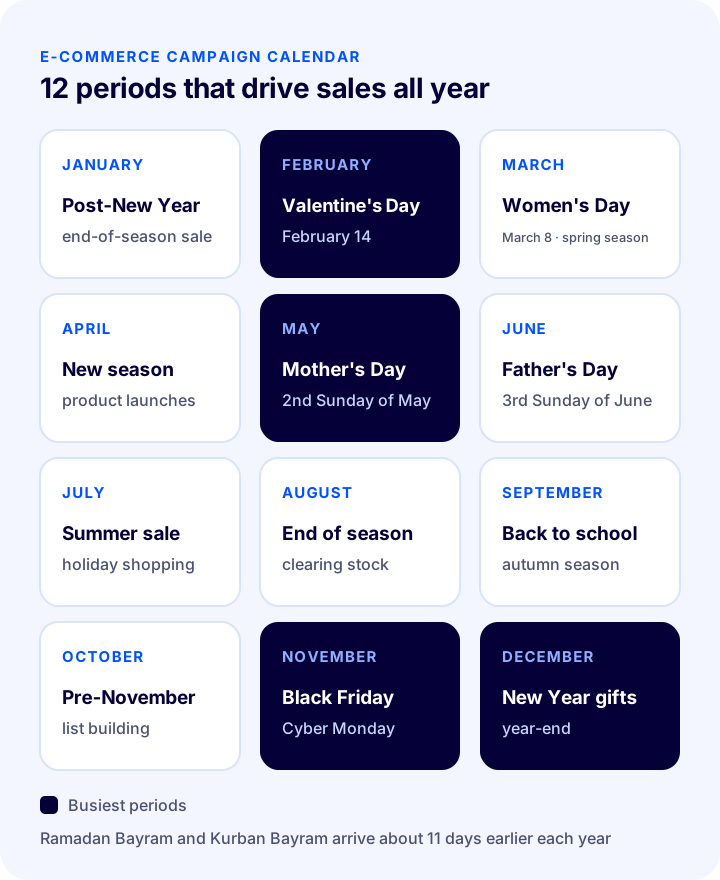
| Period | Standout campaign opportunity | Start preparing |
|---|---|---|
| January | Post-New Year end-of-season sale, clearing winter stock | Early December |
| February | Valentine's Day (February 14): gift sets, personalized products, gift wrapping | Mid-January |
| March | International Women's Day (March 8), opening of the spring season | Mid-February |
| April | New season products and launches | Early March |
| May | Mother's Day (2nd Sunday of May): one of the strongest gift periods of the year | Early April |
| June | Father's Day (3rd Sunday of June), report card and graduation gifts | Mid-May |
| July – August | Summer sales, holiday shopping, end-of-season stock clearance | Early June |
| September | Back to school, opening of the autumn season | Early August |
| October | Pre-November preparation: growing the newsletter and SMS opt-in customer list | September |
| November | Black Friday and Cyber Monday: the busiest discount week of the year | End of September |
| December | New Year gifts, year-end campaigns | Early November |
Ramadan Bayram and Kurban Bayram are also strong campaign periods in many sectors. Because they depend on the Hijri calendar, they arrive about 11 days earlier each year; be sure to check that year's dates when preparing your calendar.
Okumanızı öneririzBlack Friday 2025 Ne Zaman? Cyber Monday ve Online Satışları Artırma RehberiHow to Prepare a Campaign Plan: An E-Commerce Campaign Plan in 6 Steps
The calendar tells you in which period to run a campaign; the campaign plan tells you how that campaign will run. Putting the six steps below in writing for every campaign ensures that the team works toward the same goal and that the result is evaluated correctly afterward.
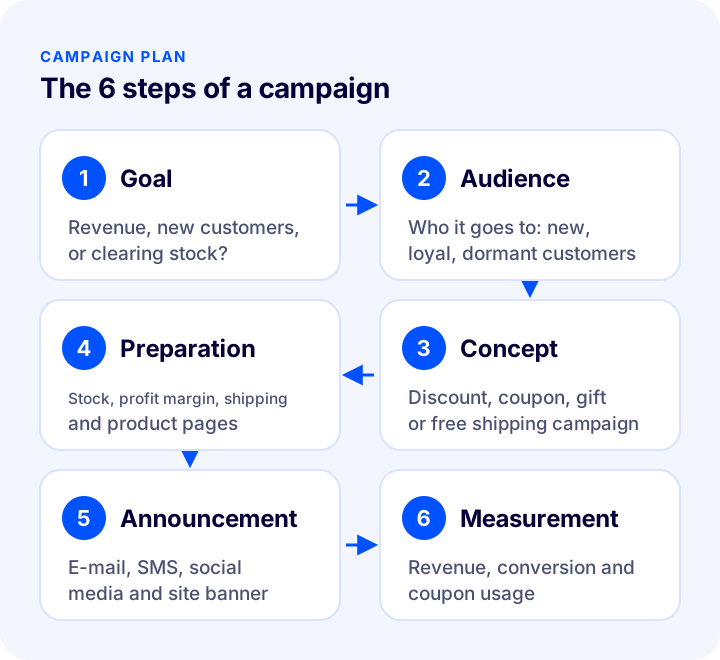
1. Set the Campaign Goal
Every campaign should have a single main goal: increasing revenue, winning new customers, raising the average basket value, winning back former customers, or clearing end-of-season stock. Without a clear goal, both the chosen discount rate and the measurement remain up in the air. Write a measurable goal such as "receive more orders in November than in the same period last year."
2. Choose the Target Audience
Instead of sending the same campaign to everyone, divide your customers into groups: those who will shop for the first time, loyal customers who have placed more than one order, those who have not shopped for a long time, and high-spending customers. A welcome discount for new customers, early access for loyal customers and a come-back coupon for those who have not returned in a long time are much stronger messages.
3. Choose the Campaign Concept
A percentage discount is not the only option. Depending on your goal, a discount based on basket amount, buy X pay for Y, a free gift, free shipping, a personalized coupon or a points campaign may give a better result. We summarized which concept suits which goal in a table in the section below.
4. Prepare the Profit Margin, Stock and Operations
Before setting the discount rate, take product cost, shipping fee, payment commission and, where applicable, marketplace commission into account, and see how much profit remains on each order after the discount. Check the stock of the products that will join the campaign, discuss a busy-period plan with your shipping company and review the images, descriptions and size information on your product pages.
5. Plan the Announcement
Plan in advance who will hear about the campaign, when and through which channel: e-mail and SMS to opted-in customers, social media posts, a banner on your home page and a campaign page. For large campaigns, a three-stage communication of a "coming soon" announcement, a start announcement and a "final hours" reminder works well. However, avoid sending too many messages to the same customer in a short time.
Okumanızı öneririzE-ticaret Siteleri için Kampanya Duyurma Rehberi6. Measure and Take Notes
A campaign isn't over when it ends. Record whether you reached your target metric, which channel and which customer group performed better, and how many coupons were generated and how many were used. These notes are the most valuable input for next year's campaign calendar.
Which Campaign Type Suits Which Goal?
The right setup lets you get far more results from the same budget. The table below summarizes the most common e-commerce campaign types and the goals they work best for.
| Campaign type | Best-suited goal | Watch out for |
|---|---|---|
| Percentage or amount discount | Quick revenue and traffic | If used too often, it weakens the perception of the full price |
| Discount based on cart total | Raising the average cart value | The threshold should be slightly above the current average cart value |
| Buy X pay for Y, discount on the 2nd item | Increasing quantity, clearing stock | Works better with complementary products |
| Free gift | Offering value without discounting | The gift must be genuinely meaningful to the customer |
| Free shipping | Reducing cart abandonment | Include the shipping cost in your profit calculation |
| Personalized coupon | New customers, win-back, loyalty | Set the coupon's validity period and single-use limit |
| Flash sale by hour or day | Creating urgency, driving traffic to specific hours | Your operations must be able to handle the sudden surge |
| Points, gift vouchers, balance | Increasing repeat purchases | Earning and spending rules should be simple |
Campaigns Outside the Calendar: Those Triggered by Customer Behavior
A campaign calendar plans campaigns aimed at everyone on specific dates. Yet every day of the year, some of your customers are at a perfect moment for a campaign: one has just signed up, one has left a product in their cart, one left without completing payment, and another hasn't shopped for months. Campaigns that catch these moments don't depend on the calendar; they start with the customer's behavior.
The behavior-based campaigns that deliver the most results are:
- Welcome campaign: A coupon for the first purchase is sent to a new member shortly after signing up.
- Cart reminder: A customer who left products in their cart first receives a reminder; if they haven't ordered, a second message offers a small discount.
- Payment completion: An order with an unfinished payment gets a link that lets the customer complete the payment easily.
- Win-back: A customer who hasn't ordered for a long time receives a "we miss you" message and a coupon to come back.
- Post-delivery thank-you: After an order is delivered, a small thank-you coupon invites the customer to shop again.
Running these campaigns by hand is practically impossible; you can't track one by one whose cart still has products or how many days it has been since someone last shopped. That's why behavior campaigns are built with marketing automation: you define the rule once, "when this happens, wait this long, send this," and the system runs at the right moment for every customer on its own. For example, Faprika's Roket marketing automation add-on offers these scenarios as ready-made flows; when a customer places an order, the flow stops automatically, so nobody who has already bought gets a reminder.
Okumanızı öneririzSepeti Terk Etme Oranlarını Düşürmenin YollarıChecklist for Preparing for a Busy Campaign Period
In busy periods such as Black Friday, New Year's, or Mother's Day, even a small oversight can turn into lost sales. Before the campaign starts, go through this list:
- Stock: Is there enough stock for the campaign products, and are stock levels updated instantly across all sales channels?
- Price and campaign rules: Do discounts start and end on the right products at the right dates and times? Are campaigns stacking up in unexpected ways and causing excess discounts?
- Product pages: Are images, descriptions, and size and variant information complete?
- Site speed: Do pages load quickly as traffic increases? Do the payment steps work smoothly?
- Shipping: Is your carrier aware of the surge in volume, and are delivery times stated correctly to customers?
- Customer service: Does the team know the campaign terms and the return and exchange rules?
- Communication: Are emails and SMS messages sent only to customers who have given consent, and does every email include an unsubscribe link?
Which Metrics Should You Use to Measure Campaign Success?
Judging a campaign's success by revenue alone can be misleading. If high revenue comes with low profit and a high return rate, the campaign may actually have lost money. Track these metrics together:
| Indicator | What does it tell you? |
|---|---|
| Campaign revenue and number of orders | The campaign's total effect on sales |
| Conversion rate | How many visitors turn into buyers |
| Average cart value | Whether cart-based setups are working |
| Profit per order | The real effect of the discount on profitability |
| Coupon generation and usage rate | How attractive the offer is to the customer |
| Email and SMS open and click rates | The performance of announcement messages and channels |
| Number of new and returning customers | The campaign's contribution to customer acquisition |
| Return rate after the campaign | Whether the products sold in the campaign were actually kept |
Common Mistakes in Campaign Planning
- Discounting all the time: A customer who sees a discount every week stops paying full price and waits for the next campaign.
- Setting the discount rate without calculating profit: Once shipping, payment, and commission costs are added, discounted sales can lose money.
- Sending everyone the same message: When a new customer and one who has shopped five times get the same offer, neither is fully convinced.
- Flooding customers with messages: Too many emails and SMS messages in a short time increase unsubscribes and complaints.
- Leaving preparation to the last week: When stock, shipping, and site preparation don't get done in time, sales slip away on the busiest days.
- Not measuring the result: You can't learn from a campaign you don't measure; the same mistakes get repeated next year.
Campaign Management with Faprika
With Faprika's e-commerce infrastructure, you can set up every scenario in your campaign calendar from the panel and connect behavior-based campaigns to automation as well:
- Unlimited campaign setups: Percentage discounts on selected brands, products, or categories, buy X pay for Y, second-item discounts, cart-total campaigns, gift products, and shipping campaigns are all set up from the same campaign module.
- Time- and condition-based campaigns: You can define campaigns by month, week, day, and hour, discounts by day of the week, and campaigns by payment type.
- Points, gift vouchers, and balance: With reward points, gift vouchers, and balance campaigns, you can invite your customers to shop again.
- Bulk SMS and email: You can send your campaign announcements to customers by bulk SMS and email.
- Back-in-stock and price-drop alerts: Customers are notified by variant when a product is back in stock or its price drops; the product or price opportunity they were waiting for reaches your customer automatically.
- Campaign reports: With the campaign discount report, you can see how much discount and how many sales each campaign brought.
- Marketing automation: Behavior campaigns such as welcome, cart reminder, payment completion, and win-back run automatically with personalized coupons through the Roket add-on; sent, opened, and clicked messages and orders coming from automation are measured in a single panel.
You can review which campaign features are included in each plan on the e-commerce plans page, and other tools you can use for campaigns and marketing on the add-ons page.
Frequently Asked Questions
What is an e-commerce campaign calendar?
It is a work calendar in which the discounts, coupons, gifts and announcements planned for a year are laid out in advance, together with their dates, goals, target audiences and preparation steps.
How far in advance should campaign preparation start?
Starting 3–5 weeks ahead for special days such as Valentine's Day or Mother's Day, and at least 6–8 weeks ahead for the busiest periods of the year such as Black Friday and New Year, is a safe lead time for stock, shipping and announcement plans to be ready.
How is the campaign discount rate determined?
The discount rate is set not by the selling price but by the profit left per order. If, after deducting product cost, shipping fee, payment commission and, where applicable, marketplace commission, the profit after the discount is still acceptable, the rate is appropriate.
How many campaigns should you run per year?
There is no fixed number; what matters is that campaigns do not run back to back and that each has a clear goal. Alongside the major special days, a few campaign days that belong only to you and behavioral campaigns that run all year make a balanced structure.
How are cart reminder and win-back campaigns automated?
With marketing automation tools, you define a rule once: for example, a reminder email is sent when a product has sat in the cart for a day, a personalized coupon is offered in the second message if the customer hasn't clicked, and the flow stops when the customer places an order.