
Contents 17 sections
- What Is Customer Lifetime Value (CLV)?
- Why Does Customer Lifetime Value Matter?
- How Is Customer Lifetime Value Calculated? The CLV Formula
- CLV Calculator
- How Do You Find a Customer's Retention Period?
- What Is the Difference Between Revenue-Based and Profit-Based CLV?
- How Do You Compare CLV with Customer Acquisition Cost (CAC)?
- How Do You Set an Ad Budget Based on CLV?
- Does the Channel a Customer Comes From Affect CLV?
- What Is the Difference Between Historical and Predictive CLV?
- Why Does CLV Differ by Segment?
- 8 Ways to Increase Customer Lifetime Value
- What Data Do You Need to Calculate CLV?
- Common Mistakes When Calculating CLV
- CLV Checklist
- Increase Customer Lifetime Value with Faprika
- Frequently Asked Questions
Most e-commerce businesses evaluate a customer by a single order: how much was spent on advertising, and how much was earned from the first order. Yet a customer's real value does not appear in the first order, but in the total of the orders they place for as long as they stay with you. The metric that measures this total is called customer lifetime value, or CLV for short.
In this guide, we explain with examples what customer lifetime value is, how it is calculated step by step, how to compare it with customer acquisition cost, and why it differs by segment. With the CLV calculator in the article, you can enter your own store's values and see the result right away.
What Is Customer Lifetime Value (CLV)?
Customer lifetime value (CLV) is the total revenue or profit a customer brings during their relationship with a business. For example, a customer who places a 600 TL order three times a year and keeps shopping for two years has a revenue-based lifetime value of 3.600 TL.
The abbreviations LTV (Lifetime Value) and CLTV are also used for the same concept; all three mean the same thing. CLV is expressed in two ways: revenue-based CLV shows the customer's total spend, while profit-based CLV shows the gross profit left to the business from that spend. The one to use in marketing decisions is profit-based CLV.
Why Does Customer Lifetime Value Matter?
CLV shows how valuable a customer really is to a business, and it is the common yardstick for marketing, campaign, and customer service decisions.
- It sets the limit of the ad budget: The most that can be spent to win a customer is limited by the profit that customer will bring. An ad that loses money on the first order can actually be profitable if the customer buys again.
- It makes valuable customers visible: A small share of customers can bring most of the revenue. CLV lets you tell these customers apart and gives you the reason to treat them specially.
- It changes campaign decisions: Offering a discount on the first order is an investment if the customer comes back; if not, it is just a loss. CLV makes it possible to tell the difference.
- It shows the quality of growth: If CLV is falling while the number of new customers rises, the store is collecting one-time buyers.
- It makes investment in customer experience measurable: Fast shipping, easy returns, or good support do not show up directly in revenue, but they extend the customer's retention period; the effect is visible in CLV.
How Is Customer Lifetime Value Calculated? The CLV Formula
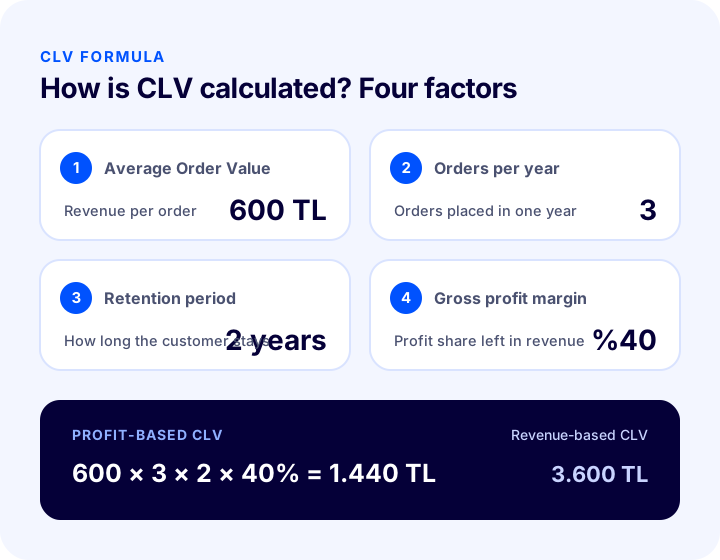
The simple CLV formula most used in e-commerce has four factors:
CLV = Average basket × Orders per year × Average retention period (years) × Gross profit margin
Step-by-Step CLV Calculation
- Find the average basket: Divide total revenue in a given period by the number of orders in the same period. With 1.200.000 TL revenue and 2.000 orders, the average basket is 600 TL.
- Find the number of orders per year: Divide the total number of orders in a year by the number of distinct customers who shopped in that same year. If 2.000 orders come from 667 customers, the annual orders per customer is about 3.
- Determine the average retention period: Work out how many years customers keep shopping after their first order (there are two methods below).
- Apply the gross profit margin: Multiply the revenue-based value by the gross profit margin to move to profit-based CLV.
Example: For a store with a 600 TL average basket, 3 orders per year, a 2-year retention period, and a 40% gross profit margin, revenue-based CLV = 600 × 3 × 2 = 3.600 TL, and profit-based CLV = 3.600 × 0,40 = 1.440 TL.
CLV Calculator
Enter your store's average basket, number of orders per year, customers' average retention period, gross profit margin, and the average amount you spend to win a customer. The tool calculates revenue-based and profit-based customer lifetime value, the CLV:CAC ratio, and by which order the customer acquisition cost is recovered.
How Do You Find a Customer's Retention Period?
The retention period is the average time a customer keeps shopping after their first order, and it is the hardest factor of CLV to estimate. It can be found with two practical methods.
1. Calculating from the Churn Rate
The annual customer churn rate is the share of customers who shopped a year ago and have not shopped at all this year. The average retention period is the inverse of this rate:
Average retention period (years) = 1 ÷ Annual churn rate
If 500 of the 1.000 customers who shopped last year placed no order this year, the churn rate is 50% and the average retention period is 1 ÷ 0,50 = 2 years. If the churn rate falls to 25%, the retention period rises to 4 years; in other words, an improvement in the churn rate directly multiplies CLV.
2. Calculating with Cohort Tracking
Customers who place their first order in the same month are tracked as a cohort (group), and how many of them order again in the following months is laid out in a table. The sample table below is meant to show how the calculation is done:
| First order month | Customer | Shopped in month 3 | In month 6 | In month 12 |
|---|---|---|---|---|
| January | 200 | 70 (%35) | 50 (%25) | 40 (%20) |
| February | 180 | 72 (%40) | 54 (%30) | 45 (%25) |
The cohort table shows that customers who came in which period or through which campaign stay longer. For example, if customers who came during a big discount period have a low repeat purchase rate, the customer acquisition from that campaign is not as valuable as it seemed.
What Is the Difference Between Revenue-Based and Profit-Based CLV?
Revenue-based CLV shows the customer's total spend, while profit-based CLV shows the gross profit left to the business from that spend after product cost is deducted. The ad and campaign budget should always be compared with profit-based CLV.
| Topic | Revenue-based CLV | Profit-based CLV |
|---|---|---|
| Formula | Avg. basket × orders per year × retention period | Revenue-based CLV × gross profit margin |
| Example result | 3.600 TL | 1.440 TL |
| What does it show? | The customer's total spend | The profit the customer leaves with the business |
| What is it used for? | Revenue targets, size comparisons | Ad budget, campaign and discount decisions |
| Risk | Don't overspend on marketing | A more cautious but accurate limit |
How to Compare CLV with Customer Acquisition Cost (CAC)?
Customer acquisition cost (CAC) is the average amount spent to win a new customer: total advertising and marketing spend in a period divided by the number of new customers won in the same period. The ratio of CLV to CAC shows whether marketing is generating profit.
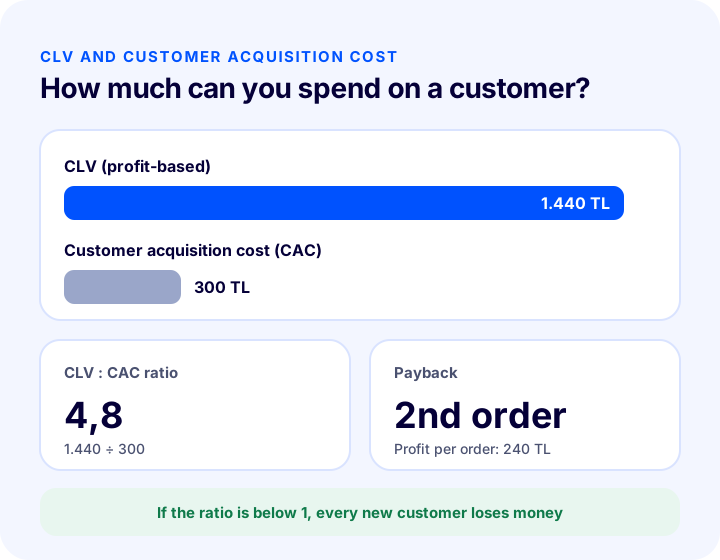
- CLV : CAC ratio: Profit-based CLV divided by customer acquisition cost. In the example, 1,440 ÷ 300 = 4.8; in other words, each customer leaves 4.8 times the amount spent to acquire them as profit.
- If the ratio is below 1: Winning a customer costs more than the profit they will bring; the more you grow, the larger the loss.
- As the ratio rises: There is more room to allocate budget to marketing. A very high ratio may also indicate that you are not investing enough in growth.
- Payback period: The order in which the customer acquisition cost is recovered. If gross profit per order is 600 × 0.40 = 240 TL, an acquisition cost of 300 TL is recovered with the 2nd order. The later the payback comes, the greater the business's cash requirement.
How to Set the Advertising Budget Based on CLV?
The most you can spend to win a customer is the profit-based CLV; spending all of it means earning no profit from that customer. For this reason, the budget is set as a fraction of CLV:
Target customer acquisition cost = Profit-based CLV ÷ Target CLV : CAC ratio
For example, if the profit-based CLV is 1,440 TL and you want each customer to leave at least 3 times the amount spent to acquire them as profit, you can spend at most 1,440 ÷ 3 = 480 TL per customer. Choose this target according to your own cash position: a business that cannot wait long for its acquisition cost to be recovered should aim for a higher ratio.
Once you know your target acquisition cost, advertising decisions become clearer. If the cost per customer of an ad campaign is below the target, the budget can be increased; if it is above, the campaign should either be improved or stopped. A campaign that loses money on the first order should be continued only if customers buy again and this is measured.
Does the Channel a Customer Comes From Affect CLV?
Yes. Customers who come to the same store through different channels often differ in average basket value, order frequency and retention period. A customer who finds a product by searching on a search engine and a customer who comes only because they saw a big discount may not behave the same way.
That is why CLV should also be calculated by channel: track the new customers from each channel as a separate cohort, compare their repeat purchase rates and average basket values, then compare each channel's acquisition cost with its own CLV. A channel that looks expensive on the first order may actually be the most profitable one if it brings customers who stay for a long time; a channel that looks cheap may be full of one-time buyers.
What Is the Difference Between Historical and Predictive CLV?
Historical CLV is the total of everything the customer has spent so far; predictive CLV also takes into account the spending the customer is expected to make in the future.
| Method | How is it calculated? | When to use it? |
|---|---|---|
| Historical CLV | Total profit from the customer's past orders | Finding the most valuable customers, building a VIP list |
| Simple predictive CLV | The four-factor formula in this article | Setting advertising budgets and targets |
| Segment-based predictive CLV | The formula is applied with separate data for each segment | Allocating different campaigns and budgets to segments |
For a small or medium-sized e-commerce business, using historical CLV and simple predictive CLV together is often enough; the real gain comes from splitting the calculation into segments.
Why Does CLV Differ by Segment?
Calculating a single CLV for all customers blends very differently behaving customers into one average. The difference in value between a one-time buyer, a regular customer and a VIP customer only becomes visible when calculated by segment.
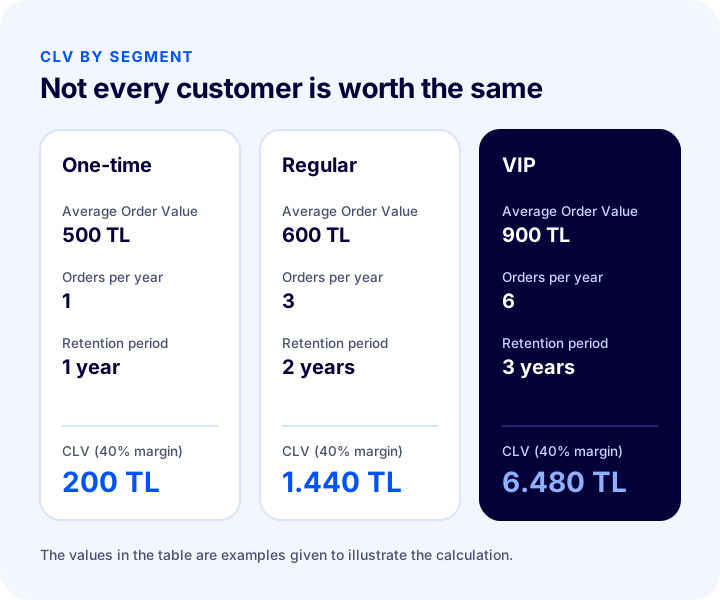
In the example, the VIP customer's CLV is about 32 times that of the one-time customer. This difference shows two things: spending to avoid losing a VIP customer is recovered far more easily, and moving a one-time customer to a second order is the fastest way to raise CLV. The best-known way to divide segments by order frequency, last order date and total spend is RFM analysis.
Recommended readingWhat Is Customer Segmentation? How to Segment with RFM Analysis in E-Commerce8 Ways to Increase Customer Lifetime Value
To increase CLV, you need to raise at least one of the four factors in the formula: average basket value, order frequency, retention period or profit margin.
- Deliver the first order flawlessly: The first experience is what most influences whether a customer places a second order. The right product, fast shipping and careful packaging are the foundation of retention.
- Set up a welcome flow: Automated messages after the first order, containing a thank-you, usage tips and an offer for a second order, carry the customer to a second purchase.
- Remind customers to reorder: For products that run out or are used regularly, a reminder sent when the product is expected to run out increases order frequency.
- Use a points and loyalty system: Points earned with every purchase and spent on the next give customers a concrete reason to come back.
- Raise the average basket value: Complementary product suggestions, bundle products and campaigns based on basket total increase the value of every order.
- Win back customers who are drifting away: Win-back messages with a special offer for customers whose last order was a long time ago reduce the churn rate.
- Set your VIP customers apart: Giving your most valuable customers privileges such as early access, special discounts or gifts is the shortest way to avoid losing them to competitors.
- Improve the return and support experience: Easy returns and fast replies bring back even customers who ran into a problem, while a bad return experience can lose you your most loyal customer.
What Data Is Needed to Calculate CLV?
Calculating customer lifetime value does not require special software; four pieces of data you can get from your e-commerce panel are enough:
- Order list: The date and amount of each order and which customer it belongs to. Average basket value and order frequency come from here.
- Member list: Customers' registration dates and first order dates. The cohort table and retention period are calculated from here.
- Product costs: The purchase or production cost of the products sold, needed to find the gross profit margin.
- Marketing spend: Advertising and campaign expenses and the number of new customers won in the same period; customer acquisition cost comes from here.
Exporting this data in the same format every month and combining it in a spreadsheet is the simplest way to monitor CLV regularly.
Common Mistakes When Calculating CLV
- Setting the budget with revenue-based CLV: Setting the advertising budget from revenue ignores product costs and leads to overspending on marketing.
- Using a single average: The average of all customers hides the difference between a VIP customer and a one-time buyer.
- Taking an optimistic retention period: An unmeasured retention period inflates CLV and misleads budget decisions.
- Not deducting returns: If returned orders are included in revenue, average basket value and CLV look higher than they really are.
- Generalising from a campaign period: Order frequency and average basket value during a heavy discount period do not represent the rest of the year.
- Calculating CLV once and leaving it: CLV changes as prices, costs and customer behaviour change; it should be updated every three months.
CLV Checklist
| Check | Why does it matter? |
|---|---|
| Is CLV calculated on a profit basis? | Budget decisions are only right with profit-based CLV. |
| Were the four factors taken from the same period? | Data from different periods distorts the result. |
| Was the retention period measured or assumed? | An assumed period can inflate CLV. |
| Were returns deducted from revenue and order count? | Returns make average basket value look higher. |
| Was CLV also calculated separately by segment? | A single average hides valuable customers. |
| Is the customer acquisition cost known? | Without the CLV : CAC ratio, advertising profitability cannot be seen. |
| Is CLV updated at regular intervals? | As costs and behaviour change, so does the value. |
Increase Customer Lifetime Value with Faprika
In the Faprika e-commerce infrastructure, the tools that raise CLV's factors are in the same panel. The Roket marketing automation add-on is used to automate repeat purchases, loyalty and win-back.
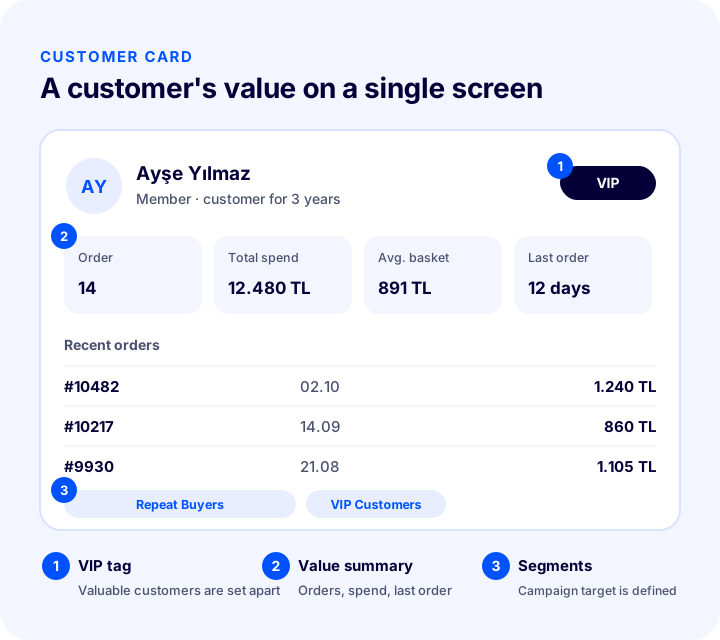
- Segments: In Roket, customers are divided into live segments by criteria such as number of orders, total spend, days since last order and email engagement. Ready-made segments are available, such as VIP Customers, Customers with Multiple Orders and Customers Who Haven't Shopped for 1 Month.
- Automated flows: With the Welcome + Coupon, Cart Reminder, Win-back (We Miss You) and Post-Delivery Thank-You templates, the customer is automatically guided to a second order after the first.
- Personalised coupons: A discount coupon specific to the customer is generated within the automation; the flow starts automatically when the customer enters a segment.
- Reward points and gift vouchers: Reward point campaigns, the points system and gift voucher campaigns give customers a concrete reason to come back.
- Loyal / VIP customer detection: Valuable customers are identified; customers are divided into groups through user group settings, and Roket automation moves a customer into, for example, the VIP group automatically.
- Reports: The profit / loss report, campaign discount report and membership / login reports provide the data CLV calculation needs; the member list can be exported to Excel.
You can see which feature is included in which plan in the comparison table on the e-commerce plans page.
Frequently Asked Questions
What is customer lifetime value (CLV)?
Customer lifetime value is the total revenue or profit a customer brings during their relationship with a business. Revenue-based CLV shows the customer's total spend; profit-based CLV shows the gross profit left to the business from that spend.
How is CLV calculated?
With the simple method, CLV is the product of the average basket, the number of orders per year, the customer's average retention period (in years), and the gross profit margin. With a 600 TL average basket, 3 orders per year, a 2-year retention period, and a 40% margin, CLV comes to 1.440 TL.
Is there a difference between CLV and LTV?
No. CLV (Customer Lifetime Value), LTV (Lifetime Value), and CLTV describe the same concept: the total value a customer brings throughout their relationship with a business.
How is a customer's retention period calculated?
The most practical method is that the average retention period is the inverse of the annual customer churn rate: 1 ÷ churn rate. If half of customers stop buying within a year, the churn rate is 50% and the average retention period is 2 years.
What does the CLV : CAC ratio show?
It is the ratio of profit-based customer lifetime value to customer acquisition cost, and it shows whether marketing is generating profit. If the ratio is below 1, winning a customer costs more than the profit that customer brings.
How can customer lifetime value be increased?
By raising the average basket, order frequency, customer retention period, or profit margin. A flawless first delivery, welcome and win-back messages, a points system, and special perks for VIP customers are the most effective ways.