Contents 11 sections
- E-Commerce SMS Marketing: What Is It?
- Why Does SMS Marketing Work in E-Commerce?
- How Do You Get Consent for SMS Marketing? What Is İYS?
- Which SMS Scenarios Drive Sales in E-Commerce?
- How Do You Write an Effective SMS?
- When and How Often Should SMS Be Sent?
- How Do You Measure SMS Marketing Results?
- The 8 Most Common Mistakes in SMS Marketing
- E-Commerce SMS Marketing Checklist
- SMS Marketing in E-Commerce with Faprika
- Frequently Asked Questions
SMS is still one of the fastest-read and most direct channels in e-commerce: the message lands on the customer's phone, with no app to download or box to open. But the same directness makes it the channel that annoys people fastest when done badly. SMS marketing in e-commerce means sending the right person a message with consent, at the right moment, written around one clear action; what matters is not how many messages you send but how many orders they bring.
This article is laid out like a lesson: it explains step by step what SMS marketing is, which messages are transactional and which count as commercial messages, the consent and İYS process, which scenarios bring sales, how to write an SMS, when to send it and how to measure the result. The two tools in the article are there for you to try out how many parts your message will take and whether your campaign is profitable.
What Is SMS Marketing in E-Commerce?
SMS marketing in e-commerce means a store sending customers short messages with campaigns, reminders, stock alerts or special offers. The goals are to bring customers back to the site, complete carts, drive repeat purchases and keep the relationship alive.
SMS marketing needs to be separated from two different message types, because the legal rules and expectations differ:
| Message type | Example | Purpose | Is consent required? |
|---|---|---|---|
| Transactional (informational) message | Order received, shipped, delivered, one-time verification code | To report a completed action | Generally not a commercial message; even so, no campaign should be added to its content |
| Commercial message (marketing message) | Discount announcement, new season, cart reminder campaign, special day offer | To increase sales and move the customer to act | Yes; prior consent is obtained and the right to opt out is provided |
Putting both order information and a campaign in one message can turn it into a commercial message. Avoiding mixed messages is the safe route both legally and for customer experience.
We recommend readingHow to Write an Order Confirmation Email?Why Does SMS Marketing Work in E-Commerce?
The strength of SMS comes from its speed and visibility. The message usually appears on the phone's lock screen and, being short, is read quickly. In e-commerce this is clearest in time-sensitive messages: a limited-time offer, a product waiting in the cart, an item back in stock.
- Suits time-sensitive messages: A message like “Ends tonight at midnight” can take hours to be noticed in email; in SMS it is often seen sooner.
- Asks for a direct action: It suggests one clear step, such as clicking a single link or using a code.
- Works with the customer's account: The phone number is already in the order and the membership; no extra channel needs to be set up.
- Is measurable: Visits and orders coming from the link in each message can be tracked.
On the other hand, SMS is limited: it is short, carries no images, every send has a unit cost, and it quickly tires customers when sent too often. So SMS is used not in place of email and notification channels, but alongside them and for the right job.
| Channel | Best at | Weakness |
|---|---|---|
| SMS | Short time-sensitive offers, reminders, stock alerts | Short text, unit cost, annoyance when sent often |
| Long content, visual campaigns, newsletters, detailed information | Being noticed and opened can be slower | |
| Push notification | App or browser notification, order status | The user must have allowed notifications |
How Do You Get Consent for SMS Marketing? What Is İYS?
The precondition for sending commercial SMS is that the recipient has given prior consent to receive the message. In Turkey, commercial electronic messages are regulated under Law No. 6563 on the Regulation of Electronic Commerce and the related regulation. The core of this framework is simple: consent is obtained in advance, the recipient can opt out free of charge at any time, and these consent and opt-out records are kept in the Message Management System (İYS).
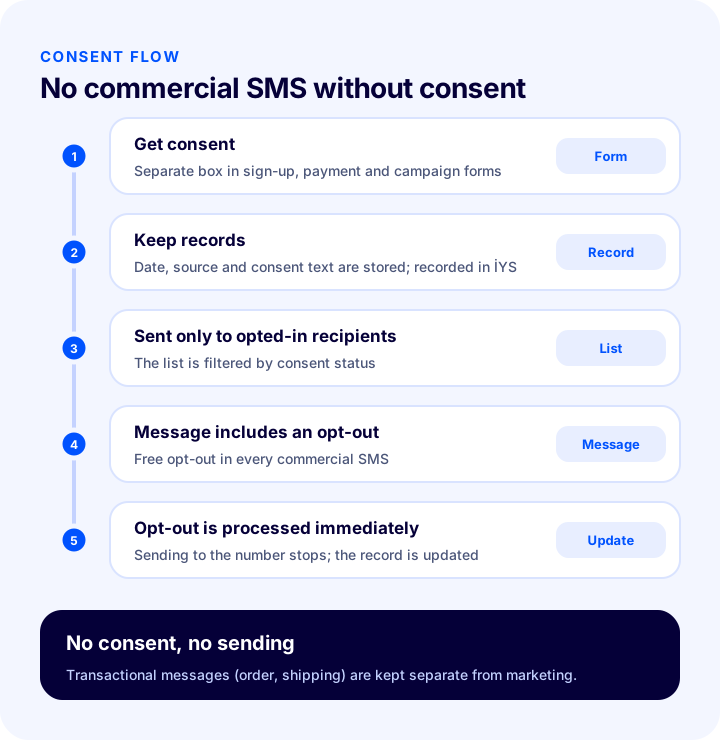
This article is not legal advice. For special cases such as merchant and tradesman recipients, and for current implementation details, consult your company's legal advisor. The flow below shows the basic sequence followed in practice.
Where and How Is Consent Obtained?
- On the sign-up form: There is a separate, unchecked consent box for commercial messages. The box does not come pre-checked, and campaign consent is not made a condition of membership.
- On the payment page: During checkout, the customer can accept campaign messages separately from the order's notification messages.
- On campaign sign-up forms: Forms such as “Stay informed” or “Get a discount code” ask for consent explicitly and state what is being consented to.
- In stores and call centers: Consent obtained by phone or in store must be kept in a way that can be recorded.
How Is the Right to Opt Out Provided?
Every commercial SMS includes a free, easy way for the recipient to stop receiving messages. When an opt-out request arrives, it is recorded without delay and commercial SMS to that number stops. Telling someone "we won't message you again" matters less than actually honoring it, so consent and opt-out records must be kept up to date in a single place in your system.
Okumanızı öneririzİleti Yönetim Sistemi (İYS) Hakkında Bilmeniz Gereken Her ŞeyIn E-Commerce, Which SMS Scenarios Drive Sales?
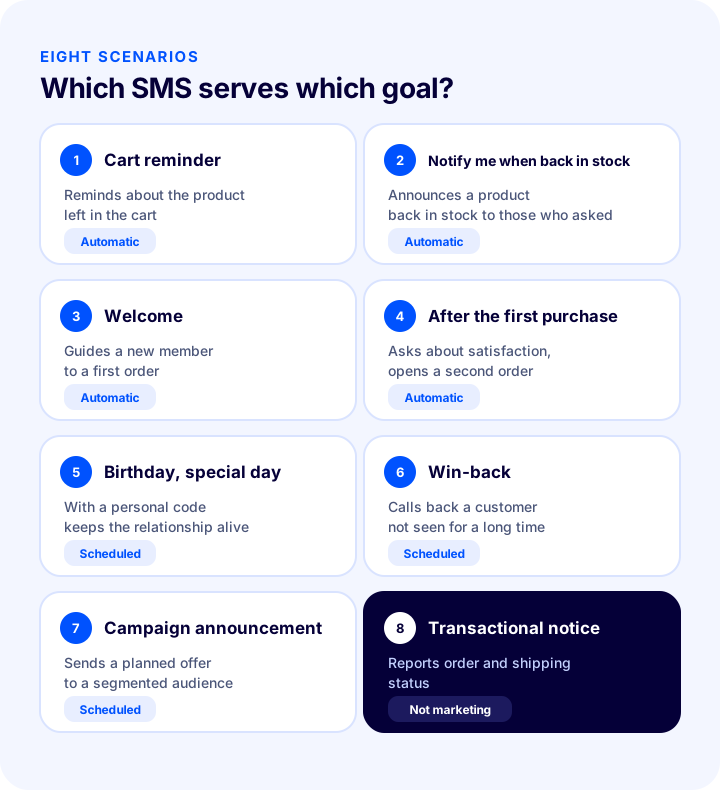
Every message should serve a goal. Instead of starting with all of them at once, begin where the most is lost: in most stores, that means products waiting in the cart and repeat purchases after the first order.
| Scenario | Trigger | Purpose of the message | Note |
|---|---|---|---|
| Cart reminder | Cart left waiting | Complete the purchase | For members who gave consent; a discount is not required |
| Notify me when back in stock | Followed product back in stock | Turn a pending request into an order | One of the most relevant messages, since the customer asked for the notification |
| Welcome | Membership and consent | Guide to the first order | Short, a single offer |
| After the first purchase | A few days after delivery | Satisfaction and second order | Sent separately from the informational message |
| Birthday and special day | Date | Keep the relationship alive | A personal single-use code works well |
| Win-back | No purchase for a long time | Win back the inactive customer | Limited to the audience that has bought before |
| Campaign announcement | Planned campaign | Traffic and sales | Not sent often; segmented |
| Transactional notice | Order, shipping, delivery | Trust and information | Contains no marketing; kept separate |
Cart Reminder SMS
A customer who leaves items in the cart has usually not given up, only postponed. The reminder is a short message containing the product and a link back to the cart. A discount is not required in the first message; the way to proceed without creating a discount habit is to send a plain reminder first and, if there is no result, add a small incentive later.
Back-in-Stock SMS
A customer who turns on a notification for a sold-out product has already shown purchase intent. The message sent when the product returns to stock is among the most relevant of all campaign messages. We have a separate guide on setting up the sold-out product page correctly.
We recommend readingWhat to Do with an Out-of-Stock Product Page?Win-back and Special Day SMS
A message to customers who haven't shopped for a long time can open in a personal tone, such as "we miss you, your favorite products are in stock," instead of a campaign pitch. On personal occasions such as a birthday, a single-use, time-limited discount code is both trackable and hard to abuse.
Recommended readingWhat Is a Discount Coupon? How Is It Used in E-Commerce?How to Write an Effective SMS
A good SMS is short, has a single purpose, and clearly shows who is sending it. Within the first three seconds the reader should find answers to "from whom, about what, and what do I need to do."
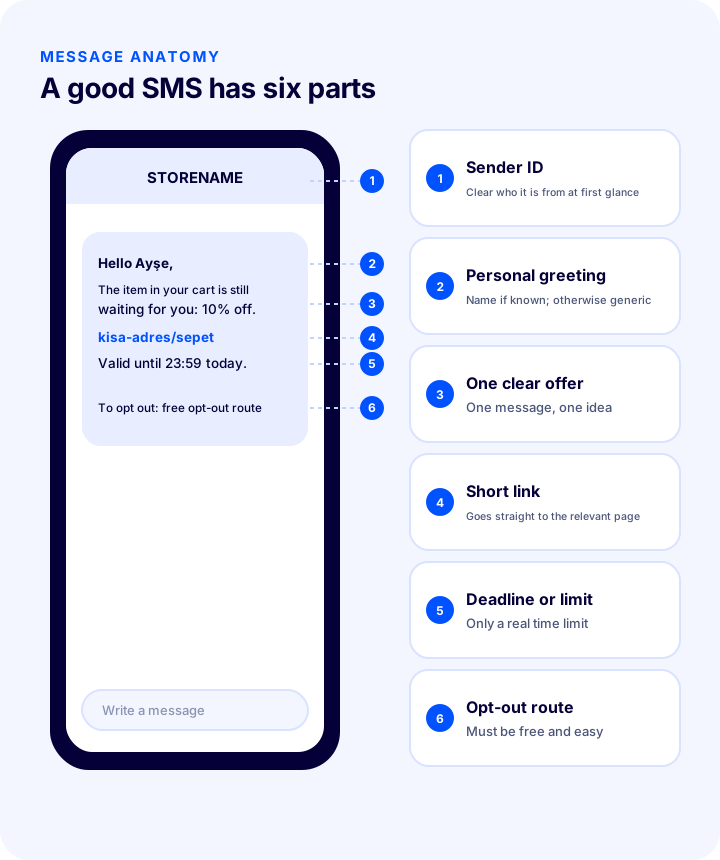
- Sender ID: It should be clear at first glance who the message is from; the sender ID is defined through your SMS provider.
- Greeting: Starting with the customer's name raises interest; if there is no name, use a general greeting, because unfilled fields such as "Dear [name]" damage trust.
- One clear offer: A message carries one idea. "20% off selected products" is enough; don't squeeze three separate campaigns into one message.
- Short link: Long addresses both take up characters and look untrustworthy. The link should go directly to the relevant product or campaign page, not to the home page.
- Deadline or limit: A real time limit such as "until 11:59 PM today" speeds up action; only deadlines that are actually valid should be written.
- Opt-out route: Commercial messages state the free way for the recipient to stop receiving them.
Examples of Good and Bad Messages
| Message | Why? |
|---|---|
| Bad: "OPPORTUNITY!!! DON'T MISS OUT!!! DISCOUNT ON ALL PRODUCTS!!!" | The sender is unclear, capital letters and exclamation marks pressure the reader, which product gets which discount is vague, and there is no link or opt-out route. |
| Good: "Hello Ayşe, the product in your cart is still waiting for you. To complete your order: short-link/cart. If you don't want to receive these messages, you can use the opt-out route." | A greeting, a single action, a direct link to the cart, an opt-out notice; no exaggeration. |
| Bad: "The new season is here, campaigns have started, free shipping, installment options, new products added, click now." | Several offers in the same message; none of them stands out. |
| Good: "The product you follow is back in stock. Limited quantity; to see it: short-link/product." | A notification the customer asked for, short and relevant. |
SMS Character Limit and Number of Segments
A single SMS segment carries a limited number of characters. A message that exceeds the limit is split into multiple segments, and on most infrastructures each segment is charged separately. Letters specific to Turkish (such as ş, ğ, ı, İ) can change the message encoding and reduce the number of characters that fit per segment; because this behavior can differ between providers, confirm the exact count with your SMS provider.
The tool below works with two commonly accepted assumptions: 160 characters per segment (153 in concatenated segments) for a message without Turkish letters, and 70 (67 in concatenated segments) for a message containing Turkish letters. You can turn the result into a cost by entering your message text and your number of recipients.
What the tool shows is that shortening helps both readability and cost: on a list of a thousand people, bringing the message down to a single segment reduces the cost by the number of segments. Don't distort the meaning because of the character limit; when shortening, first remove unnecessary words and the long address.
When and How Often Should SMS Be Sent?
The value of a message depends on the moment it arrives. A cart reminder goes out shortly after the cart is abandoned, a stock notification as soon as the product arrives, and a campaign announcement at reasonable hours when the customer looks at the phone. A commercial message that arrives at night or very early in the morning harms the brand, however good the discount.
- Send trigger-based messages instantly: Event-based messages such as cart, stock, and order status are automatic.
- Schedule planned campaigns at a reasonable hour of the day: By watching your own customers' behavior, see at which hour you get more clicks and adjust the timing accordingly.
- Limit the frequency: Don't send campaign SMS to the same person back to back in a short time; set an upper limit per customer.
- Plan ahead for special days: Messages pile up in busy periods; setting up the calendar in advance prevents overlaps.
Sending by Segment
Sending the same message to everyone is the easiest method and usually the lowest-yielding one. Group customers by purchase history, interests, and last purchase date; write different messages for high-basket customers, new members, and those who haven't been seen for a long time. We have a separate guide on segmentation methods.
Recommended readingWhat Is Customer Segmentation? How Is Segmentation Done with RFM Analysis in E-Commerce?How to Measure SMS Marketing Results
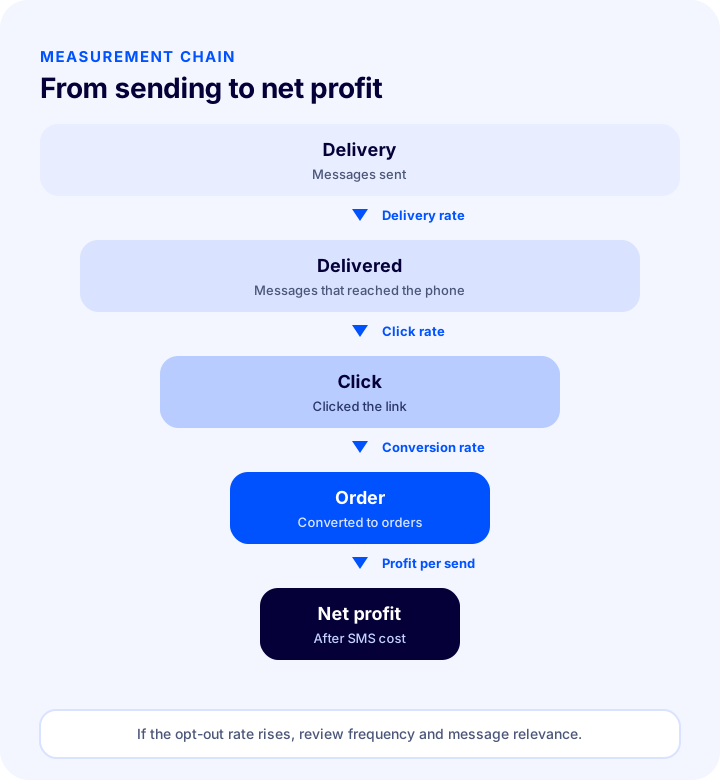
The success of an SMS campaign is measured not by the number of messages sent but by the net profit the message creates. Tracking each link of the measurement chain separately shows where the loss occurs.
| Criterion | How is it calculated? | What does it tell you? |
|---|---|---|
| Delivery rate | Delivered ÷ sent | Shows number quality and infrastructure problems |
| Click rate | Clicked ÷ delivered | How appealing the message and the offer are |
| Conversion rate | Ordered ÷ clicked | Whether the landing page and the offer turn into sales |
| Opt-out rate | Opted out ÷ delivered | A frequency and relevance problem; if it rises, send less |
| Profit per send | (Order profit − SMS cost) ÷ sent | Whether the campaign truly earned money |
For measurement, add a distinctive tracking parameter to the link in each campaign message; this lets you see the visits and orders from that campaign separately. If possible, also measure whether the message really creates additional sales by not sending to a small part of an audience (a control group); if the customer would have bought anyway, the SMS's contribution is smaller than it appears.
The tool below evaluates the campaign using the number sent, click and conversion rates, average basket, profit margin, and SMS cost; it also shows the lowest conversion rate needed for the campaign not to lose money (break-even). The default values are examples; enter your own data.
The break-even rate the tool gives is the campaign's benchmark: if your real conversion rate is above it, the campaign is earning money. When the margin is high, the offer attractive, and the list clean, the return rises; on low-margin products, a discount easily eats the SMS's profit.
The 8 Most Common Mistakes in SMS Marketing
- Sending without consent: Sending commercial SMS to a list without consent is both a legal risk and a source of complaints.
- Hiding the opt-out route: If the recipient cannot stop the messages, they will complain; the right to opt out must be easy and free.
- Sending the same message to everyone: Sending without segments annoys irrelevant people and raises the opt-out rate.
- Sending too often: A customer who receives several campaign messages a week quietly unsubscribes.
- Long and confusing messages: Multiple offers, long addresses, and capital letters make the message unreadable.
- Adding a campaign to a transactional message: Turning an order notification into marketing changes the type of the message and damages trust.
- Not measuring: Continuing without knowing which campaign earned money makes the cost invisible.
- Neglecting list cleaning: Invalid numbers, opt-outs, and old records worsen the delivery rate and the cost.
SMS Marketing Checklist for E-Commerce
| Title | To check |
|---|---|
| Consent | Is commercial message consent collected with a separate checkbox, recorded, and in line with İYS? |
| Opt-out | Does every marketing SMS have a free opt-out route, and is the opt-out record processed immediately? |
| Separation | Are transactional and marketing messages in separate templates and separate flows? |
| Segment | Is the message sent according to customer group? |
| Text | Is there a single offer, a short link, a clear sender, and the right greeting? |
| Part | Does the message fit into a single segment if possible, and has the cost been calculated? |
| Time | Is the sending time reasonable and a frequency limit set? |
| Measurement | Are links tracked, and are delivery, click, order, and opt-out rates reported? |
| List | Are invalid numbers and opt-outs cleaned regularly? |
SMS Marketing in E-Commerce with Faprika
SMS marketing gets easier when customer data, order status, stock, and campaign information are in the same place. In Faprika these parts are managed from the same panel; which feature is included in which plan varies by plan, and for details you can see the plans page.
- Message templates: Messages sent to the customer at stages such as membership, order created, and shipped are managed with templates; the SMS option can be turned on for a template, and parameters such as customer name and order information can be added to the message. To send by SMS, the SMS integration settings must be configured.
- Bulk SMS: Bulk SMS can be sent to all registered users or to groups selected with specific filters; the module works with the aim of sending in line with KVKK (Turkish Personal Data Protection Law) and İYS. The details are on the Bulk SMS Module page.
- İYS integration: Helps keep customers' SMS and email consents up to date. For details, see the İYS integration page.
- Cart reminder: The module that sends reminders to customers who leave products in the cart is described on the Cart Reminder page.
- Notify me when available: An automatic notification is sent to customers who turned on a notification for a sold-out product when it returns to stock; the settings are explained step by step in the Notify Me When Available tutorial.
- User groups: It is possible to divide customers into groups and define campaigns and benefits specific to each group; details are in the User Groups tutorial.
- Campaign and coupon module: You set up the discount and gift-voucher campaigns you announce by SMS in the same panel.
These features integrate communication with the customer beyond a single channel: sending the order notification by email and SMS, the campaign by bulk SMS, and the stock notification automatically all work on the same customer data.
Frequently Asked Questions
What is SMS marketing in e-commerce?
SMS marketing in e-commerce means a store sending customers short messages with campaigns, cart reminders, stock alerts or special offers. The goal is to bring customers back to the site and increase sales. It works best with consent-based, segmented sending.
Is it allowed to send SMS without consent?
No. To send commercial SMS, you must obtain the recipient's prior consent and give the recipient a free way to opt out; consent and opt-out records are kept in the Message Management System (İYS). For special cases, consult your company's legal advisor.
Are order and shipping SMS also considered commercial messages?
Messages that report a completed action, such as order received or shipped, are generally not considered commercial messages. However, if a campaign is added to the same message, it can become a commercial message; so it is safer to keep transactional messages separate from marketing.
How many characters should an SMS be?
An SMS without Turkish characters usually holds 160 characters in a single part, while an SMS with Turkish characters (such as ş, ğ, ı, İ) holds about 70 on most platforms. A longer message is split into several parts and may be charged per part. Confirm the exact count with your SMS provider.
When should SMS marketing messages be sent?
Event-based messages (cart reminders, stock alerts) should be sent when triggered, while planned campaigns should go out at reasonable hours for the customer. Avoid sending to the same person back to back, and set an upper limit on frequency.
How is the success of SMS marketing measured?
Delivery, click, order and opt-out rates are tracked separately; the real measure is the net profit left after sending costs are deducted. Adding a tracking parameter to campaign links lets you see which message brought sales.