Contents 18 sections
- E-Commerce or Eticaret? Which Spelling Is Correct?
- What Is E-Commerce?
- How Did E-Commerce Emerge?
- How Does E-Commerce Work?
- Which Payment Methods Are Used in E-Commerce?
- How Much Has E-Commerce Grown in Turkey?
- What Are the Types of E-Commerce?
- What Are the Advantages and Disadvantages of E-Commerce?
- E-Commerce Site or Marketplace?
- What Does an E-Commerce Business Need?
- Who Can Do E-Commerce?
- How Do You Start E-Commerce?
- What Is the Legal Framework in E-Commerce?
- What Are the Commonly Used Concepts in E-Commerce?
- What Are Common Mistakes in E-Commerce?
- The Future of E-Commerce: Which Trends Stand Out?
- E-Commerce with Faprika
- Frequently Asked Questions
What is e-commerce? In short, it is the buying and selling of products and services over the internet. This process, in which the order is placed, the payment is made and the product is often delivered by carrier, can run on a store’s own website, on a marketplace or on a social network. Today e-commerce is not just “online shopping”; it is a business model in which a business manages sales, stock, invoicing, shipping and customer relations together.
In this guide, we explain in plain language what e-commerce is, how it works, which types exist, its advantages and disadvantages, its size in Turkey and what businesses need when starting e-commerce. Whether you are an entrepreneur who wants to learn the subject from start to finish or a student who wants to clarify a concept quickly, you can find what you are looking for in the sections below.
E-Commerce or Eticaret? Which Spelling Is Correct?
The correct spelling in Turkish is the hyphenated “e-ticaret”; the “e” is an abbreviation of the word electronic and is separated from ticaret (commerce) by a hyphen. Most people type “eticaret” without the hyphen into the search box; search engines understand these as the same topic, so searches such as what is eticaret, how to do eticaret or how to set up an eticaret site are also covered by this guide.
The same rule applies to words such as “e-fatura”, “e-posta” and “e-ihracat”. We use the hyphenated spelling in our articles; however, whichever form you search for, the sections below explain in the same way what eticaret is, how it works and how to start.
What Is E-Commerce?
E-commerce (electronic commerce) is the selling and buying of goods and services over the internet and similar electronic networks, carried out together with its payment, delivery and after-sales processes. Its parties are a seller and a buyer; a website, a mobile application or a marketplace comes in between.
In traditional commerce, the customer walks into a store, touches the product, pays at the register and takes it home. In e-commerce, all of these steps happen on screen and behind the scenes through software: the product page is the store shelf, the cart is the shopping basket, the virtual POS is the checkout, and shipping is the road that brings the product to the customer's door.
Electronic commerce is not just the sale of physical goods. Digital products such as software licenses, e-books and courses, as well as services such as reservations, subscriptions and consulting, also fall within the scope of e-commerce. In Türkiye, this field operates under the Law on the Regulation of Electronic Commerce and consumer legislation.
Okumanızı öneririzGeleneksel Ticaret ve E-Ticaret Arasındaki FarklarHow Did E-Commerce Emerge?
The origins of e-commerce go back to the opening of the internet to commercial use in the 1990s and the development of the first online payment systems. In the early years only a few product categories were sold online, but as payment security and shipping networks improved, online shopping became widespread. The spread of smartphones and mobile apps took e-commerce to its second big leap, and the pandemic introduced many businesses and consumers to online shopping for the first time.
Today, e-commerce has evolved into a multi-layered structure with marketplaces, selling through social networks, mobile apps, cross-border sales and AI-assisted recommendations. What used to be seen as "opening a website" now requires operational know-how that manages inventory, logistics, finance and marketing together.
Are Electronic Commerce and E-Commerce the Same Thing?
Yes. "Electronic commerce" is the official, long name of the term, while "e-commerce" is its common short form in everyday use. In legislation, electronic commerce refers to online economic and commercial activity carried out in an electronic environment without the parties being physically face to face. E-commerce is understood to cover not only sales but also advertising, information and contracting processes.
How Does E-Commerce Work?
For the customer, an e-commerce order is just a few clicks; for the business, it is six connected steps. When one of these steps fails, the customer experience suffers: if stock is wrong, the order is cancelled; if shipping information is not sent, the customer calls; if no invoice is issued, a legal problem arises.
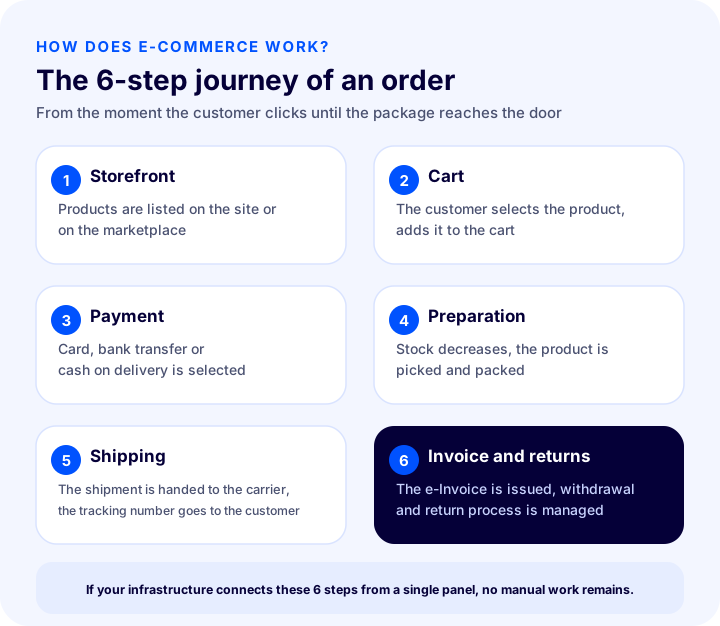
- Storefront: Products are listed on the website, on a marketplace or on both. Photos, descriptions, prices and stock information appear here.
- Cart: The customer selects the product, chooses options such as size or color, and adds it to the cart.
- Payment: Payment is collected by credit card, bank transfer or cash on delivery. Card payments are processed securely through the virtual POS.
- Preparation: The order reaches the warehouse, stock is reduced, and the product is picked and packed.
- Shipping: The package is handed to the carrier, and the tracking number is sent to the customer.
- Invoice and returns: An e-Invoice or e-Archive invoice is issued; if the customer exercises the right of withdrawal, the return and refund process begins.
Which Payment Methods Are Used in E-Commerce?
In e-commerce, the payment method directly affects the customer's decision to complete the order. If customers cannot find the method they are used to, they may abandon the cart; so it is necessary to offer several options and make sure each one works securely.
| Method | How does it work? | Point to watch |
|---|---|---|
| Credit and debit card | Collected instantly through the virtual POS; installment options can be offered | Requires a virtual POS agreement and a secure payment page |
| Bank transfer / EFT | The customer pays into your account, and the order is prepared once payment is confirmed | Checking and matching payments takes effort |
| Cash on delivery | Payment is collected on delivery | Return and refused-delivery rates may rise; there is an additional service fee |
| Digital wallet and balance | The customer pays with a store or payment-institution balance | Requires integration and accounting follow-up |
| Pay by link | For orders taken by phone or message, a payment link is sent to the customer | Matching with the order should be easy |
How Much Has E-Commerce Grown in Türkiye?
According to statements based on the Ministry of Trade's Electronic Commerce Information System (ETBİS) data, the volume of e-commerce in Türkiye rose by about 52 percent year on year in 2025 and exceeded 4.5 trillion lira. The share of e-commerce in overall trade reached 19.3 percent, the number of transactions about 6 billion, and the number of businesses engaged in e-commerce 634 thousand.
| Indicator (2025) | Value |
|---|---|
| E-commerce volume | Over 4.5 trillion lira (about 52% increase on the previous year) |
| Share of overall trade | 19.3 percent |
| Number of transactions | About 6 billion |
| Number of businesses engaged in e-commerce | About 634 thousand |
These figures are compiled from public statements by the Ministry of Trade; for current and detailed data, we recommend consulting the ETBİS reports published by the ministry. What the figures point to is clear: e-commerce is no longer a side channel but a main channel approaching one-fifth of trade, and most businesses have to be present in this market.
What Are the Types of E-Commerce?
E-commerce is divided into different types according to who the seller and buyer are and where the sale takes place. The four most common models are B2C, B2B, C2C and D2C; in addition, channels such as marketplaces and social commerce are also commonly referred to as separate "types" in everyday talk.
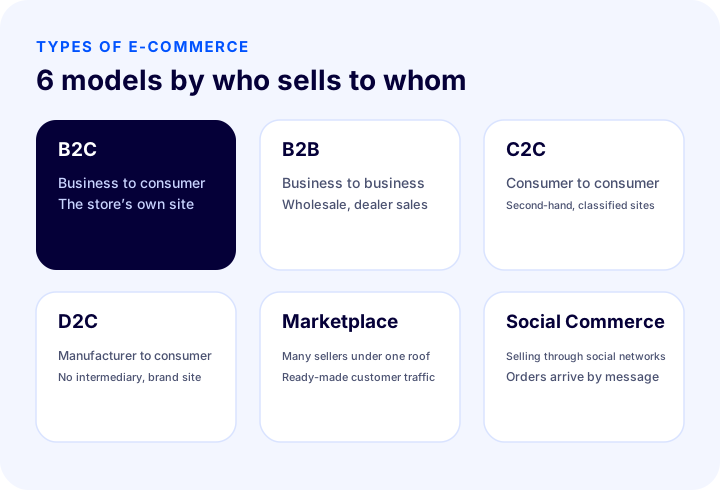
| Type | Seller → Buyer | Example |
|---|---|---|
| B2C | Business → Consumer | A clothing store selling from its own website |
| B2B | Business → Business | A manufacturer's wholesale sales to its dealers |
| C2C | Consumer → Consumer | Second-hand product listings |
| D2C | Manufacturer → Consumer | A brand selling directly from its own website, without intermediaries |
| Marketplace | Many sellers → Consumer | A platform where many sellers sell products under one roof |
| Social Commerce | Business → Consumer | An order that comes from a social network post |
Most businesses do not stick to a single model. For example, a manufacturer can sell directly to consumers from its own site (D2C), through marketplaces (marketplace), and wholesale to its dealers (B2B). In this case, the real task is to bring all channels together under a single stock and order system.
Okumanızı öneririzE-Ticaret Türleri Nelerdir? Okumanızı öneririzB2B, B2C ve C2C Nedir? Farkları Nelerdir?What Are the Advantages and Disadvantages of E-Commerce?
The biggest advantage of e-commerce is that it removes the limits of place and time; its biggest disadvantage is the increase in competition and operational workload. There are pros and cons for both sides:
| Advantages | Disadvantages | |
|---|---|---|
| For the business | Rent and staff costs fall; sales run 24/7; you reach every part of the country and even other countries; sales and customer data can be measured | Competition is intense; there are advertising and shipping costs; returns and stock management create extra work; customer trust is earned over time |
| For the customer | Shopping from home, a wide choice of products, easy price comparison, the ability to read reviews | Not being able to handle the product, waiting for shipping, the risk of being defrauded by unsafe sites |
Most of the disadvantages can be managed with the right infrastructure and organization. Stock errors are reduced with software, shipping problems with the right agreement, and lack of trust with a transparent return policy and payment security.
E-Commerce Site or Marketplace?
Many people who start e-commerce face the same question: should I build my own site or sell on a marketplace? The answer is often "both", but you need to know the difference between the two.
| Criterion | Your own e-commerce site | Marketplace |
|---|---|---|
| Customer traffic | You bring it yourself (ads, search, social networks) | The platform has ready-made traffic |
| Brand and control | Design, price and campaigns are entirely up to you | The platform's rules apply |
| Cost | Infrastructure and marketing costs | Commission on sales and costs arising from the rules |
| Customer data | The customer is yours, repeat sales are easy | Customer data is limited |
| Speed of getting started | Setup and the first customer take time | You can start quickly |
The practical approach is this: sell on marketplaces to get fast sales and first revenue, and grow your brand and loyal customer base on your own site. Managing the products, stock and orders of both channels from a single panel significantly reduces errors and workload.
Okumanızı öneririzPazaryeri Entegrasyonu Nedir?What Does an E-Commerce Business Need?
What an e-commerce business needs is not just a website. Six components work together: store infrastructure, payment, shipping, invoicing, stock and warehouse, and marketing.
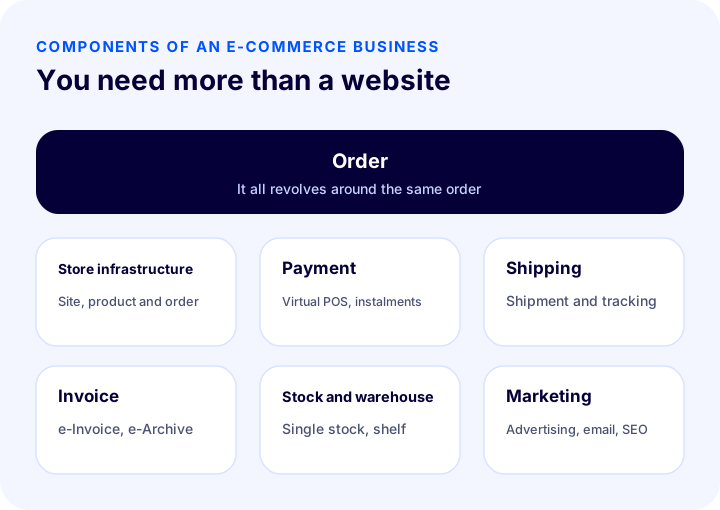
1. Store Infrastructure
E-commerce infrastructure is the software where products are listed and the cart and order process are managed. Whether you use a ready-made e-commerce plan or custom software depends on your budget and needs; however, the infrastructure must be mobile-friendly, fast and search-engine friendly.
Okumanızı öneririzE-Ticaret Altyapısı Nedir?2. Payment
Customers must be able to pay securely with their card and see installment and alternative payment options. To accept card payments, a virtual POS agreement is made with a bank or payment institution.
Okumanızı öneririzSanal POS Nedir? Özellikleri ve Avantajları3. Shipping
The timely and undamaged arrival of the order largely determines customer satisfaction. Agreements are made with carriers; as volume grows, prices are negotiated. When the infrastructure is integrated with the carrier, the barcode, tracking number and status information flow automatically.
We recommend readingHow to Make a Shipping Agreement in E-Commerce?4. Invoicing and Accounting
In e-commerce, an e-Invoice or e-Archive invoice must be issued for sales. Moving from order to invoice by hand takes time and produces errors; automatic invoicing is done with software.
5. Stock and Warehouse
If you sell the same product on several channels, stock must be managed from one place; otherwise a product sold on one channel still shows as "available" on another and leads to cancellations. As the warehouse grows, shelf layout and the picking process also become important.
We recommend readingWhat Is a WMS? How Does a Warehouse Management System Work?6. Marketing
Opening a site does not mean customers will come. Search engine optimization (SEO), advertising, email and social network work bring visitors to the site; cart reminders and campaigns turn visitors into customers.
Who Can Do E-Commerce?
You do not need large capital or a physical store to do e-commerce. Manufacturers, wholesalers, retailers, entrepreneurs selling handmade products and businesses offering services can all do e-commerce. Entrepreneurs without stock can start with the dropshipping model, and those who want to sell abroad can start with e-export or micro-export. What matters is that the product or service being sold meets real demand and that basic legal obligations are fulfilled.
Okumanızı öneririzStoksuz E-Ticaret Nedir? Nasıl Yapılır?How to Get Started with E-Commerce?
Getting started with e-commerce can be summed up in eight steps. You can use the list and links below for the details of each step.
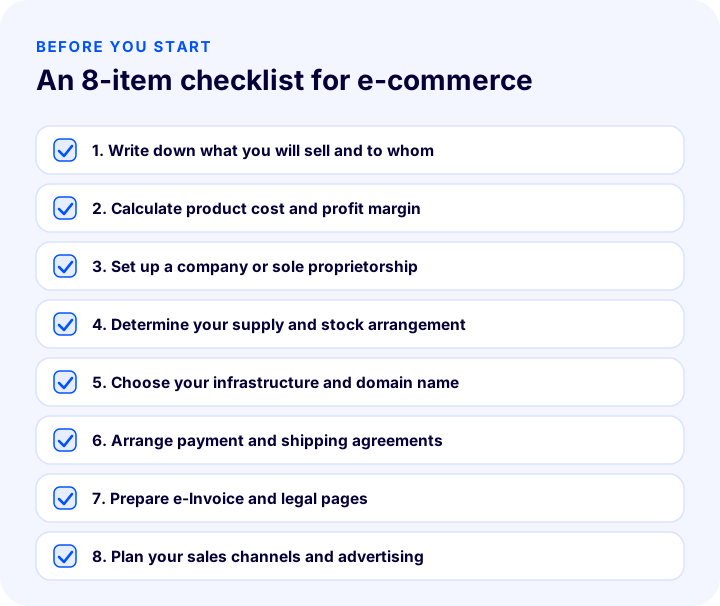
- Decide what you will sell and to whom. A single product group and a clear target audience give better results than trying to sell everything.
- Calculate costs and profit. Once you factor in product cost, shipping, commission, advertising and a returns allowance, is the remaining profit enough?
- Choose your business type. Setting up a sole proprietorship or a company has different consequences in terms of tax and liability.
- Set up your supply and stock system. Decide whether you will sell from your own stock, from a supplier, or with the dropshipping model.
- Choose your infrastructure and domain name. Pick a short, memorable domain name and an infrastructure that allows you to grow.
- Arrange payment and shipping agreements. Be ready to work with a virtual POS and at least one carrier.
- Prepare your e-Invoice setup and legal pages. The distance sales contract, privacy and return conditions must be on the site.
- Plan your sales channels and advertising. Decide which of your own site, marketplace and social network channels to start with.
What Is the Legal Framework for E-Commerce?
Businesses doing e-commerce must comply with commercial legislation and consumer rights. The main topics are as follows:
- Business registration and tax: If you sell regularly, you need to set up a sole proprietorship or a company and register as a taxpayer.
- e-Invoice and e-Archive: The invoicing obligation for sales is fulfilled with software.
- Distance sales and the right of withdrawal: The customer is informed before the sale; the right of withdrawal is granted within the period set by legislation (there are exceptions).
- Protection of personal data (KVKK): When customer data is processed, obligations such as the privacy notice and cookie consent are fulfilled.
- Ministry of Trade registration: E-commerce service providers and intermediary service providers may have registration and reporting obligations such as ETBİS.
The details of the obligations vary depending on your business type and sales channels; we recommend getting support from a certified public accountant before you start.
Okumanızı öneririzE-Ticaret Sitesi Açmak İçin Gerekli BelgelerWhat Are the Commonly Used Concepts in E-Commerce?
Knowing the concepts often heard in the world of e-commerce makes it easier both to understand what you read and to talk with your team. The most common terms are as follows:
| Concept | Meaning |
|---|---|
| Conversion rate | The rate showing what share of site visitors place an order |
| Cart abandonment | Visitor behavior where someone adds a product to the cart but leaves without completing the order |
| Average cart value | The average amount a customer spends in one order |
| Integrations | Two systems (for example the infrastructure and a shipping or accounting software) exchanging data with each other automatically |
| Multichannel selling | Selling the same product in more than one place (site, marketplace, store) while managing stock jointly |
| Dropshipping | A selling model where you pass the order on to the supplier without holding product stock |
| e-Export | Selling over the internet to customers abroad |
| Virtual POS | The system that makes it possible to accept card payments online |
What Are the Common Mistakes in E-Commerce?
- Underestimating costs: If commission, shipping, returns and advertising expenses are not taken into account, sales rise but profit does not.
- Managing stock by hand: When selling on several channels, stock errors are inevitable; they bring cancellations and lost customers.
- Neglecting mobile: Most visitors come from their phones; a site that is hard to use on a phone loses sales.
- Skipping trust signals: A site without contact details, return terms and a secure payment badge struggles to get customers to pay.
- Relying only on ads: If sales stop the moment you pause ads, there is not enough investment in search engine visibility and repeat customers.
- Forgetting customer service: A store that is slow to reply and makes returns difficult quickly starts to slip in reviews.
The Future of E-Commerce: Which Trends Stand Out?
E-commerce is constantly evolving. The main trends businesses should watch in the coming period are the following:
- Mobile-first shopping: The phone is the main shopping screen; speed and easy payment are decisive.
- Multichannel selling: Your own site, marketplaces, social networks and physical stores are managed from a single stock.
- AI-powered experience: Product recommendations, content and ad creation, and answering questions are increasingly supported by AI; AI assistants are also starting to recommend products and brands.
- E-export: Selling abroad becomes a growth path when the domestic market is saturated.
- Automation: Invoicing, shipping, stock and marketing processes are run by rules rather than by hand.
E-Commerce with Faprika
Faprika is an infrastructure that has been developing e-commerce software for 20 years and runs the e-commerce of more than 3000 brands. All six components listed in this guide come together in a single panel: store infrastructure and a mobile-friendly site, virtual POS and payment integrations, integration with 23 shipping companies, e-Invoice and e-Archive, stock and warehouse management, and campaign and marketing tools.
You can manage your products, stock and orders on marketplaces together with your own site from the same panel, and sell abroad with the e-export module. You can review which plan suits you on the e-commerce plans page, and find the add-ons you can use on the add-ons page.
Frequently Asked Questions
What is e-commerce?
E-commerce (electronic commerce) is the buying and selling of products and services over the internet. Ordering, payment, delivery and after-sales processes are carried out through a website, a marketplace or a social network.
What are the types of e-commerce?
The most common types are B2C (business to consumer), B2B (business to business), C2C (consumer to consumer) and D2C (manufacturer to consumer). Marketplaces and social commerce stand out as the channels through which these models are sold.
What are the advantages of e-commerce?
For the business: low fixed costs, 24/7 sales, reach across a wide geography and measurable data; for the customer: shopping from home, a wide choice and easy price comparison.
What do you need to get started with e-commerce?
You need a clear product and target audience, a cost calculation, a company or sole proprietorship, an e-commerce infrastructure, a virtual POS and shipping agreement, an e-Invoice setup and legal pages. To sell on a marketplace, you also need seller approval from the platform concerned.
What is the difference between e-commerce and selling on a marketplace?
On your own e-commerce site, the brand, the price and the customer data belong to you, but you bring in the traffic yourself. A marketplace has ready-made traffic, but the platform's rules and commissions apply. Most businesses use both together.
How much has e-commerce grown in Türkiye?
According to statements by the Ministry of Trade, e-commerce volume exceeded 4.5 trillion lira in 2025, and its share of overall trade reached 19.3 percent.