Contents 18 sections
- What Is Cash on Delivery?
- How Does a Cash-on-Delivery Order Work?
- What Are the Pros and Cons of Cash on Delivery?
- What Is the Real Cost of Cash on Delivery?
- Cash on Delivery Cost and Risk Tool
- What Risks Does Cash on Delivery Involve?
- How Is a Cash-on-Delivery Order Confirmed?
- For Which Products Should Cash on Delivery Be Offered?
- How Should the Cash-on-Delivery Option Be Shown on the Payment Page?
- How Are Cash-on-Delivery Collections Reconciled?
- When Should Cash on Delivery Be Restricted?
- How Do Cash on Delivery and the Right of Withdrawal Work?
- Should the Cash-on-Delivery Fee Be Passed On to the Customer?
- How Is Cash-on-Delivery Performance Measured?
- 8 Common Mistakes in Cash on Delivery
- Cash on Delivery Checklist
- Managing Cash on Delivery with Faprika
- Frequently Asked Questions
In online shopping, not every customer is ready to enter their card on a website: some do not yet trust the site, some do not want to pay online by card, and some want to pay only after seeing the product. Cash on delivery is the payment method that wins these customers; but if it is not managed, undelivered orders, two-way shipping costs and delayed collections can eat into your profit.
This article is structured like a lesson. Step by step, you will learn how cash on delivery works, its pros and cons, its real cost, how to reduce the risks (SMS confirmation, amount limit, restrictions), the flow of cash-on-delivery orders and which products it should be offered for. The tool in the article shows what cash on delivery earns you with your own figures and at what non-delivery rate it turns into a loss.
What Is Cash on Delivery?
Cash on delivery is a method in which the customer pays for an online order, in cash or by credit card, to the courier when receiving the product. Because payment is made at delivery rather than at the time of the order, the customer does not pay before holding the product.
Carriers offer this service for an additional collection fee: it is a service charge on top of the standard shipping rate for orders whose payment is not taken in advance. The amount collected is passed on to the seller after the period set by the carrier.
We recommend readingWhat Is Cash on Delivery? (Glossary)How Does a Cash-on-Delivery Order Work?
A cash-on-delivery order differs from a normal order in two respects: payment is not taken at the time of the order, and collection becomes an action the carrier performs during delivery. As a result, it is uncertain whether the order will actually be accepted, and the confirmation step becomes more important.
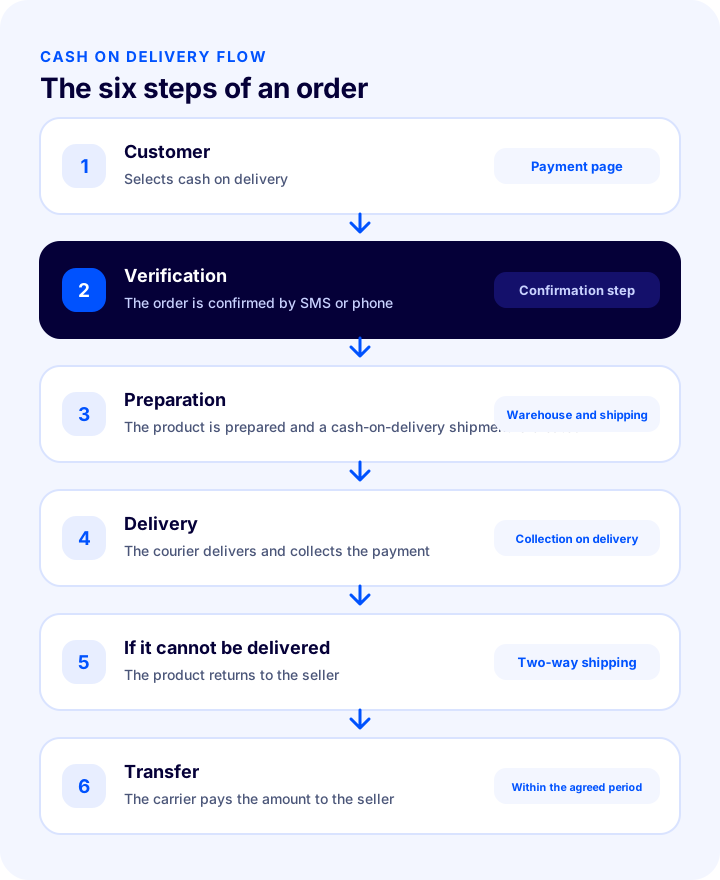
- The customer selects cash on delivery: At the payment step, a cash-on-delivery or card-on-delivery option is offered.
- The order is verified: It is confirmed (for example by SMS or phone) that the customer really placed the order.
- The product is prepared and handed to the carrier: The order is handed to the carrier as a cash-on-delivery shipment.
- The courier delivers and collects: The customer pays when receiving the product, and the payment is collected.
- If it cannot be delivered, the product returns: If the customer cannot be found or does not accept the delivery, the product is returned to you.
- The amount is passed on to the seller: The carrier pays the amount it collected to the seller after the period set in the agreement.
What Are the Pros and Cons of Cash on Delivery?
Cash on delivery solves the trust problem and widens your customer base; in return, it brings the risk of undelivered orders and additional cost. Before deciding, you need to see both sides clearly.
| Pros | Cons | |
|---|---|---|
| From the customer’s side | Does not pay without seeing the product, does not need a card, trust concerns are reduced | May need to have cash ready; may pay an additional collection fee |
| From the seller’s side | Wins customers who have no card or are hesitant, reduces abandonment at the payment step | Risk of undelivered orders, two-way shipping cost |
| Cost | No virtual POS commission | There is a collection fee from the carrier; it is usually higher than a commission |
| Cash flow | The amount comes through the carrier | The money arrives after delivery, within the carrier’s period; it can be slower than card payment |
| Operational load | No additional integration is needed | Order confirmation, returns and collection reconciliation create extra work |
What Is the Real Cost of Cash on Delivery?
The cost of cash on delivery is not just the collection fee: the likelihood of an undelivered order and the outbound and return shipping charges you pay in that case are part of the cost as well. The real cost is the average of successful and failed orders.
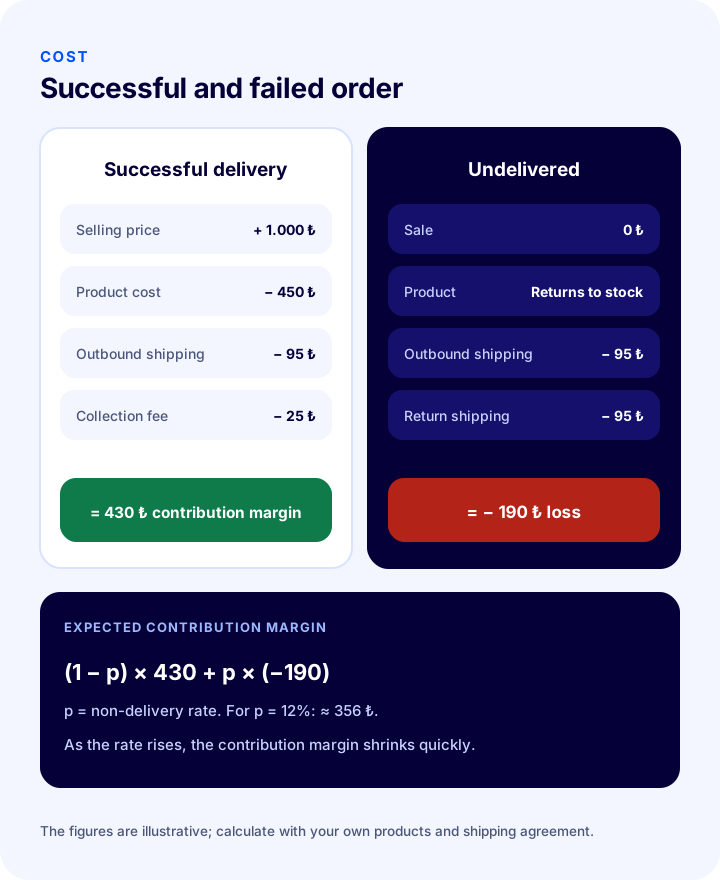
- Successful delivery: Selling price − product cost − shipping charge − collection fee.
- Undelivered order: A loss equal to the outbound shipping charge plus the return shipping charge (the product returns to stock, but packaging and labor are also lost).
- Expected contribution margin: (1 − non-delivery rate) × successful result + non-delivery rate × loss.
Cash on Delivery Cost and Risk Tool
The tool below calculates the expected contribution margin of a cash-on-delivery order, the result of the same order paid by card, and the non-delivery rate at which cash on delivery turns into a loss. Replace the figures with the values of your own product and shipping agreement; the default values are examples only.
The tool assumes zero non-delivery risk for card payment and ignores indirect costs such as packaging and labor; in reality, cash on delivery is somewhat more expensive. The most valuable output of the tool is seeing how the contribution margin erodes as the non-delivery rate rises.
We recommend readingHow Is Profit Margin Calculated?What Are the Risks of Cash on Delivery?
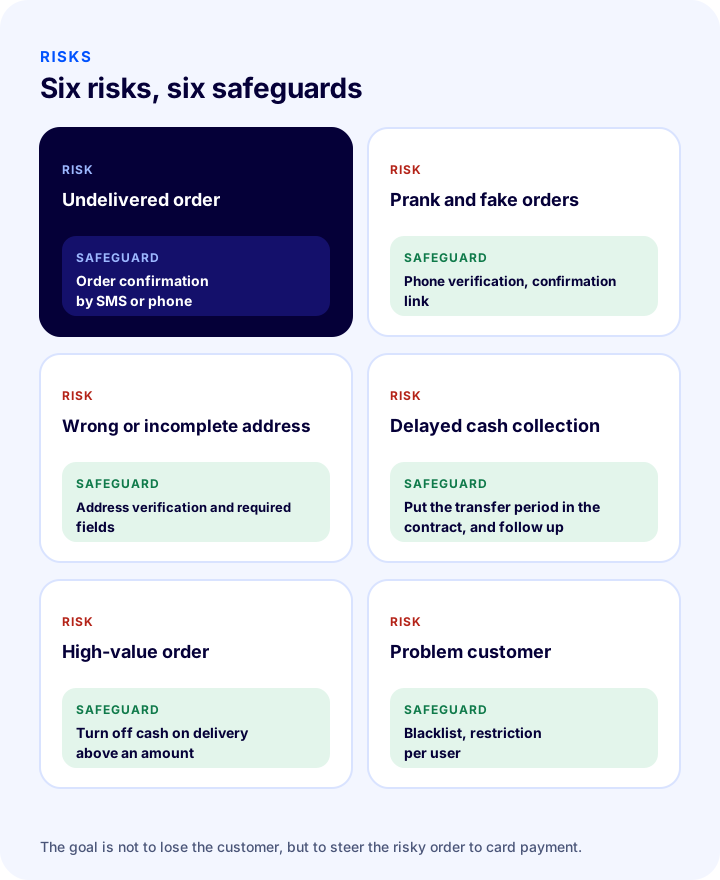
The main risks of cash on delivery are undelivered or refused orders, prank or fake orders, wrong or incomplete addresses, delayed cash collection, and losses concentrated in high-value orders. All of them can be reduced with order confirmation, limits, and restrictions.
| Risk | Measure |
|---|---|
| Undelivered or refused order | Order confirmation (SMS or call), pre-delivery notification |
| Prank or fake order | Phone number verification, confirmation link, limit on the first order |
| Wrong or incomplete address | Mandatory address fields and validation, pre-delivery check |
| Delayed cash collection | Clarify the carrier's transfer time in the contract and monitor it |
| Loss on high-value orders | Disable cash on delivery above a set amount |
| Repeat problem customer | Blacklist and per-user restriction |
How Do You Confirm Cash-on-Delivery Orders?
Order confirmation is the step that verifies the customer really placed the order and intends to accept delivery; it is the most effective way to reduce undelivered orders with cash on delivery. The most common method is to send the customer an SMS with a confirmation link and hand the order to the carrier only once confirmation arrives.
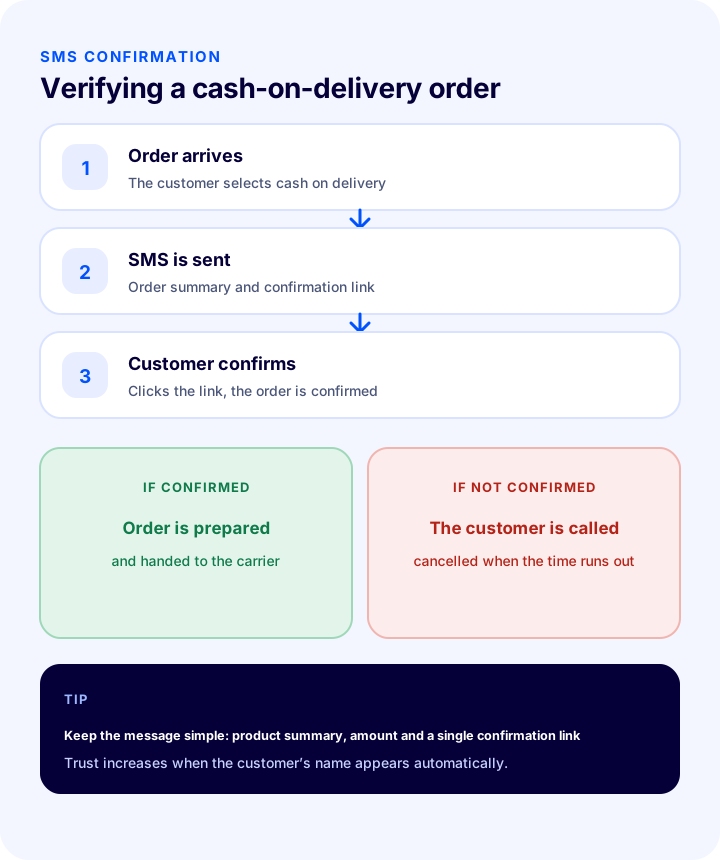
- The order comes in: The customer completes the order by choosing cash on delivery.
- The SMS is sent: A message describing the order and containing a confirmation link goes to the customer's phone.
- The customer confirms: By clicking the link, they verify the order; the order is marked as confirmed.
- The confirmed order is prepared: Preparation and shipping begin.
- Follow up if there is no confirmation: Call or cancel orders that are not confirmed within a set time.
For Which Products Should Cash on Delivery Be Offered?
Cash on delivery is not equally valuable for every product: it helps with standard products that have a low return risk and a reasonable price, but increases risk for personalized, very high-value, or hard-to-return products. When deciding, consider the product's price, likelihood of return, and resalability together.
| Product type | Cash on delivery | Reason |
|---|---|---|
| Standard, mid-priced products | Generally suitable | A returned product can be resold and the loss is limited |
| Very high-value products | Limit or disable | An undelivered order causes a large loss of shipping cost and time |
| Personalized products and products already in production | Consider disabling | Cannot be resold once returned |
| Perishable products | Be careful | The product loses value if it is not delivered |
| Hygiene products and products that cannot be returned once opened | Make the terms clear | Withdrawal exceptions must be stated in the pre-contractual information |
| Low-value products | Set a lower limit | The collection fee and shipping can eat into profit |
How Should the Cash-on-Delivery Option Be Shown on the Checkout Page?
The position and wording of the cash-on-delivery option on the checkout page determine which method the customer chooses and what they expect. Hiding the option loses customers, while promoting it too much multiplies the costly method.
- Name it clearly: Use separate, understandable names such as "cash on delivery" and "credit card on delivery".
- State the fee and conditions: If there is a collection fee, show it and the amount range it applies to below the option.
- Put card payment first: Keep the lower-cost, safer method at the top of the order and offer cash on delivery as an alternative.
- Explain the confirmation step: Tell customers in advance that a cash-on-delivery order will be confirmed by SMS or phone; the customer will be prepared.
- Give the reason when it is restricted: If cash on delivery is not offered because of the amount or region, show a short explanation.
How Do You Reconcile Cash-on-Delivery Collections?
Because the amount of cash-on-delivery orders comes through the carrier, you need to match the amounts deposited into your account with order and shipment records. Without reconciliation, missing or delayed collections are noticed months later.
- Get the collection report from the carrier: Request, on a regular (weekly) basis, the report showing which shipment was collected and when it was transferred.
- Match them with orders: Compare the shipment numbers in the report with the cash-on-delivery orders in your panel.
- Separate the collection fee: Verify that the difference between the net amount deposited and the gross amount matches the collection fee.
- Close out undelivered orders: Process orders returned by the carrier correctly in stock and order status.
- Track delays: Report to the carrier any collections that exceed the transfer time stated in the contract.
In Which Cases Should Cash on Delivery Be Restricted?
You do not have to keep cash on delivery open for every order; restricting it by amount, product, carrier, and customer noticeably reduces losses from undelivered orders. The goal is not to lose the customer but to steer high-risk orders toward card payment.
| Restriction | When does it make sense? |
|---|---|
| Upper amount limit | If the loss from an undelivered high-value order is very large |
| Lower amount limit | If the collection fee and shipping eat into profit on a low-value order |
| Carrier restriction | When a particular carrier does not collect cash on delivery or charges too much for it |
| Product or category restriction | For personalized, perishable, or hard-to-return products |
| Region restriction | In regions with a low delivery success rate |
| Per-user restriction | For customers who have had problems with previous orders |
How Do Cash on Delivery and the Right of Withdrawal Work?
A product bought with cash on delivery is also covered by distance selling rules; the customer's right of withdrawal and the return conditions are the same as for card payment. The difference is that payment is taken at delivery, so it must be clear in advance by which method the amount will be refunded to the customer on return (generally to a bank account if they paid in cash).
- The right of withdrawal is the same: The post-delivery withdrawal period and the exceptions follow the same rules as card sales.
- State the refund method in advance: A customer who paid in cash may need to provide bank account details for the refund; state this clearly in the return conditions.
- Distinguish refusing delivery: Refusing delivery when the parcel arrives and accepting it and withdrawing later are different processes; the cost and procedure depend on your shipping agreement and terms.
- Add it to the pre-contractual information: The cash-on-delivery fee (if any) and the return conditions must be shown before the payment step.
Should the Cash-on-Delivery Fee Be Passed On to the Customer?
Passing the cash-on-delivery collection fee on to the customer, absorbing it yourself, or including it in the price are the three common options, and each affects conversion differently. Passing the fee on shifts the cost to the customer, but because the total rises at the payment step, it may steer some customers toward card payment.
- Passing it on to the customer: It covers the cost and pushes risky orders to card payment; however, some customers may give up.
- Absorbing it yourself: It protects conversion but lowers the margin; consider it only for products with a high profit margin.
- Making it free above a set amount: This is campaign logic aimed at raising the cart amount; consider it together with the free-shipping threshold.
- Show it transparently: Whichever option you choose, the fee must be clearly visible before the payment step.
How Do You Measure Cash-on-Delivery Performance?
You can tell whether cash on delivery is working well with four indicators: cash-on-delivery share, confirmation rate, non-delivery rate, and the time it takes for collections to reach your account. Track them monthly, and if any value falls outside its threshold, tighten the rules.
- Cash-on-delivery share: The percentage of all orders paid on delivery; if it is very high, consider steering customers toward card payment.
- Confirmation rate: The share of orders confirmed by SMS or phone; if it is low, review the confirmation message and the waiting time.
- Non-delivery rate: The share of cash-on-delivery orders returned by the carrier; look at it broken down by region, product, and carrier.
- Collection time: How long the carrier takes to transfer the amount to your account; it determines your cash flow.
8 Common Mistakes with Cash on Delivery
- Handing orders to the carrier without confirmation: Prank and fake orders cost you shipping in both directions.
- Keeping cash on delivery open for all orders: A store that sets no limit for high amounts and risky products suffers its biggest losses on those orders.
- Not including the collection fee in the cost: The profit of a cash-on-delivery order is different from a card order's in pricing.
- Forgetting the return shipping: An undelivered order incurs shipping costs in both directions.
- Not monitoring the non-delivery rate: The rate rises quietly and erodes profit.
- Not knowing the carrier's transfer time: Your cash flow plan breaks down.
- Not stating the refund method in advance: The refund for a customer who paid in cash remains unclear.
- Making cash on delivery the only payment method: Offer card and bank transfer options too; cash on delivery is meant to win customers, not to leave them no choice.
Cash-on-Delivery Checklist
Check the items below before enabling cash on delivery and at regular intervals afterwards.
- Have you calculated the expected contribution margin of a cash-on-delivery order (including the collection fee and possible return shipping)?
- Do you know the carrier's collection fee and how long it takes to transfer the amount to your account?
- Is order confirmation (SMS or call) set up?
- Have you set an upper limit for high amounts and a lower limit for low amounts?
- Have you defined restrictions for risky products, regions, and carriers?
- Is there a blacklist or per-user restriction for problem customers?
- Have you decided how to pass the cash-on-delivery fee on to the customer?
- Are the cash-on-delivery fee and return conditions shown before the payment step?
- Is the refund method for customers who paid in cash stated in the return conditions?
- Do you track the non-delivery rate monthly?
- Are card payment and bank transfer options offered too?
Cash-on-Delivery Management with Faprika
Enabling cash on delivery is easy; the real work is managing it with the right limits. The Faprika e-commerce infrastructure offers the following for this stage (you can see which feature starts in which plan on the e-commerce plans page):
- Cash on delivery and bank transfer: Included in all plans. Enabled under Configuration > Payment Settings > Payment Types; the step-by-step guide is in the Cash on Delivery Management tutorial.
- Cash and credit card are managed separately: Cash on delivery and credit card on delivery are enabled and disabled separately, and an extra fee can be entered for each. If no fee is entered, the service is free for the customer.
- Carrier restriction: You can disable cash on delivery for specific carriers.
- Amount limits: You can block cash on delivery for carts at or above a set amount, or for carts below a set amount.
- SMS verification: For cash-on-delivery orders, an SMS with an order confirmation link is sent to the customer; the message text is editable and details such as the customer's name are inserted automatically. Sending SMS requires an SMS integration, which varies by plan.
- Cash-on-delivery order confirmation: You manage cash-on-delivery orders through a confirmation step; this feature varies by plan.
- Blacklist and restriction: Restriction and blacklist management by order, carrier, user, and payment system varies by plan.
- Automatic cancellation of unpaid orders: Automatic cancellation of orders whose payment is not completed varies by plan.
Frequently Asked Questions
What is cash on delivery?
Cash on delivery is a method in which the customer pays for an online order, in cash or by credit card, to the courier when receiving the product. Carriers offer this service for a collection fee on top of the standard shipping rate and pass the amount they collect on to the seller.
What does cash on delivery cost?
The cost of cash on delivery consists of the carrier’s collection fee plus the outbound and return shipping charges paid on undelivered orders. The real cost is the weighted average of successful and failed orders, which is why the non-delivery rate is decisive.
How can undelivered orders be reduced with cash on delivery?
The most effective measures are order confirmation (SMS confirmation link or phone), turning off cash on delivery for high-value orders, restrictions on risky products and regions, address verification and a blacklist for problem customers. Monitoring the non-delivery rate monthly also allows timely action.
Should the cash-on-delivery fee be passed on to the customer?
There are three options: pass it on to the customer, absorb it yourself, or make it free above a certain amount. Passing it on covers the cost and steers risky orders to card payment, but may put some customers off. Whichever you choose, the fee must be shown clearly before the payment step.
Is there a right of withdrawal for products bought with cash on delivery?
Yes. A product bought with cash on delivery is also covered by distance selling rules, and the right of withdrawal and return conditions are the same as for card payment. The return conditions should state in advance how a customer who paid in cash will be refunded.
Is cash on delivery suitable for every store?
No. It is useful where customer trust is low, card payment habits are weak, or the store is newly established; but it should be limited for high-value, personalized or hard-to-return products. First calculate the expected contribution margin with your own figures.