Contents 13 sections
- What Is Customer Segmentation?
- Why Is Customer Segmentation Important in E-Commerce?
- What Are the Types of Customer Segmentation?
- What Data Is Needed for Customer Segmentation?
- What Is RFM Analysis?
- RFM Segments and What to Do for Each
- How to Do Customer Segmentation: 6 Steps
- Automated Campaigns by Customer Lifecycle
- Message Examples by Segment
- How to Measure the Results of Segmentation?
- 7 Common Mistakes in Customer Segmentation
- Customer Segmentation with Faprika
- Frequently Asked Questions
The customer list of an e-commerce store is not a single audience. Someone who placed their first order yesterday, a loyal customer who shops ten times a year and a former customer who has not visited in six months all sit on the same list. Sending all of them the same discount email means giving an unnecessary discount to the loyal customer, wearing out the new customer with irrelevant offers and never noticing the customer who is about to be lost.
Customer segmentation splits this list into meaningful groups based on behavior and value, so you can send the right message to each group at the right time. In this guide we explain, step by step, what customer segmentation is, the types of segmentation used in e-commerce, RFM analysis (the most practical method) with a sample calculation, the seven core customer segments and which campaign to run for each.
What Is Customer Segmentation?
Customer segmentation is the process of dividing customers into groups based on shared characteristics such as purchasing behavior, spend, shopping frequency, demographics, location or interests. The goal is to offer each group the products, messages, offers and contact frequency that fit its needs.
Segmentation is different from defining a target audience. A target audience defines who you want to sell to; segmentation groups the people who are already your customers or have interacted with your site, based on what you know about them. The biggest advantage of segmentation in e-commerce is that most of the data you need already exists in order and membership records.
Okumanızı öneririzE-ticarette Hedef Kitlenin Belirlenmesi ve Yapılacak StratejilerWhy Is Customer Segmentation Important in E-Commerce?
Customer segmentation directs the marketing budget to the customers who bring the highest return, reduces unnecessary discounts, helps you spot customers who are about to be lost in time and increases the repeat purchase rate.
- Higher engagement: A message that fits the person's situation is opened and clicked more than a generic announcement sent to everyone.
- Lower discount cost: Instead of giving a large discount to a loyal customer who already buys at full price, you offer early access or a privilege; the discount goes to the group that really needs an incentive.
- Preventing customer churn: Valuable customers whose shopping frequency is dropping are noticed before they are completely lost and are moved into a win-back campaign.
- Better product recommendations: A customer who regularly buys from a category is shown that category's new products; a customer who has just placed a first order is shown complementary products.
- Fewer unsubscribes: Irrelevant and frequent messages lead customers to withdraw their email and SMS consent. Segmentation increases the accuracy of your messages, not their number.
What Are the Types of Customer Segmentation?
There are six segmentation types most commonly used in e-commerce: demographic, geographic, behavioral, value-based (spend), lifecycle and channel segmentation. For most stores, the types that deliver the fastest results are behavioral and value-based segmentation, which rely on order data.
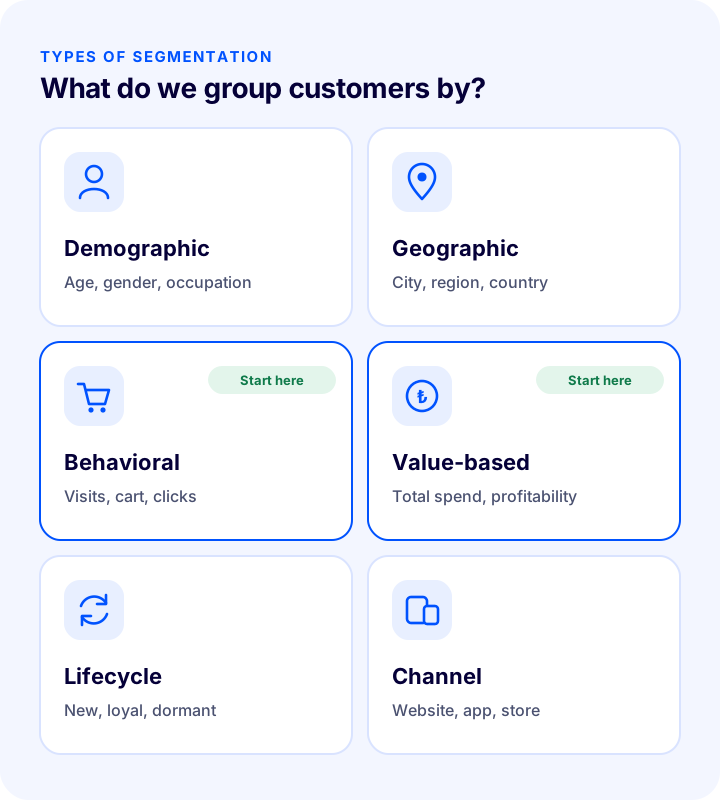
| Type | Grouped by what? | E-commerce example |
|---|---|---|
| Demographic | Age, gender, occupation | Separate announcements for women's and men's clothing categories |
| Geographic | City, region, country | Announcing winter products earlier to colder regions |
| Behavioral | Visits, cart, purchase, email engagement | Sending reminders to people who left items in their cart |
| Value-based | Total spend, order value, profitability | VIP privileges for the highest-spending customers |
| Lifecycle | The stage of the customer's relationship with the store | New member, first order, loyal customer, long-absent customer |
| Channel | The channel through which visitors arrive or shop | App-only campaigns for mobile app users |
What Data Is Needed for Customer Segmentation?
Most of the data needed for segmentation in e-commerce is already in the store's own admin panel: order history, product and category preferences, membership details, contact consents, email engagement and cart behavior.
- Order history: Order dates, quantities and amounts; the whole of RFM is calculated from this.
- Product and category preferences: Which categories and brands the customer buys from; this is the basis of accurate product recommendations.
- Membership details: Registration date, customer group and city.
- Contact consents: Whether the customer has given email and SMS consent; marketing messages are not sent to customers without consent.
- Engagement: Whether the customer opens emails and clicks on links.
- Cart and payment behavior: Items waiting in the cart and payments left incomplete.
Customer data is personal data; collecting, storing and using it in marketing must comply with personal data protection and commercial electronic communication regulations.
What Is RFM Analysis?
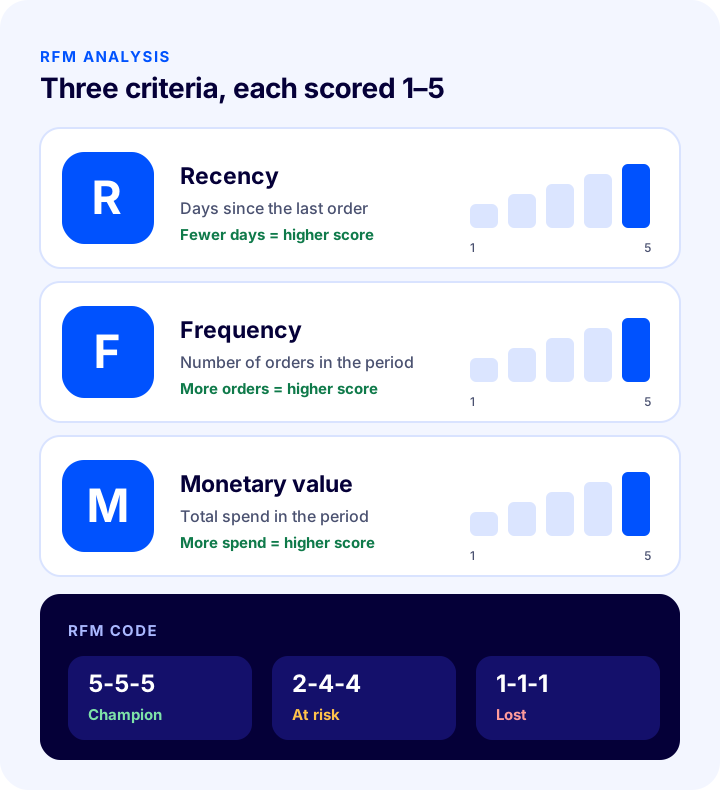
RFM analysis is a customer value analysis that scores customers on three criteria and divides them into segments: R (Recency) is the time since the customer's last order, F (Frequency) is the number of orders in a given period, and M (Monetary value) is the total spend in the same period. A customer who bought recently, buys often and spends a lot is the most valuable customer.
The reason RFM is so widely used in e-commerce is its simplicity: all three criteria are calculated from order records, with no extra data or complex model required. The result also turns directly into action: it becomes clear who should get a welcome message, who a thank-you and who a win-back message.
How Is the RFM Score Calculated?
- Choose the period: The last 12 months is usually used; extend the period if your products are bought once a year.
- Extract three values for each customer: The days since the last order, the number of orders in the period and the total spend in the period.
- Set the score thresholds: Score each criterion from 1 to 5. The most practical method is to rank customers on each criterion and split them into five equal groups; the best twenty percent get 5 and the weakest twenty percent get 1. For recency, the score rises as the number of days falls.
- Combine the scores: Each customer gets a three-digit RFM code (e.g. 5-5-5 or 2-4-4).
- Turn the codes into segments: Group similar codes into the segments in the table below.
The table below is an example showing how thresholds and scoring can be set up. Thresholds should be set according to each store's own customer distribution; these figures are for illustration only.
| Score | R: Days since last order | F: Number of orders (12 months) | M: Total spend (12 months) |
|---|---|---|---|
| 5 | 0–30 | 6 and above | 10,000 TL and above |
| 4 | 31–60 | 4–5 | 5,000–9,999 TL |
| 3 | 61–120 | 3 | 2,500–4,999 TL |
| 2 | 121–240 | 2 | 1,000–2,499 TL |
| 1 | 241 and above | 1 | Under 1,000 TL |
With these thresholds, the scores of six sample customers come out as follows:
| Customer (example) | Last order | Order | Spend | RFM | Segment |
|---|---|---|---|---|---|
| A | 12 days ago | 8 | 14,200 TL | 5-5-5 | Champion |
| B | 45 days before | 4 | 6,100 TL | 4-4-4 | Loyal customer |
| C | 20 days ago | 1 | 850 TL | 5-1-1 | New customers |
| D | 150 days ago | 5 | 7,800 TL | 2-4-4 | At risk |
| E | 70 days ago | 2 | 1,900 TL | 3-2-2 | About to sleep |
| F | 300 days ago | 1 | 600 TL | 1-1-1 | Lost |
In this example the most critical customer is D: this customer used to shop often and spend a lot, but has not come back for five months. A generic discount email will not notice them; RFM analysis points them out directly. RFM is not a one-off report: when you repeat the analysis every month, you see which segment customers move from and to, and you catch the loss before it starts.
We recommend readingE-Commerce Metrics: 15 KPIs You Need to Track and Their Calculation FormulasRFM Segments and What to Do for Each
RFM codes are usually grouped into seven core segments: champions, loyal customers, potential loyalists, new customers, at-risk customers, about-to-sleep customers and lost customers. Each segment has a different goal and the right offer is different too.
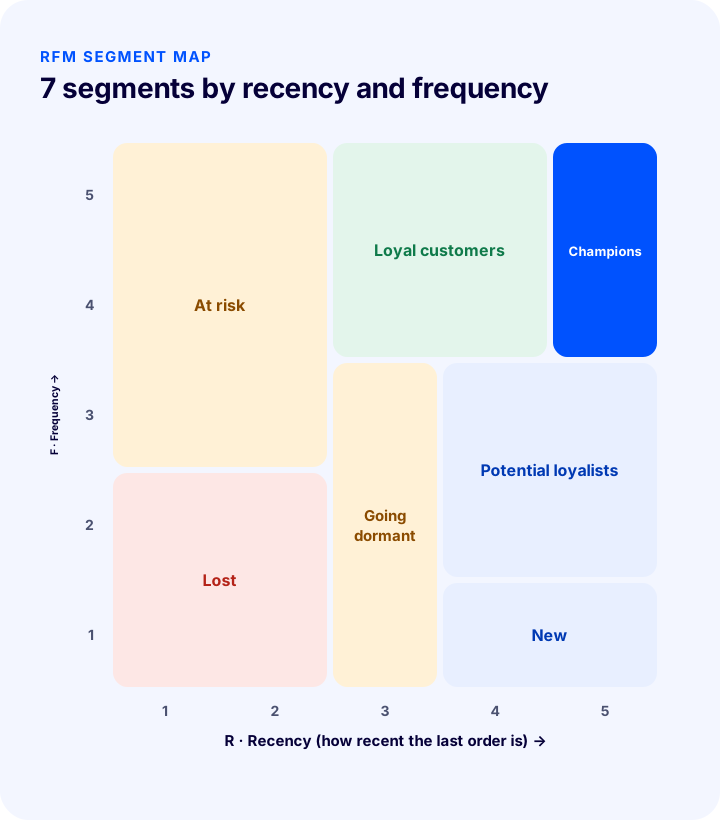
| Segment | RFM pattern | Who? | What should be done? |
|---|---|---|---|
| Champions | R 4–5, F 4–5, M high | Bought recently, often and a lot | Thank-you, early access, VIP privileges; privileges instead of discounts |
| Loyal customers | R 3–4, F 4–5 | Buys regularly | Complementary and upsell recommendations, points and gift vouchers |
| Potential loyalists | R 4–5, F 2–3 | Bought a few times recently | A personalized offer that encourages a second and third order |
| New customers | R 4–5, F 1 | Just placed their first order | Welcome series, post-delivery thank-you, reinforcing the first experience |
| At-risk customers | R 1–2, F 3–5, M high | Used to be valuable, no longer comes | A personal win-back message and a strong, personalized coupon |
| About to sleep | R 3, F 1–3 | Interest is fading | Reminder, new products and recommendations based on interests |
| Lost customers | R 1–2, F 1–2 | Has not come for a long time, bought little | A single low-cost win-back attempt; if there is no response, reduce contact frequency |
How Is Customer Segmentation Done? 6 Steps
Customer segmentation in e-commerce is done in six steps: collecting and cleaning the data, choosing the segmentation criteria, building the segments, designing a message and offer for each segment, connecting the campaigns to automation, and measuring the results and updating the segments.
- Collect and clean the data: Bring order, membership and contact consent data together. Remove records the same person opened with different email addresses, test orders and cancelled orders.
- Choose the criteria: The three RFM criteria are enough to start with. Add criteria such as category preference, city or channel later.
- Build the segments: Turn the criteria into rules, such as “those who placed their first order in the last 30 days”, “those whose total spend exceeds a certain amount” or “those who have not ordered for 120 days”.
- Design a message and offer for each segment: Based on the goals in the segment table, decide the subject, content, channel (email or SMS), offer and sending frequency.
- Connect to automation: Segments are live lists: when a customer enters a segment, the relevant message should go out automatically. Manually sent campaigns get forgotten over time.
- Measure and update: For each segment, track opens, clicks, conversion and movement between segments. Review the thresholds every three months.
Automated Campaigns by Customer Lifecycle
The most efficient use of segmentation is to attach an automated campaign to every stage of the customer lifecycle. When a customer moves from one stage to the next, the right message goes out on its own; the marketing team does not have to pull lists every week.
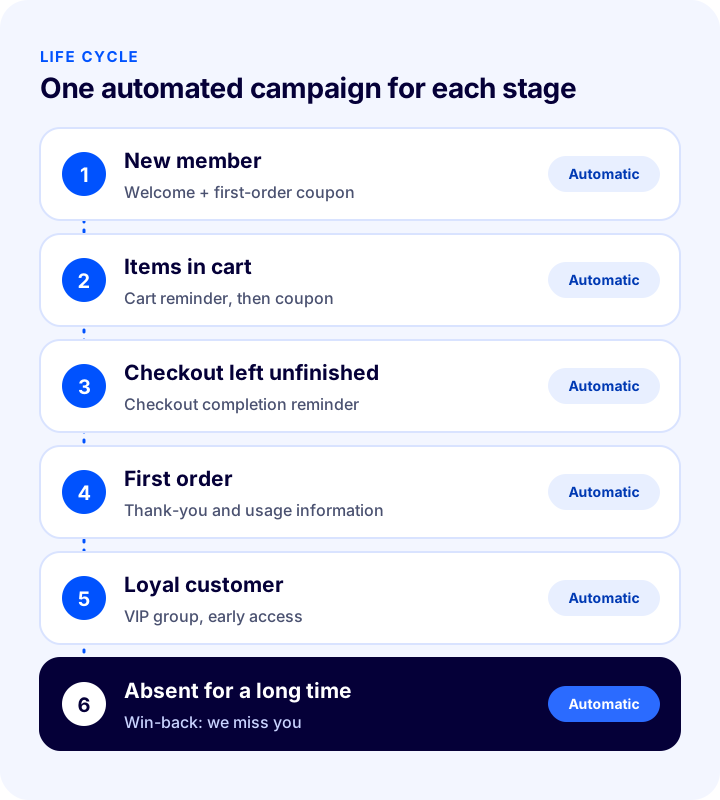
| Stage | Trigger | Automated campaign |
|---|---|---|
| New member | Membership created | Welcome message and a coupon for the first order |
| Undecided visitor | Items waiting in the cart | Cart reminder; if not clicked, a personalized coupon |
| Payment left incomplete | Order created, payment not completed | Checkout completion reminder |
| First order | Order delivered | Thank-you, product usage information, review request |
| Loyal customer | Order count or spend threshold exceeded | Added to the VIP group, early access |
| Long-absent customer | A set number of days have passed since the last order | Win-back (“we miss you”) message and coupon |
Message Examples by Segment
The same campaign should be told in a different voice to different segments. The examples below show how the subject, offer and channel of the message change by segment; the texts are examples only.
| Segment | Example subject line | Offer | Channel |
|---|---|---|---|
| Champions | “The new season opened for you before anyone else” | Early access, free shipping | |
| Loyal customers | “New products in the category you buy often” | Points or gift voucher | |
| Potential loyalists | “A coupon just for your next order” | Limited-time personalized coupon | |
| New customers | “Your order is on its way; here is the best way to use your product” | Usage information, complementary product recommendation | |
| At-risk customers | “We miss you, and we have a gift for you” | Strong personalized coupon | Email and SMS |
| About to sleep | “What has changed while you were away?” | New products based on interests | |
| Lost customers | “One last reminder” | A one-time, low-cost offer |
SMS is a short and limited channel; it should be reserved for the messages that are expected to bring the most results and are time-sensitive (cart reminders, a special offer for a valuable at-risk customer), and not used routinely for every segment.
How Do You Measure the Results of Segmentation?
Whether segmentation works is measured through the conversion rate per segment, movement between segments, the extra revenue the campaign brings and a comparison with a control group. Looking only at the open rate is misleading; the real question is whether the message changed purchasing behavior.
- Conversion by segment: Track each segment's post-campaign order rate and profit per order separately.
- Movement between segments: After a month, how many of the “at-risk” customers moved back into active segments, and how many “new customers” placed a second order? This is the most meaningful indicator of success.
- Control group: Do not send the message to a small part of a segment and compare the purchase rate of the two groups. The difference is the real effect of the campaign; you do not count customers who would have shopped anyway as the campaign's success.
- Discount cost: Evaluate the revenue that came in with coupons together with the amount of discount given. A win-back campaign that brings no profit should be redesigned.
7 Common Mistakes in Customer Segmentation
- Starting with too many segments: You cannot produce separate content for each of twenty segments. Start with five to seven segments.
- Building segments once and leaving them: Customer behavior changes; someone loyal yesterday may be at risk today. Segments must be live and continuously up to date.
- Giving everyone the same discount: A high discount for champions means leaving profit on the table with customers who would buy anyway.
- Ignoring contact consent: Email and SMS should be sent only to customers who have given consent; every message must include an option to unsubscribe.
- Not limiting message frequency: When the same customer falls into several segments, they can receive messages back to back. Set a frequency cap.
- Not measuring the result: If the effect of each segment campaign on revenue and movement between segments is not measured, you do not know what works.
- Constantly messaging lost customers: Frequent messages to a customer who does not respond damage your email reputation. After one or two attempts, reduce the frequency.
Customer Segmentation with Faprika
In Faprika, customer segmentation and automatic campaigns by segment are handled with the Roket marketing automation add-on. In Roket, a segment is a live customer list defined by rules; the number of members is calculated in real time.
- Segment criteria: Minimum and maximum number of orders, minimum total spend, days since the last order, email engagement (opened or clicked in the last 90 days), registration date, email and SMS consent, and customer group. All three RFM measures can be built with these criteria.
- 6 ready-made segments: Repeat Buyers, VIP Customers, No Purchase in 1 Month, Never Ordered, Engaged in the Last 90 Days, and Inactive for 90 Days.
- Enters Segment trigger: When a customer meets a segment's conditions, the automation starts on its own.
- Personalized coupons and adding to a customer group: Within an automation, a discount coupon is generated for the customer; the customer is moved into, for example, the VIP group.
- Ready-made templates: Welcome + Coupon, Cart Reminder, Win-back (We Miss You), Discount Announcement, Post-Delivery Thank You, and Payment Completion.
- Bulk campaigns: An email or SMS campaign is sent to consenting customers, a customer group, or a segment, immediately or at a later date; the open, click, and revenue results of every campaign are listed.
- Safety settings: Frequency limits, quiet hours for SMS, consent and unsubscribe rules, and settings that prevent repeated triggering let automations run without overwhelming customers.
In addition, Faprika plans include user group settings for dividing customers into groups, an Excel export of the member list, and sales reports by membership, city, and country; you can see which feature is in which plan on the e-commerce plans page.
Frequently Asked Questions
What is customer segmentation?
Customer segmentation is the process of dividing customers into groups according to shared characteristics such as purchasing behavior, spend amount, shopping frequency, demographic traits or location. The goal is to offer each group the right product, message, offer and contact frequency.
What is RFM analysis?
RFM analysis is a method that divides customers into segments by scoring them from 1 to 5 on the time since their last order (recency), the number of orders in a given period (frequency) and their total spend (monetary value). A customer who has bought recently, often and a lot is the most valuable customer.
How is the RFM score calculated?
First, a period is chosen (usually the last 12 months). For each customer, the days since their last order, their number of orders and their total spend are extracted. Customers are ranked on each criterion and divided into five equal groups, and a score of 1–5 is given; the three scores are combined to obtain the RFM code (e.g. 5-5-5).
Which customer segments are used in e-commerce?
The most common segments are champions, loyal customers, potential loyalists, new customers, at-risk customers, customers about to go dormant and lost customers. In addition, behavioral segments such as customers who leave items in the cart, members who have never placed an order and VIP customers are also used.
How many customer segments should be created?
Five to seven segments are enough to start. Creating as many segments as you can prepare a separate message and offer for is more effective than creating many segments that go unused.
How often should customer segmentation be updated?
Segments should be kept up to date continuously as live lists; as customer behavior changes, so does their segment. Score thresholds and segment definitions, on the other hand, should be reviewed every three months.