
Contents 11 sections
- What Is an E-Commerce Plan?
- What Do E-Commerce Plans Cover?
- What to Look For When Choosing an E-Commerce Plan? 12 Criteria
- How Does Marketplace Integration Affect Plan Selection?
- Which E-Commerce Plan Suits Your Business?
- Choosing an E-Commerce Plan Through Example Scenarios
- Ready-Made E-Commerce Plan or Custom E-Commerce Software?
- How to Evaluate the Price of an E-Commerce Plan?
- 7 Common Mistakes When Choosing an E-Commerce Plan
- What Every Faprika E-Commerce Plan Includes
- Frequently Asked Questions
Every business that decides to start e-commerce or switch its infrastructure faces the same picture: e-commerce plans lined up side by side, each with dozens of items, monthly and annual prices, and campaigns. Many people either pick the cheapest plan and pay extra a few months later because of missing features, or buy the most expensive plan and pay for features they never use.
The way to choose the right e-commerce plan is to clarify your own needs before looking at the price table. In this guide, we explain step by step what an e-commerce plan covers, the 12 criteria to consider when choosing, how marketplace integration changes plan selection, which plan suits which type of business, and the difference between a ready-made plan and custom e-commerce software.
What Is an E-Commerce Plan?
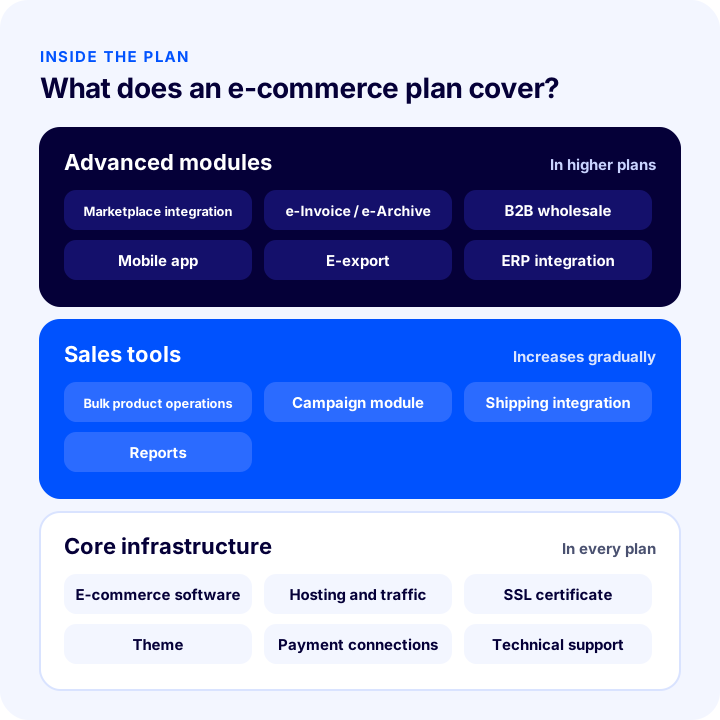
An e-commerce plan is a ready-made solution offered under a monthly or annual license that combines the e-commerce software needed to set up and run an online store with hosting, a security certificate, a theme, updates, and technical support. Plans are usually tiered by number of features: the entry plan includes core sales features, while higher plans include advanced features such as marketplace integration, e-Invoice, wholesale sales, a mobile app, and e-Export.
The biggest advantage of a ready-made e-commerce plan is being able to start selling quickly without dealing with software development and server management. Security, speed, and new features are the infrastructure provider's responsibility; you focus on products, customers, and sales.
We recommend readingE-Commerce Software Guide: What It Is, Why It Matters, and How to ChooseWhat Do E-Commerce Plans Cover?
An e-commerce plan generally consists of seven core components: e-commerce software and admin panel, hosting and traffic, a security certificate, theme and design, payment infrastructure connections, shipping connections, and technical support. The difference between plans lies in the integrations and modules added on top of this foundation.
| Component | What is it for? | Point to watch |
|---|---|---|
| E-commerce software and panel | Product, order, customer, and campaign management | Ease of use of the panel, bulk operation options |
| Hosting and traffic | The server the site runs on and monthly/annual data traffic | Traffic limit, performance on campaign days |
| SSL security certificate | Encrypted transmission of payment and personal data | Included in the plan or charged separately? |
| Theme and design | The look of the store | Mobile compatibility, adaptability to your own brand |
| Payment connections | Virtual POS, bank transfer, cash on delivery | Which banks and payment institutions you can work with |
| Shipping connections | Shipping record, barcode, and tracking | Whether you work manually or through integration |
| Technical support | Help with problems and questions | Support channels (phone, support ticket) and response time |
What to Look for When Choosing an E-Commerce Plan: 12 Criteria
When choosing an e-commerce plan, you should consider 12 criteria: number of products and bulk operation needs, sales channels and marketplace integration, invoicing, shipping, payment, wholesale sales, international sales, mobile app, SEO, traffic limit, support, and upgrade options. For each criterion, ask: "Do I need this today, or will I need it within a year?"
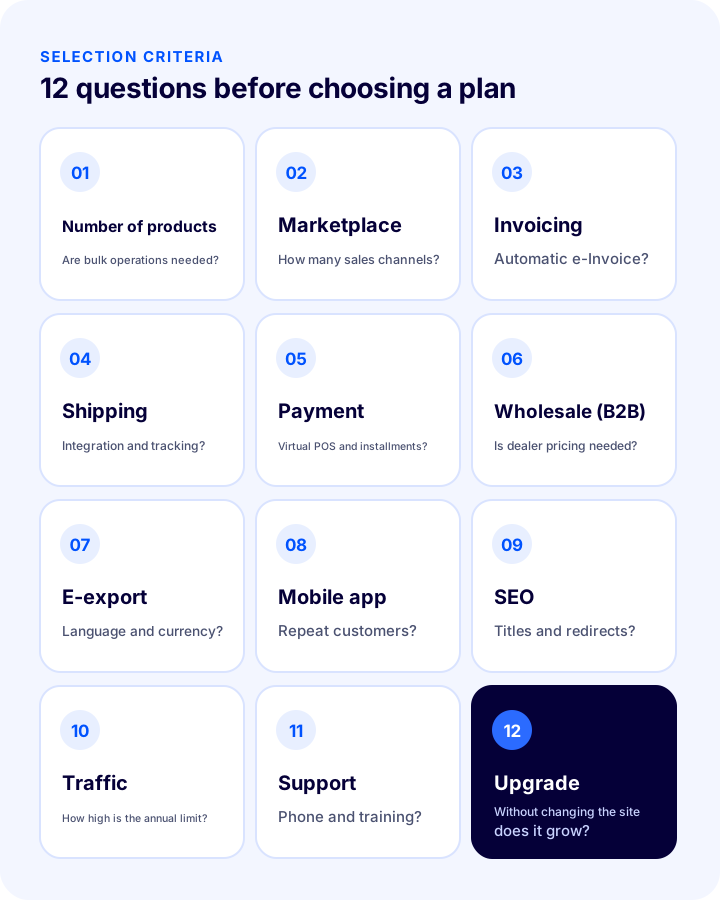
- Number of products and bulk operations: A few dozen products can be entered one by one; if you have hundreds or thousands of products, bulk product upload via Excel, bulk price and stock updates, and bulk image upload are essential.
- Sales channels and marketplace integration: If you already sell, or plan to sell, on marketplaces, look at how many marketplace integrations the plan includes and which marketplaces it supports. We cover this criterion separately below.
- Invoicing: If you receive more than a few orders a day, automatic e-Invoice / e-Archive issuing saves the hours spent issuing invoices by hand for each order.
- Shipping: Starting with a contracted carrier may be enough; as orders grow, direct integration with carriers, bulk barcodes, and a shipment tracking module become necessary.
- Payment: Check whether the virtual POS of the bank or payment institution you work with is supported, as well as installment and bank transfer options.
- Wholesale (B2B) sales: If you will sell to your dealers or corporate customers at special prices, you need a B2B module, customer groups, and tiered pricing.
- International sales (e-Export): If you need different languages, currencies, and country-based shipping, check which plan the e-Export module starts with.
- Mobile app: If you have many repeat customers, a mobile app under your own brand increases loyalty.
- SEO and marketing tools: Page titles and descriptions, URL structure, and redirects that can be managed from the panel; integration with analytics and advertising tools.
- Traffic and hosting limit: Ask about the plan's annual traffic limit and how the site performs on campaign days.
- Support: Check whether channels such as phone and support tickets are included in the plan, as well as setup and training support.
- Upgrade options: Being able to move up to a higher plan without changing sites protects you from the most expensive mistake: switching platforms.
How Does Marketplace Integration Affect Plan Selection?
Marketplace integration is the criterion that changes e-commerce plan selection the most: how many marketplaces you will sell on directly determines which plan you need. In a two-way marketplace integration, products are entered once and sent to the marketplaces, stock is updated on every channel at the same time, and marketplace orders are collected in a single panel.
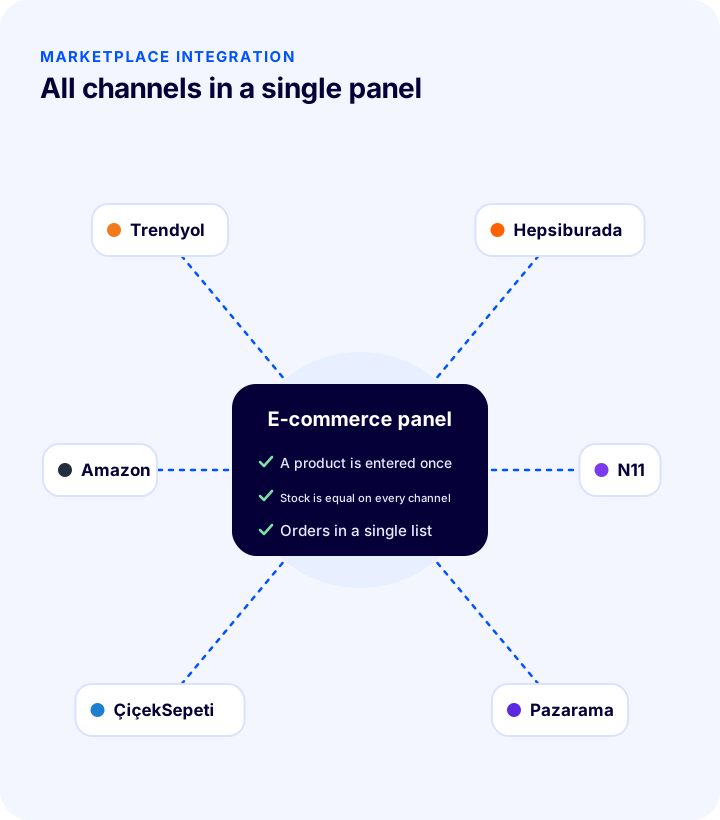
In an e-commerce plan with marketplace integration, the following tasks are automated:
- Product transfer: Products, variants, and images are entered once and sent to the selected marketplaces.
- Stock synchronization: When a product sells on one channel, its stock drops on the other channels too; the risk of selling the same product twice is reduced.
- Price management: Different price and commission rules can be defined per marketplace and updated in bulk.
- Order collection: All marketplace orders land in the same list as your own site's orders; invoicing and shipping are managed from the same place.
Which Marketplace Integration Comes in Which Plan?
In Faprika, marketplace integrations increase with the plan tier. The Ultimate plan includes 1 marketplace integration. The Elite plan includes 5 marketplace integrations (Trendyol, Hepsiburada, N11, Pazarama, and ÇiçekSepeti). The Premium Smart plan offers unlimited domestic marketplace integrations (Trendyol, Hepsiburada, PttAVM, Pazarama, ÇiçekSepeti, N11, A101, Koçtaş, İdefix, LC Waikiki, and Flo). In the Enterprise plan, marketplace integration is unlimited. Integrations for international marketplaces such as Amazon appear in the plan comparison table as additional (optional) integrations for the Ultimate and Elite plans.
| Your sales channel | Suitable option |
|---|---|
| Your own site only | Start, Master, or Ultimate (depending on your other needs) |
| Your own site + 1 marketplace | Ultimate |
| Your own site + a few major domestic marketplaces | Elite (5 marketplaces) |
| Your own site + many domestic marketplaces | Smart (unlimited domestic marketplaces) |
| International marketplaces and e-Export | Enterprise (unlimited marketplaces, e-Export module) |
| Marketplaces only, without a site | Marketplace Integration Plan |
There is also a separate option for businesses that do not yet have their own site and sell only on marketplaces: with the Marketplace Integration Plan, all marketplace integrations in Faprika (Trendyol, Hepsiburada, N11, Amazon, Ozon, AliExpress, Pazarama, PttAVM, ÇiçekSepeti, İdefix, Koçtaş, LC Waikiki, Modanisa, Flo, A101, and Temu) are managed from a single panel without needing a website; when you later open your own site from the same panel, your products are ready.
Okumanızı öneririzPazaryeri Entegrasyonu Nedir? Çift Yönlü Senkronizasyon RehberiAmazon Integration and International Marketplaces
Amazon integration lets you list your products in Amazon's stores in different countries and manage stock and orders from your e-commerce panel. Selling on international marketplaces brings extra work such as translating product information, currency pricing, international shipping, and return processes. So if you are targeting international marketplaces, look not only at whether the integration exists but also at the plan's e-Export capabilities (multiple languages, multiple currencies, country-based shipping). For details, see the Amazon integration and e-Export pages.
Okumanızı öneririzAmazon Entegrasyonu ve Ürün Stok TakibiWhich E-Commerce Plan Suits Your Business?
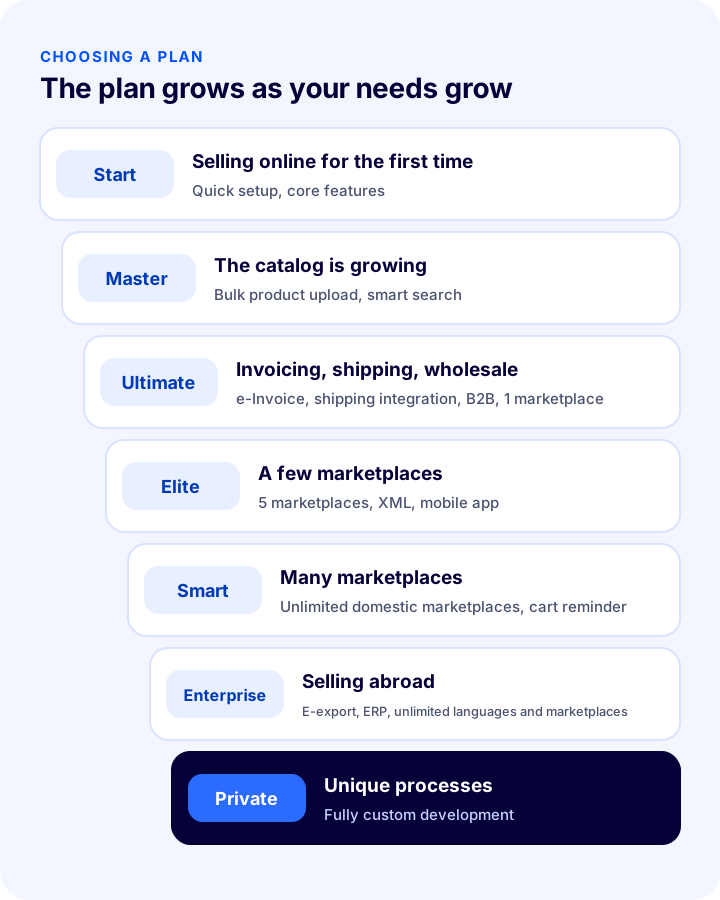
Which e-commerce plan is suitable depends on the size of the business, the number of products, the sales channels, and how much of the operation needs to be automated. The flow and table below offer a starting point for the most common business types.
| Business type | Key need | Recommended plan | Monthly (starting at) |
|---|---|---|---|
| Starting online sales for the first time | Quick setup, core sales features | Start | ₺1.650 |
| Product count growing fast | Bulk product upload and updates, smart search | Master | ₺2.240 |
| Invoicing and shipping done by hand, also selling wholesale | Automatic e-Invoice, shipping integration, B2B | Ultimate | ₺3.740 |
| Sells on a few marketplaces, many repeat customers | 5 marketplaces, XML, mobile app, return management | Elite | ₺5.333 |
| Sells on many domestic marketplaces | Unlimited domestic marketplaces, cart reminder, bulk SMS and email | Smart | ₺7.500 |
| Sells abroad, wants to integrate accounting | E-Export module, ERP integration, unlimited languages | Enterprise | ₺12.500 |
| Combines store, warehouse, and online sales | Omnichannel, warehouse management, custom design | Exclusive | ₺45.000 |
| Has business processes of its own | Fully custom development | Private | By quote |
Prices are the current campaign prices on the plan pages; for annual and multi-year payment options and campaign terms, see the e-commerce plans and premium e-commerce plans pages.
We recommend readingWhat Is B2B E-Commerce? How to Set Up a Wholesale SiteChoosing an E-Commerce Plan Through Example Scenarios
Let's see how the criteria are used in practice through three example businesses. The examples are fictional scenarios prepared so readers can compare them with their own situation.
Scenario 1: A Boutique Clothing Brand Opening Its First Store
Imagine a small boutique that now wants to collect the orders coming from social media on its own site: 80 products, a few orders a day, no marketplaces yet. The needs list is short: a theme adapted to its brand, payment by card and bank transfer, contracted shipping, campaigns and discount codes, size and color variants. The entry plan is enough for this business; it should put most of its budget into product photography and bringing in visitors. When the product count reaches a few hundred, moving up to the next plan for bulk product upload will be enough.
Scenario 2: A Home Textile Manufacturer That Also Sells to Dealers
Imagine a manufacturer that sells to consumers on its own site and also supplies 40 dealers wholesale: 1,200 products, dozens of orders a day, invoices and shipping records done by hand, and a store on Trendyol as well. This business's must-haves are automatic e-Invoice, shipping integration, bulk product updates, B2B sales, and 1 marketplace integration; all of these start in the Ultimate plan. If it plans to expand to Hepsiburada and N11 within a year, starting directly with the Elite plan, which has 5 marketplace integrations, makes more sense than changing plans later.
Scenario 3: A Cosmetics Brand That Wants to Go International
Imagine a cosmetics brand with a site based in Turkey and a few domestic marketplaces that now wants to expand to Europe and Amazon. Its needs list includes a multilingual store, currency pricing, country-based shipping, international marketplace integration, and integration with an accounting system. These needs point to the Enterprise plan, which includes the e-Export module, unlimited languages, unlimited marketplaces, and ERP integration. The brand also needs to research separately the sales rules for its cosmetic products in the target countries.
Ready-Made E-Commerce Plan or Custom E-Commerce Software?
A ready-made e-commerce plan is the right choice for the vast majority of businesses because of its quick setup, low starting cost, and the fact that security is handled by the infrastructure provider. Custom e-commerce software, on the other hand, suits large brands with business-specific processes that standard plans cannot meet.
| Ready-made e-commerce plan | Custom e-commerce software | |
|---|---|---|
| Setup time | Short | Long (design, development, testing) |
| Starting cost | Low, monthly or annual license | High, project budget |
| Updates and security | With the infrastructure provider | With you or the development team |
| New features | Come with the plan | Each developed separately |
| Flexibility | As much as the plan, add-on, and design options allow | Unlimited |
| Who is it for? | Beginners, SMEs, growing brands | Large businesses with processes of their own |
There are also options that combine both worlds: a business that starts with ready-made plans on Faprika can, as it grows, move to fully custom development with Faprika Private on the same software; there is no need to change platforms.
Recommended readingHow Much Does It Cost to Build an E-Commerce Site?How to Evaluate the Price of an E-Commerce Plan
The price of an e-commerce plan should be judged not by the monthly fee but by the total first-year cost with all the features you need. A plan that looks cheap can end up costing more than a higher plan once the missing features are bought separately.
- Calculate the annual total: Multiply the monthly price by 12; compare the annual and multi-year payment campaigns.
- List the extra-cost items: Add items such as integrations outside the plan (optional), e-Invoice credits, additional marketplaces, or extra design services to the total.
- Check what is included: See whether hosting, the SSL certificate, the theme, and technical support are included in the plan.
- Ask about the upgrade terms: Find out whether your data and design are preserved when you move to a higher plan.
- Request a demo: Before buying, see how you would use the panel with your own products; ask about setup and training support for your team.
For example, the annual prices of the Ultimate and Elite plans are ₺44,880 and ₺64,000 respectively. The main differences are four additional marketplace integrations, XML integration, the mobile app, and returns management. If you need each of these features, compare the cost of acquiring them separately and the time spent on manual work against the difference.
7 Common Mistakes When Choosing an E-Commerce Plan
- Looking only at the price: The cheapest plan can become the most expensive option once you pay extra for missing features.
- Thinking about today and forgetting tomorrow: If you plan to open up to marketplaces or switch to e-Invoice within a year, factor that in from the start.
- Paying for features you will not use: For a business with no plans to sell abroad, buying an e-export plan is an unnecessary cost.
- Miscounting marketplaces: List the marketplaces you sell on or plan to sell on; compare them with the plan's number of integrations and supported marketplaces.
- Not asking about traffic and performance: A site that slows down on campaign days makes you lose customers at the busiest sales moment.
- Not checking the upgrade path: Having to switch sites when you grow means losing design, data migration, and search engine rankings.
- Ignoring support and training: A team that doesn't know how to use the panel will never use the plan's best features.
What Every Faprika E-Commerce Plan Includes
The core infrastructure is ready in all Faprika e-commerce plans; the difference between plans lies in the modules and integrations added on top. All Professional plans include the following:
- SSL security certificate, unlimited web, database, and hosting; annual traffic from 2,000 GB on Start up to 5,000 GB on Elite
- Fast page loading with a content delivery network (CDN)
- Konsept theme options
- Instant virtual POS, virtual POS integrations with banks and payment institutions, bank transfer, and cash on delivery
- Campaign module: buy X pay for Y, discounts by cart total, shipping campaigns, gift vouchers, and reward points
- Revenue, profit / loss, product, category, and campaign reports
- Technical support by phone and support ticket
To compare all the features of the plans line by line, see the comparison table on the e-commerce plans page; for all marketplace integrations, see the marketplace add-ons page.
Frequently Asked Questions
What is an e-commerce plan?
An e-commerce plan is a ready-made solution in which the e-commerce software needed to set up and run an online store is offered under a monthly or annual license, together with hosting, an SSL certificate, a theme, updates, and technical support. Higher plans add advanced features such as marketplace integration, e-Invoice, wholesale sales, and e-export.
Which e-commerce plan should I choose?
If you are starting to sell for the first time, an entry plan fits; if your product count is growing quickly, a plan with bulk product operations; if you want to automate invoicing and shipping or sell wholesale, a plan with e-Invoice, shipping, and B2B; and if you sell on several marketplaces, a plan with multi-marketplace integration. First write down your needs and compare the plans against that list.
Which e-commerce plan includes marketplace integration?
In Faprika, the Ultimate plan includes 1 marketplace integration and the Elite plan 5. The Smart plan includes unlimited integration with domestic marketplaces, and the Enterprise plan includes unlimited marketplace integration. For those who sell only on marketplaces without a site, there is also a separate Marketplace Integration Plan.
How is Amazon integration done?
The Amazon integration is set up by entering your Amazon seller account's API details into the e-commerce panel. Products are then sent to Amazon, stock and prices are updated from the panel, and Amazon orders land in the same list as your other orders. For selling abroad, product translation, foreign-currency pricing, and international shipping should also be planned.
Which is better, a ready-made e-commerce plan or custom software?
For new and growing businesses, a ready-made e-commerce plan is more suitable because of its low starting cost, fast setup, and the fact that security is handled by the provider. For large businesses with unique processes, custom e-commerce software is preferred.
Can I upgrade my e-commerce plan later?
Faprika plans are tiers of the same infrastructure; each plan includes all the features of the one before it. So moving to a higher plan as your needs grow does not mean changing sites. When choosing a plan, be sure to ask about this upgrade option; changing platforms is costly in terms of data transfer and search engine ranking.