Contents 17 sections
- Is No-Capital E-Commerce Possible?
- What Are the 7 Ways to Do No-Capital E-Commerce?
- What Are the Advantages and Disadvantages of No-Capital E-Commerce?
- Which No-Capital E-Commerce Model Should You Choose?
- What Should You Do in the First 30 Days on a Near-Zero Budget?
- Which Free or Low-Cost Tools Can You Use When Starting Without Capital?
- How Do You Choose the First Product for No-Capital E-Commerce?
- What Is a Realistic Expectation in No-Capital E-Commerce?
- How Do You Find Your First Customer When Starting Without Capital?
- How Do You Build Customer Trust in a No-Capital Store?
- Which Resources Can You Use Instead of Capital?
- How Is Profit Calculated in No-Capital E-Commerce?
- What Are the Common Mistakes and Pitfalls to Watch For in No-Capital E-Commerce?
- What Is the Legal Situation in No-Capital E-Commerce?
- How Do You Grow Your E-Commerce as Capital Builds Up?
- A Low-Cost Start with Faprika
- Frequently Asked Questions
How to Do e-commerce Without Capital The honest answer: building a sustainable e-commerce business with literally zero lira is hard, but it is possible to keep the initial investment very small. Selling without holding stock, working with pre-orders, turning your own labor into a product or selling digital products are the main ways to start e-commerce without setting aside a large budget.
In this guide we explain what "capital" covers in e-commerce, how you can reduce each cost to zero or close to it, the seven ways to start without capital, how to choose among them, and what to do in the first 30 days with a near-zero budget, step by step. We have also added warnings about schemes that promise to "get rich with no investment at all."
Is E-Commerce Without Capital Possible?
E-commerce without capital means selling without making a large upfront investment; it does not mean having no costs at all. E-commerce has four main cost items: stock, infrastructure, advertising and operations. There is a way to shrink each of them:
| Expense item | How to reduce it? | Point to watch |
|---|---|---|
| Stock | Selling without stock, pre-orders, made-to-order production | Delivery and quality depend on the supplier or on your own labor |
| Infrastructure (website) | A low-cost ready-made e-commerce plan, a marketplace store or a social media storefront | There is a monthly fee or commission; the system may become insufficient as orders grow |
| Advertising | Organic content, search engines and free methods on social media | Results come slowly; it takes time and effort |
| Business | A sole proprietorship on a small scale, or an arrangement permitted by legislation | Legal obligations begin once you sell regularly; talk to an accountant |
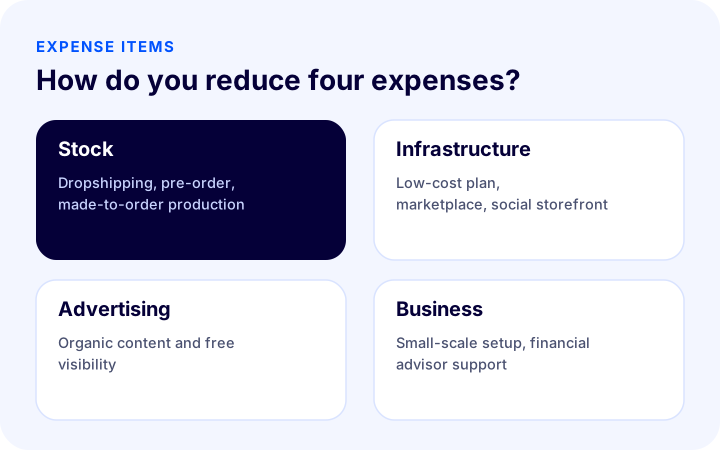
In other words, you are not eliminating capital; you are converting it into time, effort and a supplier who shares the risk. The upside of this conversion is that your first mistake does not cost you a great deal; the downside is that the result depends on your discipline and steady work. That is why, in the early days, you should focus less on finding a product and more on finding a product that leaves a profit and can be proven to sell.
Recommended readingHow Is E-Commerce Done? Step-by-Step Guide to Building an E-Commerce SiteWhat Are the 7 Ways to Do E-Commerce Without Capital?
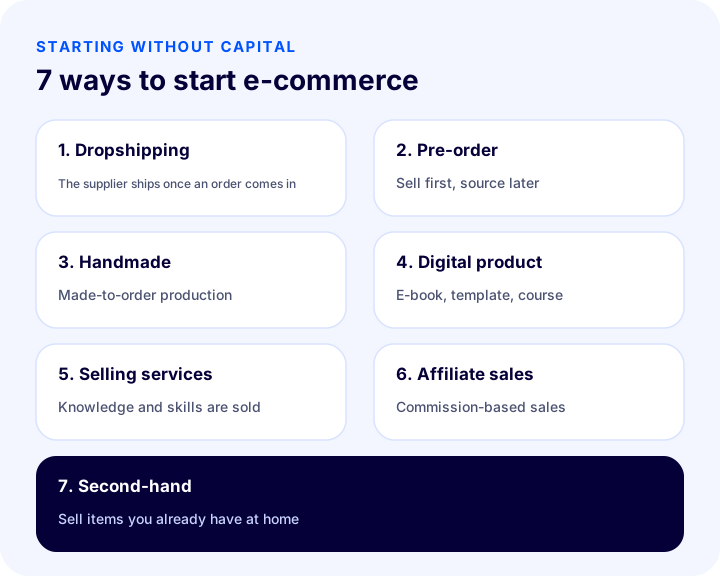
There are seven basic models you can start with little or no capital. Each has different risks and rewards; none of them should be started without working out the product, the customer and the profit.
1. Selling Without Stock (Dropshipping)
In selling without stock you do not buy the product; when a customer places an order, you pass it on to the supplier, and the supplier ships the product to the customer. You set the price, manage the storefront and handle customer communication.
- How to start: Find a reliable supplier with stock, bring the product information and stock into your site or marketplace, and set the selling price together with the supply cost and expenses.
- Advantage: There is no stock cost and no storage.
- Risk: The profit margin is thin; stock, quality and delivery time depend on the supplier; customer complaints come to you.
2. Selling by Pre-Order
With pre-orders you sell the product first and source or produce it once orders have been collected. You must state the delivery time clearly to the customer from the start.
- How to start: Prepare the design or a sample of the product, take orders with an image and a description, and source or produce once enough orders have been collected.
- Advantage: The risk of unsold stock is reduced; demand is measured in advance.
- Risk: If delivery is delayed, customer trust suffers; you need to calculate the sourcing time and cost carefully.
3. Handmade and Made-to-Order Production
If you turn your manual skills into a product, you need no large investment beyond raw materials. If you produce to order, you do not hold stock either.
- How to start: Start with a few sample products, take good photos of them, offer personalization options and produce to order.
- Advantage: Original products, differentiation from competitors and a high profit margin.
- Risk: Your production capacity is limited; as orders increase, you may run out of time.
4. Selling Digital Products
With digital products such as an e-book, a template, an online course or a design file, there is no stock and no shipping. You can sell a product you prepare once over and over.
- How to start: Turn your expertise or skill into a file, show a sample section, take payment and grant access to the file automatically.
- Advantage: There is no stock or shipping cost, and it is easy to scale.
- Risk: Preparing the product takes time; there is a risk of copying and a trust issue.
5. Selling Services
Selling services such as design, translation, writing, consulting and training over the internet removes the need for product stock. Your starting capital is your knowledge and your time.
- How to start: Package your service (what it includes, how long it takes), show sample work, and take appointments and payment.
- Advantage: Low cost and a quick start.
- Risk: Income is limited by your time; you need a team to grow.
6. Affiliate Marketing (Commission-Based Sales)
In affiliate marketing you promote someone else's product and earn a commission on sales that come through your link. Stock, shipping and customer service stay with the product owner.
- How to start: Choose products that suit your own audience, create honest content and direct people with a tracking link.
- Advantage: There is almost no investment.
- Risk: Earnings depend on the commission and the size of your audience; the quality of the product affects your reputation.
7. Selling Second-Hand and Household Items
Selling items you no longer use is one of the simplest ways to build your first capital. Classified ad sites and marketplaces can be used for this.
- How to start: Take clear photos of the items, write an honest description, set a reasonable price, and choose a secure payment and delivery method.
- Advantage: It requires no investment and gives quick results.
- Risk: It is not a sustainable business; when your stock of items runs out, the income ends.
What Are the Advantages and Disadvantages of E-Commerce Without Capital?
Starting without capital lowers the risk, but you pay the price of every model with time and effort. Before deciding, look at the pros and cons together:
| Advantages | Disadvantages |
|---|---|
| Low starting risk; little money can be lost | The profit margin is generally thin, and growth takes time |
| The chance to start quickly and test the market | Delivery and quality are mostly in someone else's hands |
| Little burden of stock and warehousing | Customer complaints mostly come back to you |
| The chance to grow by learning and to reinvest income | The result depends on disciplined, regular work |
Which E-Commerce Model Without Capital Should You Choose?
The right model depends on your skills, your time and your risk tolerance. The table below compares the models in broad terms; the criteria are general assessments, not hard rules.
| Model | Starting cost | Profit potential | Speed | Main risk |
|---|---|---|---|---|
| Dropshipping | Low | Medium-low | Fast | Delivery and quality rest with the supplier |
| Pre-order sales | Low | Medium | Medium | Delivery time and trust |
| Handmade production | Low-medium | High | Medium | Capacity limit |
| Digital product | Low | High | Slow (preparation) | Preparation time, copying |
| Selling services | Very low | Medium | Fast | Income tied to time |
| Affiliate marketing | Very low | Low-medium | Slow (building an audience) | Dependence on commission and audience |
| Second-hand sales | Very low | Low | Fast | Not sustainable |
What Should You Do in the First 30 Days with a Near-Zero Budget?
Dividing the first month into four weeks keeps you focused and makes clear when you need to make decisions.
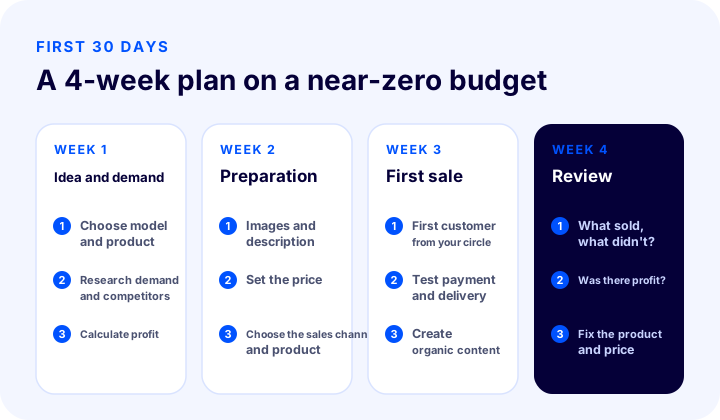
- Week 1: Idea and demand. Choose a model and a product, research search terms and competitors, and work out the profit.
- Week 2: Preparation. Prepare the brand name, product images, description and price; decide on the sales channel (a social media storefront, a marketplace or a low-cost e-commerce plan).
- Week 3: First sale. Find your first customers through your circle and organic content; test the payment and delivery flow.
- Week 4: Evaluation. Answer the questions: what sold, what did not, was there profit left? Adjust the product and the price based on feedback.
If there are still no sales at the end of the fourth week, do not give up; first find the cause: the product, the price, the customer or the channel? Change a single variable and try again.
Okumanızı öneririzEvden E-Ticaret Nasıl Yapılır?Which Free or Low-Cost Tools Can You Use When Starting Without Capital?
You do not need expensive tools in the early period. Free or low-cost solutions in the following categories are often enough:
- Image editing: Take clean product photos with a phone camera and free image-editing tools; good lighting often matters more than expensive equipment.
- Sales storefront: Showcase your products with a social media account, a marketplace store or a low-cost e-commerce plan.
- Receiving payments: To begin with, you can use bank transfer, payment links or a payment-institution solution suited to small businesses.
- Customer communication: Start with a messaging app and email; add a customer support tool as orders increase.
- Content and announcements: Short videos and posts that show the product in use provide free visibility.
- Calculation: You can use our free calculation tools for profit and desi calculations.
How Do You Choose the First Product for E-Commerce Without Capital?
If your capital is limited, you have no room for trial and error; so choose the first product as a test rather than as an idea. Make sure a good first product has the following qualities:
- It solves a clear problem: The customer understands at first glance why they should buy the product.
- It is small, light and sturdy: Shipping cost is low, and the risk of breakage and returns is small.
- The profit margin is sufficient: The profit left after shipping, commission and returns is worth your effort.
- Demand is evident: People regularly search for the product or the problem it solves.
- Sourcing is easy: There is a source from which you can obtain the product reliably and repeatedly.
- There is room to stand out: You can differentiate yourself from competitors through a niche audience, personalization or service.
Before deciding on the first product, read the reviews on competitors' product pages; fixing the shortcomings customers complain about may be your first opportunity to set yourself apart from others selling the same product.
Recommended readingE-Commerce Business Ideas: Start with Low CapitalWhat Is a Realistic Expectation for E-Commerce Without Capital?
E-commerce without capital is not a path to quick riches; it is a path of starting small and growing by learning. In the first weeks the number of sales may be low; what matters is making the first sale, collecting customer feedback and verifying the profit calculation. Growth usually comes from a combination of three things: the right product, consistent work and improvement driven by measurement. Rather than spending income in the first months, reinvesting part of it in stock, product range and infrastructure is the safest way to turn your business into one with capital.
How Do You Find Your First Customer When Starting Without Capital?
If you have no advertising budget, you use your time and creativity to find customers. The first customers usually come from the following sources:
- Your close circle: Show the product to friends, family and acquaintances; the first review and the first sale often come from here. Ask those who like it for a recommendation and a review with photos.
- Content on social media: Short videos that show the product in use, before-and-after images and the product story provide organic visibility. Regular posting is more lasting than a one-off ad.
- Communities and groups: Share useful information in the communities where your target audience is; focus on helping rather than selling directly.
- Search within the marketplace: If you sell on a marketplace, write the product title and description around the words people search for; you benefit from the platform's ready-made traffic.
- Search engine: Prepare product and blog content on your own site and build up organic traffic over time.
- Small collaborations: Promote each other with small brands that address the same audience but are not your competitors.
Note down the number of first customers coming from each channel; devote your time to whichever channel brings customers more cheaply and faster.
How Do You Build Customer Trust for a Store Without Capital?
The biggest challenge for a new and unknown store is trust. Even without a large advertising budget, you can build trust with these concrete steps:
- State your contact details clearly: Make your phone number, email and (if any) address visible.
- Specify return and delivery terms clearly: Make the delivery time and the return method readable before ordering.
- Use real photos: Images you took yourself, rather than someone else's photos, inspire trust.
- Show customer reviews: With the permission of your first customers, share their reviews and photos.
- Use secure payment: Prefer well-known and secure payment methods.
- Communicate quickly and openly: Answering questions quickly is a small store's strongest advantage.
Which Resources Can You Use Instead of Capital?
There are three valuable resources you can use instead of money: time, knowledge and your network. Devote your time to creating content, answering customer questions and developing the product. If you have knowledge or skill, turn it into a service or a digital product. See the people around you (friends, family, community) as your source of first customers and first recommendations; however, relying only on acquaintances is not sustainable, so use them as a first step and then move on to customers you do not know.
Manage time as capital too: prepare daily and weekly task lists, prioritize the work that brings the most results (usually talking to customers and selling), and turn repetitive tasks such as the product and the storefront into templates.
How Is Profit Calculated in E-Commerce Without Capital?
If you are starting without capital, every lira counts, so you should calculate your profit from day one. The rule is simple: subtract the product cost, shipping, payment or marketplace commission, returns allowance and (if any) advertising from the selling price. What remains is your net profit.
A hypothetical example to show the method: you buy a product from a supplier for 100 lira and sell it for 180 lira. Shipping is 30, commission or payment cost is 15, and the returns allowance is 5 lira. Net profit: 180 − (100 + 30 + 15 + 5) = 30 lira. If your advertising spend is higher than these 30 lira, you lose money with every sale. The figures are only an example; calculate the real costs of your own product.
Recommended readingHow Much Does It Cost to Build an E-Commerce Site? Cost GuideWhat Are the Common Mistakes and Pitfalls to Watch Out for in Zero-Capital E-Commerce?
- Believing "easy money with no investment" promises: Be careful with courses, systems or memberships that promise big earnings and ask for an upfront payment. Real e-commerce takes effort and time.
- Not calculating profit: Selling a product that leaves no profit once shipping, commission and returns are deducted.
- Working with an unreliable supplier: In dropshipping, the supplier's stock, quality and delivery directly determine your reputation. Place a small trial order first.
- Hiding the delivery time: Not stating the real delivery time clearly in pre-order and dropshipping sales leads to complaints and returns.
- Ignoring legal obligations: Once you sell regularly, business registration, tax and invoicing obligations may begin.
- Infringing copyright and trademark rights: Using someone else's images, product name or registered trademark without permission causes problems.
- Trying too many things at once: Testing several models with limited time means you cannot develop any of them enough.
What Is the Legal Situation for Zero-Capital E-Commerce?
There is a legal difference between small-scale, irregular selling and regular, commercial selling. If you sell regularly and for profit, a business registration, tax liability and invoicing obligations generally come into play. Marketplaces also require a business document from sellers. Because the line between one-off sales of personal items and commercial activity, and the current exemptions, can change from period to period, we recommend consulting a certified accountant before you start.
Okumanızı öneririzŞirket Kurmadan E-Ticaret Yapılır mı? Okumanızı öneririzE-Ticaret Sitesi Açmak İçin Gerekli BelgelerHow Do You Grow Your E-Commerce as Capital Builds Up?
As the first sales and revenue come in, investing in the following order keeps your risk low:
- Multiply the product that works: Increase the variants and stock of the product that sells; drop the one that does not.
- Set up your own e-commerce site: Reduce your dependence on the marketplace or social network, and tie customer data and the brand to yourself.
- Automate the infrastructure: Manage stock, order, shipping and invoice processes with software; errors decrease as orders grow.
- Invest in advertising: Set aside a measured advertising budget for products you know are profitable.
- Add new channels: Sell on multiple marketplaces and, if needed, expand into overseas markets.
A Low-Cost Start with Faprika
Faprika works with ready-made plans for those who want to start e-commerce at low cost: a mobile-friendly store, payment and shipping integrations, e-Invoice and e-Archive, and marketplace management all come in a single panel. Features such as dropshipping are offered depending on the plan. You can review which plan suits your starting needs on the e-commerce plans page and talk to our expert.
Frequently Asked Questions
How do you do zero-capital e-commerce?
To start e-commerce without a large upfront investment, you can use models such as dropshipping, pre-order sales, handmade and made-to-order production, digital products, selling services or affiliate marketing. First validate demand and profit margin, then start with a small trial sale.
Can you do e-commerce with no money at all?
Building a sustainable business at completely zero cost is difficult; however, it is possible to cut the initial investment very low. Time, effort and knowledge are used instead of capital; expenses such as infrastructure, operations and advertising can be covered with small starting fees.
What do you sell in zero-capital e-commerce?
With dropshipping you can sell supplier products; with pre-orders and made-to-order production, handmade products; and you can also sell digital products (e-books, templates, courses), services and second-hand items. When choosing, look at demand, profit margin and ease of delivery.
Is zero-capital e-commerce reliable?
As a model it is reliable; however, offers that promise "easy earnings with no investment" and ask you for an upfront payment are generally risky. Work with trustworthy suppliers, do the profit calculation yourself and meet your legal obligations.
When do you start earning if you start without capital?
The time varies with the product, the channel and your effort. It may be faster with services and second-hand sales, and slower with digital products and affiliate sales. That is why you should plan the first month as a period of measuring and adjusting.
Do you need to set up a company for zero-capital e-commerce?
If you sell regularly and for profit, a business registration and tax obligations generally come into play. The situation may differ for small, irregular sales; before you start, we recommend consulting a financial advisor.