
Contents 22 sections
- What Are E-Commerce Business Ideas?
- How to Choose a Good E-Commerce Business Idea
- Which Business Ideas Stand Out in Physical Product Sales?
- What Do the Easiest-Selling Products in E-Commerce Have in Common?
- What Are the E-Commerce Ideas You Can Start with Low Capital?
- Which Business Ideas Exist in Digital Products and Services?
- Which Idea Should You Choose If You Have Several?
- How to Find a Niche E-Commerce Idea
- How Do You Validate an E-Commerce Idea Before Turning It into Sales?
- How Do You Write a Customer Profile (Persona) in E-Commerce?
- Which E-Commerce Ideas Suit Selling Abroad?
- Which Products Require Care When Selling Online?
- Which Ideas Suit Selling Through Social Networks?
- Which Channel Should You Sell Your Idea Through?
- What Is the Roadmap for Bringing an E-Commerce Idea to Life?
- How Do You Price Your E-Commerce Idea?
- How Do Seasonality and Repeat Sales Affect an E-Commerce Idea?
- How Do You Stand Out from Competitors?
- What Should You Do in the First 30 Days?
- What Are Common Mistakes When Choosing an E-Commerce Idea?
- Turn Your E-Commerce Idea into Sales with Faprika
- Frequently Asked Questions
The real question of entrepreneurs searching for e-commerce business ideas is: “What should I sell to make money?” In this guide we cover physical product, digital product and service ideas you can start with low capital; how to tell whether an idea is good for e-commerce; the steps to turn an idea into sales; and common mistakes.
Let us say this up front: there is no “single product everyone makes money from.” What makes money is less the product itself than the fit between product, customer and channel. So as you read the list, ask “would this suit me?” and then test each idea against the criteria below.
What Are E-Commerce Business Ideas?
E-commerce business ideas cover physical products, digital products and services that can be sold over the internet. They fall into three main groups:
- Physical product sales: Products shipped by carrier, such as apparel, cosmetics, home and living, pets, sports and outdoor, baby and kids, food and handmade products.
- Digital product sales: Products that need no stock or shipping, such as e-books, online courses, templates, software licenses and subscriptions.
- Service sales: Services bought over the internet, such as consulting, design, training and reservations.
Whichever group you start from, the sales process is similar: a product page, payment, delivery (file access for digital products) and customer service.
We recommend readingE-Commerce Explained: Types, Advantages and How to StartHow to Choose a Good E-Commerce Business Idea
A good idea gets a yes to five questions: is there demand, is there profit left, how will I find customers, how will I deliver the product, and how will I stand out from competitors? Scoring ideas against these questions is far more reliable than choosing by instinct.
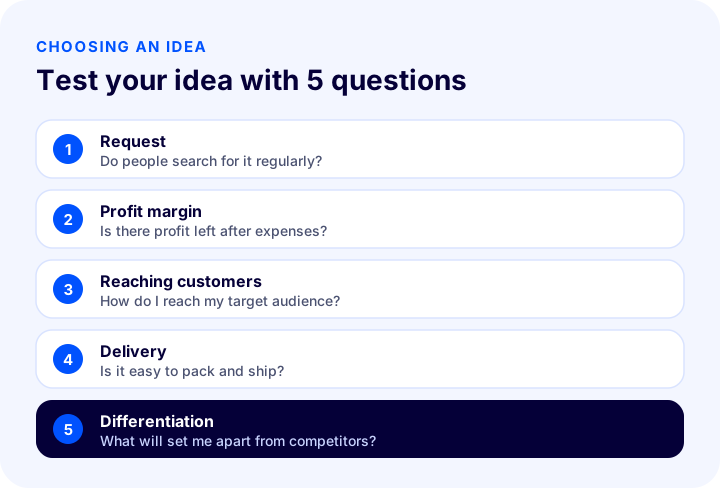
| Criterion | Question to ask | How to test it |
|---|---|---|
| Request | Do people search for this product regularly? | Look at search terms; examine competitors’ reviews and sales counts |
| Profit margin | Is there profit left after all expenses? | Calculate cost, shipping, commission, returns and advertising |
| Reaching customers | How do I reach my target audience? | Research which searches, social networks and marketplaces it can be found on |
| Delivery | Can the product be packed and shipped easily? | Look at size, weight, fragility and return rate |
| Differentiation | What will set me apart from competitors? | Find a niche, brand, service, packaging or advantage other than price |
Which Business Ideas Stand Out in Physical Product Sales?
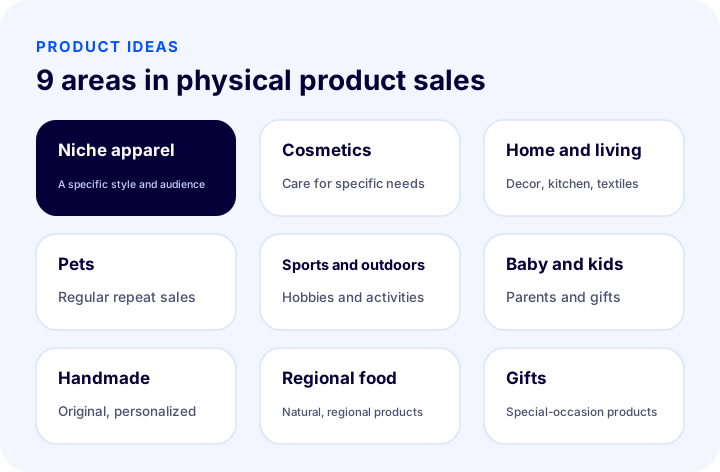
Selling physical products is the most common route in e-commerce. The winners are usually not stores that "sell everything" but niches that solve a specific need for a specific audience. The ideas below are only starting points; you need to narrow each one down to your own niche.
| Idea | Who is it sold to? | Point to watch |
|---|---|---|
| Niche clothing and accessories | A specific style or audience (plus size, modest wear, sportswear) | Size-related returns tend to be high; state the size chart and return conditions clearly |
| Cosmetics and personal care | People looking for products suited to their skin type or specific need | Compliance with product safety and labeling regulations is important |
| Home decor and lifestyle | People who have just moved or are setting up a home | For fragile and bulky products, shipping costs can eat into profit |
| Pet products | Pet owners | Repeat purchases are high; a subscription can be considered |
| Sports, outdoor and hobbies | People interested in a particular sport or hobby | Seasonality and product knowledge matter |
| Baby and children's products | Parents and gift buyers | Safety and certification information builds trust |
| Handmade and boutique products | People looking for original, personalized products | Production capacity and delivery time are limited |
| Regional and food products | People looking for natural, regional products | Food regulations, shelf life and packaging are mandatory |
| Auto spare parts and accessories | Vehicle owners | Compatibility (make, model) information is critical; return risk is high |
| Gifts and personalized products | People looking for a gift for a special occasion | Demand peaks on special occasions, so plan your stock |
What Do the Easiest-Selling Products in E-Commerce Have in Common?
The "easiest-selling product" is not a single product but products that have certain characteristics. You can assess whether a product will sell easily online by looking at the following traits:
- It answers a clear need: When customers search for the product, you don't have to explain what it is for.
- It has steady demand: It is searched for year-round or in predictable periods, and can be bought repeatedly.
- Its price is high enough to leave a profit and reasonable enough to reduce objections: With very cheap products, shipping and commission eat the profit; with very expensive ones, trust concerns grow.
- It is light, sturdy and easy to pack: Shipping costs are low, and the risk of damage and returns is small.
- It is easy to compare and explain: The customer can decide with an image and a few lines of information.
- It works as a gift or an impulse purchase: Products bought on special occasions and at first sight increase conversion.
- It leaves room to stand out from competitors: You can make a difference through a niche, brand, personalization or service.
Products that have most of these traits are the ones that reach a first sale fastest. Products that lack them run into problems with either profit margin or operational load, so instead of relying solely on "it sells a lot", test the product against this list.
What Are Some Low-Capital E-Commerce Ideas?
If you don't have large capital, you don't have to give up on e-commerce; there are models that reduce risk and the initial investment:
- Dropshipping: You sell without holding stock, passing the order to the supplier when it arrives. There is no stock cost, but delivery and quality depend on the supplier.
- Pre-order sales: You sell the product first, then produce or source it after orders are collected. The risk of being stuck with stock decreases.
- Small-batch and handmade production: You make a small number of products with your own labor and grow according to demand.
- Digital products: With e-books, templates and courses, there is no stock or shipping; you prepare once and sell many times.
- Working with suppliers: You bring the supplier's product information and stock into your site; your product range builds up quickly.
With all of these models, it is essential to do the price and profit calculation up front; in dropshipping, the profit margin is usually narrow.
Okumanızı öneririzStoksuz E-Ticaret Nedir? Nasıl Yapılır? Okumanızı öneririzEvden E-Ticaret Nasıl Yapılır?What Business Ideas Exist in Digital Products and Services?
Digital products and services are sold without the hassle of stock, warehousing and shipping. If you have knowledge or talent, you can turn them into a product:
- E-books and guides: Turn your area of expertise into a file and sell it as a download.
- Online courses and training: Package a skill with video and materials.
- Templates and design files: Presentations, documents, graphics or website templates.
- Subscription service: Regular content, a product box or a membership.
- Consulting and services: Make an appointment-based or project-based service purchasable online.
With digital products, brand trust and the quality of the content come first; showing a sample before purchase increases conversion.
If You Have Multiple Ideas, How Do You Choose?
If you have three or five ideas, score them all against the same criteria. Give each criterion a score from 1 to 5 and compare the totals. The table below is a hypothetical example prepared only to show the method:
| Criterion | Idea A (niche cosmetics) | Idea B (plus-size clothing) | Idea C (bulky home product) |
|---|---|---|---|
| Request | 4 | 5 | 3 |
| Profit margin | 4 | 3 | 2 |
| Reaching customers | 3 | 4 | 3 |
| Ease of delivery | 5 | 4 | 2 |
| Differentiation | 3 | 4 | 3 |
| Total | 19 | 20 | 13 |
In this example, A and B scored close to each other; when making the final decision, also factor in your own knowledge, your sourcing options and your interest. C was eliminated because it is weak on shipping and profit. Scores vary by person and market; what matters is putting the ideas on the same scale.
How Do You Find a Niche E-Commerce Idea?
A niche is an area that appeals to a narrower but clearer group of customers. You find it where competition is low and customers struggle to find what they are looking for. You can use the following methods to find a niche:
- Look at complaints: Complaints that recur in the reviews of existing products point to an unmet need.
- Examine search terms: Look at topics people search for, such as "where to find …" or "… recommendation", that return few results.
- Start from your own experience: A problem you have experienced is probably someone else's problem too.
- Combine two interests: Intersections such as sports and babies, or pets and travel, are less crowded.
- Separate a trend from a lasting need: Don't confuse a short-lived fad with a need that will last a long time.
How Do You Validate an E-Commerce Idea Before Turning It into Sales?
Validating an idea means testing demand and profit in small steps before making a large investment. It can be done in five steps:
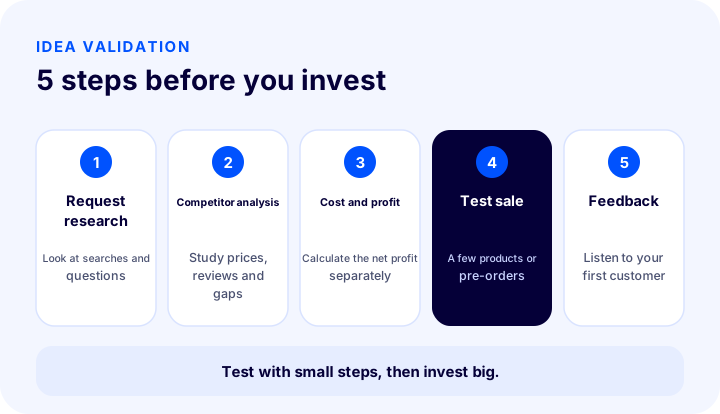
- Demand research: Look at the search terms and question patterns related to the product.
- Competitor analysis: Read competitors' product pages, prices and reviews; note their shortcomings.
- Cost and profit calculation: Calculate your net profit including shipping, commission, returns and advertising.
- Small trial sale: Test real sales with a few products, pre-orders or a small ad.
- Feedback: Get opinions on the product, price and delivery from your first customers, and adjust the idea accordingly.
How Do You Write a Customer Profile (Persona) in E-Commerce?
A customer profile means describing the person who will buy your product as if they were a concrete individual. A broad definition such as "women aged 25–40" is not enough to decide on advertising, product descriptions and pricing. Write a short profile that answers these questions: Who is this person, and how does their day go? What problem do they have, and how does your product solve it? How do they make a purchase decision (price, reviews, brand)? Which channels do they spend time on? What reservations keep them from buying (trust, shipping, returns)?
As the profile becomes clearer, so does which information to highlight on the product page, which message to use in ads and which channel to be on. If you have more than one type of customer, start with the one with the greatest potential.
Which E-Commerce Ideas Are Suitable for Selling Abroad?
Selling abroad is a new growth path for products facing intense competition in the domestic market. Handmade, regional, original-design and Türkiye-specific products in particular can offer a point of differentiation for international buyers. Small-volume, light and easily packed products are also more suitable in terms of shipping costs and customs procedures. Selling abroad requires extra preparation on language, currency, shipping and documentation; for this reason, it is generally healthier to first set up a working operation at home and then expand abroad.
Okumanızı öneririzE-İhracat Nedir? E-İhracat Nasıl Yapılır?Which Products Should You Be Careful About When Selling Online?
Not every product can be sold freely online. The online sale of some product groups may be restricted by legislation or subject to special permission, and others are restricted by marketplaces' own rules. In areas such as food, cosmetics, medicines and health products, children's products and electronic devices, there may be requirements for documents, certificates and labels. Before investing in an idea, check the current regulations on the online sale of the product and the rules of the platform you will sell on; if necessary, seek advice from a financial advisor or the relevant authority.
Which Ideas Are Suitable for Selling Through Social Networks?
Products that are visually striking, have a story to tell, and work as gifts or impulse purchases do well on social networks: boutique clothing and accessories, handmade products, decoration, cosmetics, personalized gifts and regional delicacies come first among them. Social networks are strong for building trust and community; however, as the number of orders grows, taking orders by message makes it harder to track stock and invoices. At this point, using social networks as a storefront and your e-commerce site as the center for orders, payments, stock and invoices provides a sustainable setup.
Okumanızı öneririzSosyal Ağdan E-Ticaret Nasıl Yapılır?Which Channel Should You Sell Your Idea Through?
Once the idea is clear, you choose a sales channel. There are three main routes: your own e-commerce site, marketplaces and social networks. Your own site leaves your brand and customer data with you; marketplaces offer ready-made traffic; social networks build trust and community. Most businesses use two or all three together; in that case, managing stock and orders from one place reduces the risk of errors.
Okumanızı öneririzPazaryeri Entegrasyonu Nedir?What Is the Roadmap for Putting an E-Commerce Idea into Action?
Once the idea has been chosen and validated, it is time for execution. In short: set up your business, decide on your brand and domain name, choose an e-commerce infrastructure, upload your products, make payment and shipping agreements, prepare e-Invoice and the legal pages, then attract your first customers through channels and advertising. For the details of these steps, see the guide explaining how to do e-commerce.
Recommended readingHow Is E-Commerce Done? Step-by-Step Guide to Building an E-Commerce SiteAs for government and institutional support and incentives: these vary from period to period and by type of business. For current conditions, we recommend following the announcements published by the relevant institutions and consulting your financial advisor.
How Do You Price Your E-Commerce Idea?
Price determines both the customer's perception and your profit. A very low price leaves no profit and raises doubts about the product's quality; a very high price leaves you behind competitors. Set the price in three steps:
- Work out the cost: Add up product cost, packaging, shipping, payment and marketplace commission, the returns allowance and advertising expenses.
- Set your target profit margin: Decide how much profit you need to add on top of cost for your business to be sustainable.
- Compare with the market: Look at the price range of similar products; if you have a difference (niche, quality, service), reflect it in the price.
After setting the price, make sure campaigns and discounts do not eat into profit. You can try out different price scenarios with the free profit margin calculator.
How Do Seasonality and Repeat Sales Affect an E-Commerce Idea?
Some products see intense demand at certain times of the year (gifts, seasonal clothing, school-season products); others sell steadily all year (pet food, personal care, consumables). With seasonal products, you need to plan your stock and advertising by season. With steadily selling products, repeat purchases and subscriptions lower the cost of acquiring customers over time. When choosing an idea, consider which of these two structures it is closer to, and plan your cash flow accordingly.
How Can You Stand Out from Competitors?
When many stores sell the same product, competing on price alone is not sustainable. Consider the following ways to stand out:
- Niche and expertise: Focus on a specific audience or use; build trust with product knowledge and content.
- Brand and story: Tell why your brand exists and what it does differently.
- Service and experience: Fast delivery, easy returns, personalized packaging and quick customer communication.
- Product set and information: Present the product not on its own but together with products to be used alongside it and a usage guide.
- Custom production or personalization: Create an offer different from competitors by providing name, color or size options.
What Should You Do in the First 30 Days?
After choosing the idea, the first month should be divided into fast, measurable steps: in the first week, validate the idea and calculate costs; in the second week, make decisions on the business, domain name and infrastructure; in the third week, prepare the products and the payment and shipping setup; in the fourth week, run the first trial sale and collect feedback. At the end of each week, write down what worked and update the next week's plan accordingly.
What Are Common Mistakes When Choosing an E-Commerce Idea?
- Chasing trends: Investing in stock of short-lived fashion products and losing money when demand drops.
- Not calculating profit: Going for a product that leaves no profit once shipping, commission and returns are deducted.
- Starting too broad: Setting up a store that sells everything; a clear niche builds trust much faster.
- Not validating demand: Investing heavily in a product you love, only to find out later that customers were not looking for it.
- Overlooking delivery challenges: Choosing fragile, bulky or high-return products without taking these factors into account.
- Not thinking about how to reach customers: Preparing the product without planning traffic and advertising.
Turn Your E-Commerce Idea into Sales with Faprika
Whatever your idea is, you need product pages, payment, shipping, e-Invoice and marketplace management to start selling. Faprika brings all of these together in a single panel: a mobile-friendly store, integration with 23 shipping companies, e-Invoice and e-Archive, campaign tools and multi-marketplace management. You can review the plan that suits your needs on the e-commerce plans page.
Frequently Asked Questions
What are the best e-commerce business ideas?
The best idea is not the same for everyone; it is one that has demand, leaves a profit, is easy to deliver online and fits your interests and knowledge. Niche apparel, cosmetics, home and living, pets, sports and hobbies, handmade products and digital products stand out, but each should be narrowed down to your own niche before you assess it.
Can you do e-commerce without capital?
Starting with no capital at all is hard; however, models such as dropshipping, pre-order sales and digital products can bring the initial investment down a lot. Even so, you need to set aside a small budget for infrastructure, advertising and operating expenses.
What can you sell in e-commerce?
You can sell physical products (such as clothing, cosmetics, home goods, food and accessories), digital products (e-books, courses, templates) and services. When choosing, consider demand, profit margin, ease of delivery and competition.
Which e-commerce ideas can you start with low capital?
Dropshipping, pre-order sales, handmade and small-batch production, digital products and working-with-a-supplier models are ways to start with low capital.
Will my e-commerce idea work, and how can I tell?
Research demand, examine competitors, calculate all costs to see the profit, and test real interest with a small test sale. Feedback from the first customers shows how solid the idea is.
Why does focusing on a niche matter?
A niche addresses a narrower but clearer audience; there is less competition, advertising is more efficient and customer trust builds faster. General stores that sell everything struggle to compete with large platforms.
What are some e-commerce ideas you can do from home?
Handmade products, boutique apparel and accessories, personalized gifts, regional products, digital products and dropshipping are ideas you can start from home. Small, easy-to-pack products that need no warehouse make managing from home easier.
In e-commerce, what matters more: the idea or the execution?
Both are needed, but the result mostly comes from execution. Instead of waiting for the perfect idea, it is more effective to test a reasonable idea with a small trial and improve it based on feedback.