Contents 18 sections
- What Steps Are Needed to Do E-Commerce?
- 1. How Do You Determine the Business Idea and Target Audience for E-Commerce?
- 2. Which E-Commerce Business Model Should You Choose?
- 3. How Are Cost and Profit Calculated in E-Commerce?
- 4. How Do You Choose the Business Type for E-Commerce?
- 5. How Do You Choose a Brand Name and Domain Name?
- 6. How Do You Choose an E-Commerce Platform?
- 7. How Do You Upload Products and Design the Store?
- 8. How Do You Set Up Payment and Shipping Agreements?
- 9. How Do You Set Up the Legal Framework in E-Commerce?
- What Checks Should Be Done Before the Store Goes Live?
- 10. How Do You Find the First Customers?
- What Should Be Measured After Starting E-Commerce?
- How Are Customer Service and Returns Managed in E-Commerce?
- What Are the Alternative Ways to Start in E-Commerce?
- What Are Common Mistakes in E-Commerce?
- How to Do E-Commerce with Faprika?
- Frequently Asked Questions
How to do e-commerce? In short: you decide what to sell and to whom, calculate your costs, set up your business, choose an e-commerce platform, upload your products, set up payment and shipping, prepare e-Invoice and the legal pages, and launch sales channels and advertising to attract your first customers. This guide walks you through these ten steps in order, with practical detail.
If you are just starting e-commerce, you do not have to perfect every step at once. What matters is getting the order right: first validate demand and profit, then invest in the platform and advertising. If you still want to learn what e-commerce is, you can first take a look at the what is e-commerce guide.
What Steps Are Needed to Do E-Commerce?
Setting up e-commerce can be summed up in ten steps. The roadmap below shows at a glance what each step solves; we explain every step in detail in the sections that follow.
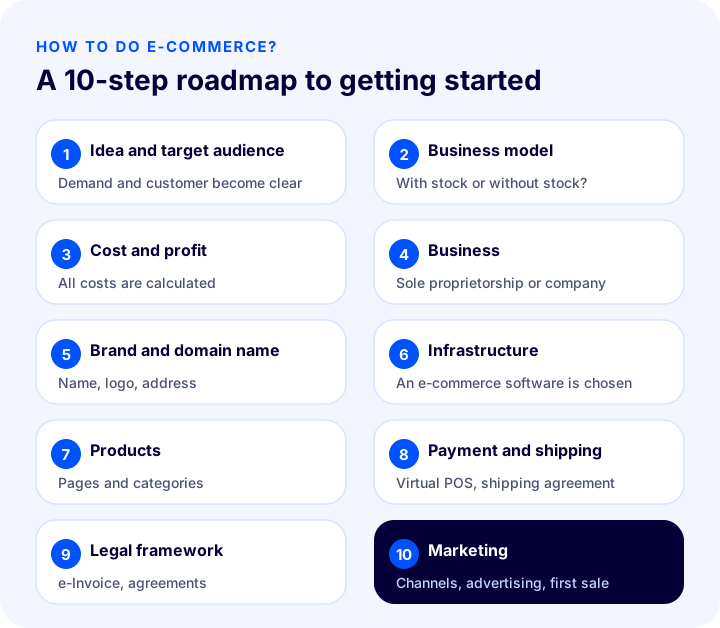
| Step | What is done? | Output |
|---|---|---|
| 1. Idea and target audience | Demand is researched, the customer is defined | A clear product group and customer profile |
| 2. Business model | You decide: your own stock, wholesale or no stock | Supply and stock plan |
| 3. Cost and profit | All expenses and the profit margin are calculated | Target sales price and break-even point |
| 4. Business | A sole proprietorship or company is set up | Tax status and invoicing authority |
| 5. Brand and domain name | Name, logo and domain name are chosen | Your identity and address |
| 6. Platform | E-commerce software is selected | A working store |
| 7. Products | Product pages and categories are prepared | A storefront ready for sales |
| 8. Payment and shipping | Virtual POS and shipping agreements are made | Collection and delivery setup |
| 9. Legal framework | e-Invoice, contracts, privacy and return terms are prepared | A legally compliant store |
| 10. Marketing | Channels and advertising are planned, first sales are made | First customers and measurement |
1. How Do You Determine the Business Idea and Target Audience for E-Commerce?
A business idea is a product or product group that answers a need and that enough people are searching for. The target audience is the group of people most likely to buy this product. Investing in a platform or advertising without clarifying both means spending on guesswork.
How Do You Validate Demand?
- Look at search demand: How much do people search for your product in search engines, and with which words?
- Examine competitors: Read the prices, product pages and customer reviews of stores selling the same product; reviews show customers’ real complaints and expectations.
- Run a small test: Start with a few products or with pre-orders and measure real interest.
- Talk to customers: Describe the product to a few people from the target audience around you and ask what they find missing.
How Do You Define the Target Audience?
Define the target audience not only with numbers such as age, location and income, but also with their needs and shopping habits. “Women” is a broad definition; “women who work long hours in an office and look for comfortable yet stylish shoes” is a definition that helps you shape the advertising, the product description and the price.
Okumanızı öneririz2025'te En Çok Kazandıran İş Fikirleri ve Yeni Ticaret Trendleri2. Which E-Commerce Business Model Should You Choose?
The business model determines where you source the product and who holds the stock. There are four basic paths: producing your own product, buying wholesale and reselling, selling without stock, and working with a ready-made supplier.
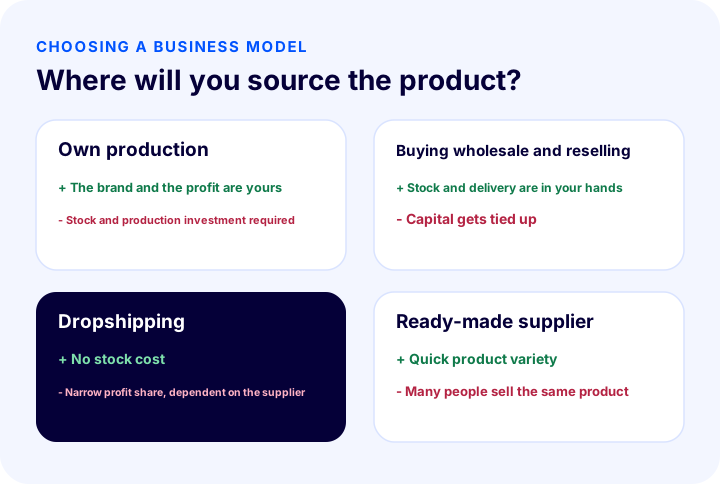
| Model | How does it work? | Advantage | Point to watch |
|---|---|---|---|
| Own production | You produce and sell the product | Brand and profit margin are yours | Production and stock investment required |
| Buying wholesale and reselling | You buy the product from a wholesaler and keep it in stock | Stock and delivery control is yours | Capital is tied up, and there is a risk of unsold stock |
| Dropshipping | When an order comes in, the supplier ships the product | No stock cost; you start with low capital | Delivery and quality depend on the supplier, and the profit margin is narrow |
| Working with a ready-made supplier | You bring the supplier’s product information and stock into your site | Quick product variety | Many people sell the same product, so standing out is hard |
If you want to examine the no-stock model in detail, take a look at our stoksuz e-ticaret guide. If you are thinking of starting from home on a low budget, the evden e-ticaret guide will help too.
3. How Are Cost and Profit Calculated in E-Commerce?
Calculating profit means subtracting the product cost and all selling expenses from the sales price. The most common mistake in e-commerce is to count only the product cost and forget shipping, commission, advertising and the return allowance.
| Expense item | Description |
|---|---|
| Product cost | Purchase or production cost and, if any, packaging |
| Shipping | Shipping fee per order; varies with desi and the agreed price |
| Payment commission | Transaction fee paid to the virtual POS or payment institution |
| Marketplace commission | The share deducted from the sale if you sell on a marketplace |
| Advertising | Advertising cost per customer |
| Returns and exchanges | Shipping and handling cost of a returned order |
| Platform and staff | Software fee, warehouse, packaging and customer service |
| Tax | VAT and income or corporate tax |
When doing the calculation, instead of setting the sales price first, add up all the expense items and then ask, “At what price should I sell this product to leave a profit?” You can try profit margin and desi calculations with our free calculation tools.
Recommended readingHow Much Does It Cost to Build an E-Commerce Site? Cost Guide4. How Do You Choose the Business Type for E-Commerce?
If you will sell regularly, you must have a business registration. Setting up a sole proprietorship is faster and cheaper, while setting up a company (limited or joint-stock) is more flexible in terms of liability, taxation and growth. Which one suits you depends on your sales volume, your number of partners and your goals; we recommend talking to a financial advisor before deciding.
- Sole proprietorship: One person, quick start; the owner’s liability is unlimited.
- Limited company: Liability is limited to the capital share; it is easy to build and grow a business with partners.
- Joint-stock company: For larger-scale businesses considering outside investment.
5. How Do You Choose a Brand Name and Domain Name?
The brand name should be short, memorable, easy to spell and evocative of your sector. Check whether a brand with the same name already exists and whether the domain name is available; a .com or .com.tr domain that suits your product or brand inspires trust.
- Avoid Turkish characters and hyphens; it should be writable when spoken over the phone.
- Run a search at the relevant authority for trademark registration; using a registered trademark causes problems.
- Prepare your logo so that it reads on both light and dark backgrounds.
6. How Do You Choose an E-Commerce Platform?
The e-commerce platform is the software your store runs on: the place where you manage products, orders, payment, shipping and invoicing. A ready-made plan lets you start quickly and affordably; custom software is needed only for very specific requirements.
| Criterion | Question to ask |
|---|---|
| Ease of use | Can I manage products, campaigns and orders without technical knowledge? |
| Integrations | Are there ready-made integrations with payment, shipping, e-Invoice and marketplaces? |
| Multichannel selling | Can I manage site and marketplace stock from one place? |
| Speed and security | Do pages open quickly, and are SSL and backups included? |
| Search engine compatibility | Can I manage the title, description, URL structure and redirects myself? |
| Growth | If my orders grow tenfold, or if I want to sell abroad, can I continue with the same system? |
| Support | Is there a team I can reach by phone when I have a problem? |
| Price | Are there extra licenses or commissions in addition to the monthly fee? |
7. How Do You Upload Products and Design the Store?
Product pages are the pages of your e-commerce site that actually make the sale. For each product, prepare a clear title, high-quality images from different angles, a clear price, options (size, color), a description that explains the benefits, and delivery and return information. If you have many products, you can upload them in bulk with Excel or XML.
- Category structure: Create clear categories that let customers find a product in two or three clicks.
- Home page: Show featured campaigns, best-selling products and trust elements.
- Mobile compatibility: Most visitors come from phones; test the pages on a phone.
- Trust: Make contact information, return terms and secure payment marks visible.
8. How Do You Set Up Payment and Shipping Agreements?
To take payment from customers you need a virtual POS, and to deliver the product you need at least one shipping company. Having both integrated with your platform eliminates manual work.
Virtual POS
A virtual POS lets you accept card payments online. You apply through a bank or payment institution; compare the commission rate, installment options and the time it takes for the money to reach your account. Offering bank transfer and cash on delivery as well increases the chance that customers find their familiar method.
We recommend readingHow to Get a Virtual POS? E-Commerce Application GuideShipping
When choosing a shipping company, compare delivery time, coverage area, damage and loss policy, and desi-based pricing. As your shipment count grows, so does your bargaining power. When your platform is integrated with the shipping company, the barcode, tracking number and status information are recorded on the order automatically.
We recommend readingHow to Make a Shipping Agreement in E-Commerce?9. How Do You Set Up the Legal Framework in E-Commerce?
Every business doing e-commerce has obligations regarding invoicing, contracts and personal data. Complete the following before your store goes live:
- e-Invoice and e-Archive: Set up invoicing for your sales; automate the move from order to invoice.
- Distance sales contract and pre-information: The customer must be able to see it before placing an order.
- Return and withdrawal terms: State the right of withdrawal, the return period and the exceptions clearly.
- Privacy and KVKK (Turkish Personal Data Protection Law) texts: The disclosure notice explaining how personal data is processed, and cookie consent.
- Registration and notification obligations: Complete the relevant registrations according to your business type and channels.
What Checks Should Be Done Before the Store Goes Live?
Before going live, place a test order from start to finish as a customer would. The checklist below helps you catch the points that are most often overlooked:
- Do the price, stock, images and options display correctly on product pages?
- Do the cart and payment steps work smoothly on a phone?
- Have card, bank transfer and (if you offer it) cash on delivery been tested with a test order?
- Do the order confirmation email and SMS reach the customer?
- Are the shipping details and tracking number recorded on the order?
- Is the e-Invoice generated automatically from the order?
- Are the return terms, distance sales agreement, privacy and cookie texts published on the site?
- Is the contact information (phone, email, address) visible?
- Are the title, description and sitemap ready for search engines?
- Are the tracking codes (conversion and ad tracking) installed?
10. How Do You Find Your First Customers?
Opening the site does not mean customers will arrive. To get your first sales, use several channels together:
- Marketplaces: Thanks to ready-made traffic, they let you get your first sales quickly; use integration to manage stock and orders from a single panel.
- Search engine optimization (SEO): Prepare your product and category pages around search intent; results build up over time.
- Advertising: Reach your target audience quickly with search and social network ads; start with a small budget and grow it by measuring results.
- Email and messaging: Add your first customers to a list and turn them into repeat sales with campaigns and cart reminders.
- Social networks: Build interest and trust with content that shows your product in use.
The Basics of Search Engine Optimization for a New Store
Unlike advertising, visitors coming from search engines accumulate over time and add no extra cost. In a new store, set up these basics correctly from the start: write a unique title and description that carry the search intent for every product and category page, keep page addresses short and clear, add descriptive alternative text to product images, check page speed and mobile compatibility, and add customer reviews and frequently asked questions to product pages. Answering the questions your customers ask before buying with blog content also increases both visibility and trust.
What Should Be Measured After Starting E-Commerce?
Once sales begin, base your decisions on numbers rather than intuition. The key indicators you should track are:
| Indicator | What does it tell you? |
|---|---|
| Conversion rate | What share of visitors place an order |
| Average cart value | How much is spent on average per order |
| Customer acquisition cost | The advertising and marketing cost spent to win one customer |
| Cart abandonment rate | Those who add products to the cart but leave without buying |
| Return rate | What share of orders are returned and why |
| Repeat purchase rate | What share of customers order again |
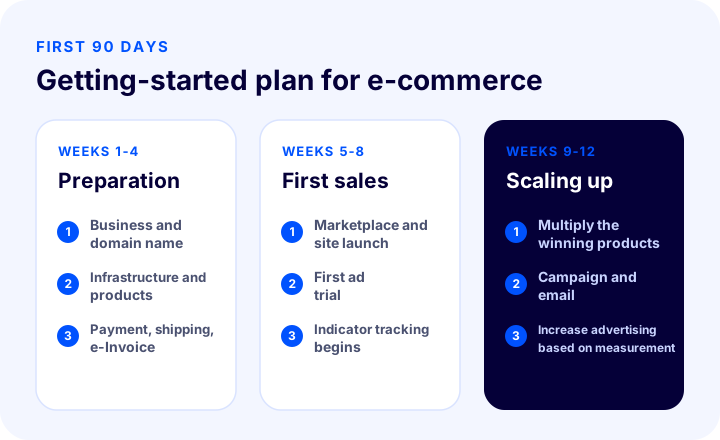
You can plan the first 90 days in three stages: in the first weeks, prepare the infrastructure and products and complete the legal setup; in the following weeks, get your first sales and start tracking indicators; in the final stage, grow advertising and campaigns based on measurement.
How Are Customer Service and Returns Managed in E-Commerce?
Sales do not end with the order. If the questions of where the customer's order is, how to return it and whom to write to go unanswered, both repeat sales and reviews suffer. Answer questions quickly (phone, email, messaging), publish frequently asked questions on the site and keep the return process simple as a step list: the customer creates the return request, receives a shipping code, the product reaches you, it is checked and the payment is refunded.
Returns are a cost, but a well-managed return process means trust. Record the reasons for returns (the size did not fit, the product looked different, it arrived damaged) and fix recurring reasons on the product page or in sourcing.
Okumanızı öneririzE-Ticarette Başarı İçin İade Süreçlerinde Yapılması GerekenlerWhat Are the Alternative Ways to Start in E-Commerce?
- Home-based e-commerce: It is possible to start without renting an office or warehouse, by keeping stock and packing at home.
- Sales without stock: Sales are made without holding stock, by passing orders on to the supplier.
- Selling through social networks: Orders are taken by message; payment links are used, and once volume grows a website is needed.
- Micro-export: Sales are made to customers abroad with small parcels.
- e-Export: Selling to foreign markets with a dedicated language, currency and shipping.
What Are the Common Mistakes in E-Commerce?
- Investing without validating demand: First show that it will sell, then grow.
- Calculating profit incompletely: A store that ignores shipping, commission, advertising and returns makes sales but does not earn.
- Starting with too many products: A scattered catalog makes both management and the customer's decision harder.
- Skipping trust elements: On a site without return terms and contact information, customers hesitate to pay.
- Managing stock manually: When selling on more than one channel, stock errors are inevitable.
- Relying only on advertising: If sales stop when the ads stop, there is a lack of investment in SEO and repeat customers.
How Do You Do E-Commerce with Faprika?
Faprika brings together most of the steps in this guide in a single panel: a mobile-friendly store, virtual POS and payment integrations, integration with 23 shipping companies, e-Invoice and e-Archive, campaign tools, multi-marketplace management and e-export. We have been developing e-commerce software for 20 years and serve more than 3000 brands. You can review the plan that suits your needs on the e-commerce plans page, and find the integrations you can use on the add-ons page.
Frequently Asked Questions
How is e-commerce done?
To do e-commerce, decide what you will sell and to whom, calculate cost and profit, set up your business, choose an e-commerce platform, upload your products, arrange virtual POS and shipping agreements, prepare e-Invoice and the legal pages, then reach your first customers through marketplaces, advertising and search engine channels.
What is needed to set up an e-commerce site?
You need a business registration (sole proprietor or company), a domain name, an e-commerce platform, virtual POS, a shipping agreement, an e-Invoice setup and legal texts (distance sales agreement, privacy, return terms). For selling on a marketplace, the seller approval of the relevant platform is also obtained.
How do you start e-commerce from scratch?
Start with a single product group and a clear target audience. Validate demand, do the profit calculation, set up your store with a ready-made e-commerce plan and earn your first income by selling together with marketplaces. As you grow, increase the product range and channels.
Is it necessary to set up a company to do e-commerce?
For regular, commercial sales you need a business registration; it can be a sole proprietorship or a company. Which one suits you depends on your sales volume and goals; we recommend talking to a financial advisor before deciding.
How much does it cost to set up an e-commerce site?
The cost varies with the platform you choose, the number of products, your advertising budget and your payment and shipping agreements. In addition to the platform fee, factor in advertising, shipping, commission and stock costs.
Is it possible to do e-commerce without stock?
Yes. In the no-stock model, you sell without holding inventory by passing the order to the supplier once it arrives. The capital requirement is lower, but delivery and quality depend on the supplier, and profit margins can be narrow.
How long does it take to get the first sale in e-commerce?
The time depends on the product, the price, the channel you choose and your advertising efforts. On marketplaces, the first sales usually come faster thanks to the ready-made traffic; on your own site, sales grow as traffic builds through search engines and advertising. That is why using both channels together is common.
Which platform should be chosen for e-commerce?
Choose a platform that is easy to use, offers ready payment, shipping, e-Invoice and marketplace integrations, and is mobile-friendly, fast and backed by phone support. Ask whether it can also meet your needs as you grow, such as selling abroad and multi-warehouse.