
Contents 15 sections
- Which Are Turkey's Biggest E-Commerce Sites?
- By What Criterion Is the "Biggest E-Commerce Site" Determined?
- How Big Is the E-Commerce Market in Turkey?
- Leading E-Commerce Platforms in Turkey
- What Are the Common Steps to Start Selling on a Marketplace?
- What Are the Tips for Becoming a Successful Marketplace Seller?
- How Are Marketplace Commission and Profit Calculated?
- Which Trends Are Shaping the Future of E-Commerce in Turkey?
- Which Platform Should You Choose as a Seller?
- Which Product Group Is Stronger on Which Platform?
- For Buyers: How to Shop Safely on E-Commerce Sites
- What Are Common Mistakes When Choosing a Platform?
- Should You Sell on a Marketplace or on Your Own E-Commerce Site?
- How Do You Manage Selling on Multiple Platforms?
- Frequently Asked Questions
Shopping online in Turkey is no longer a choice but a habit. So which are Turkey's biggest e-commerce sites, where all this shopping takes place? In this guide, we introduce the ten best-known and most used e-commerce platforms in the country, explaining what kind of platform each one is, when it was founded and what it means for sellers. We also show how the term "biggest" changes depending on the criteria, and which platform you should choose as a seller.
This list is not a ranking: criteria such as visitor numbers, revenue and seller count come out differently in different sources and keep changing. We cover each platform by its own type and assess it from the seller's point of view: which product group is strong on which platform, how the application and onboarding steps work, how commission and profit are calculated, and how you can manage multiple platforms from a single panel — all below.
Which Are Turkey's Biggest E-Commerce Sites?
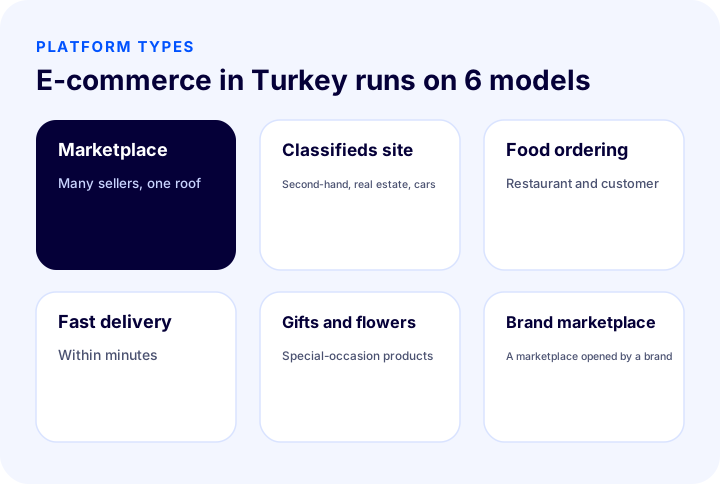
Among the best-known e-commerce platforms in Turkey are Trendyol, Hepsiburada, n11, Sahibinden.com, Yemeksepeti, ÇiçekSepeti, Getir, LC Waikiki, Pazarama and Amazon. These platforms work with different business models: some are marketplaces where many sellers sell products, some are classifieds sites, and some are platforms specialized in a single category.
| Platform | Type | Start | Summary for sellers |
|---|---|---|---|
| Trendyol | Marketplace | 2010 | Wide categories, many buyers and sellers |
| Hepsiburada | Marketplace | 2001 | A wide range from electronics to fashion and home products |
| n11 | Marketplace | 2013 | A broad marketplace that brings sellers and buyers together |
| Sahibinden.com | Classifieds and marketplace | 2000 | Second-hand, real estate, car and service listings |
| Yemeksepeti | Food ordering | 2001 | Online ordering channel for restaurants |
| ÇiçekSepeti | Flowers and gifts | 2006 | Gifts, flowers and special-occasion products |
| Getir | Fast delivery | 2015 | Delivery-in-minutes model |
| LC Waikiki | Clothing brand, marketplace since 2023 | — | A brand that opened up to marketplace selling in clothing and home textiles |
| Pazarama | Marketplace | New player | A marketplace for small and medium-sized sellers |
| Amazon | Global marketplace | In Turkey since 2018 | Access to international markets |
By What Criterion Is the "Biggest E-Commerce Site" Determined?
"Biggest" does not depend on a single number. Different criteria bring different platforms to the fore, which is why the question "Which is Turkey's biggest e-commerce site?" has no single answer.
| Criterion | What does it show? | Point to watch |
|---|---|---|
| Visitor count | How visible the platform is | A visitor is not a buyer |
| Revenue (sales volume) | Total shopping on the platform | Most platforms do not share this data in detail |
| Seller count | The breadth of competition and product variety | Many sellers means a lot of competition |
| Product variety | Customers can find everything | With more variety, standing out gets harder |
| Brand awareness | Whether it is the first address customers think of | Varies by survey and research |
The most important criterion for you as a seller is whether your target customer shops on that platform. For a given product group, a small but specialized platform can bring better sales than a general marketplace.
How Big Is the E-Commerce Market in Turkey?
According to statements based on the Ministry of Trade's Electronic Commerce Information System (ETBİS) data, e-commerce volume in Turkey grew by about 52 percent compared with the previous year in 2025 and exceeded 4.5 trillion lira. E-commerce's share of overall trade reached 19.3 percent, the number of transactions about 6 billion, and the number of businesses doing e-commerce about 634 thousand. These figures are compiled from public statements; for current detailed data, we recommend consulting the ministry's reports.
The market being this big also explains why marketplaces are so crowded: millions of buyers gather in one place, and thousands of sellers try to take a share of this traffic.
We recommend readingE-Commerce Explained: Types, Advantages and How to StartLeading E-Commerce Platforms in Turkey
Trendyol
Trendyol is a marketplace founded in 2010 that brings buyers and sellers together across a wide range of products. Sales take place in many categories, led by fashion. To become a seller, you need a business registration and must complete the platform's application process.
Okumanızı öneririzTrendyol Satıcı Başvurusu Nasıl Yapılır?Hepsiburada
Hepsiburada is a marketplace founded in 2001. It has a broad network of categories, from electronics to fashion and home products, and from personal care to hobby items. With strong filtering and search, it aims to help customers find products easily.
Okumanızı öneririzHepsiBurada Satıcı Başvurusu Nasıl Yapılır?n11
n11 is a marketplace that began operating in 2013 and brings sellers and buyers together. Sales take place in various categories, from electronics to clothing and from home appliances to personal care.
Okumanızı öneririzN11 Pazaryerinde Mağaza Nasıl Açılır?Sahibinden.com
Sahibinden.com is a classifieds platform founded in 2000 that started with second-hand goods and real estate listings and expanded into areas such as cars, electronics, household items and job listings. It functions as a marketplace for individual users and small businesses; sales happen through listings, and payment and delivery mostly take place between buyer and seller.
Yemeksepeti
Yemeksepeti is a food-ordering platform founded in 2001 that connects restaurants and customers through online orders. It offers restaurants an online sales channel, and users quick ordering and tracking.
ÇiçekSepeti
ÇiçekSepeti is a platform founded in 2006 with a focus on sending flowers, which over time expanded into categories such as gifts, personal care and food. It is a suitable channel for businesses that sell gift products with strong demand on special occasions.
Okumanızı öneririzÇiçekSepeti'nde Satıcı Nasıl Olunur?Getir
Getir is a platform founded in 2015 that stands out with its "instant delivery" model. It aims to deliver daily needs, from supermarket items to snacks and personal care, within minutes. This model shows how decisive delivery time can be in fast-moving consumer goods.
LC Waikiki
LC Waikiki is one of Turkey's well-known clothing brands, and since 2023 it has stopped being only a retail chain selling its own products and has also started operating as a marketplace offering other sellers' products. For businesses selling clothing, accessories and home products, it offers an opportunity to reach the brand's customer base.
Okumanızı öneririzLC Waikiki Pazaryerinde Nasıl Satıcı Olunur?Pazarama
Pazarama is a marketplace aimed at small and medium-sized businesses that brings products and sellers in different categories under one roof. Because it is a new player, it can offer opportunities in categories where competition is less intense.
Okumanızı öneririzPazarama'da Satıcı Nasıl Olunur?Amazon
Amazon is a worldwide e-commerce company that began operating in Turkey in 2018. It gives sellers in Turkey access to both the domestic market and international stores, which makes it notable for sellers who want to expand abroad.
Okumanızı öneririzAmazon'da Mağaza Nasıl Açılır?What Are the Common Steps to Start Selling on a Marketplace?
Although the details of marketplaces' applications and rules differ, the process of starting to sell consists of largely similar steps. Whichever platform you choose, you can follow this order:
- Complete your business registration. A sole proprietorship's or company's tax certificate, signature circular and bank account details are requested in the application.
- Submit a seller application. Enter your company and store details on the platform's seller page and complete the verification codes.
- Upload your documents. Upload all requested documents in full and in legible form; missing documents delay approval.
- Prepare your store profile. Fill in details such as store name, logo, contact information, and return and shipping address.
- Set up your shipping agreement. Choose the carrier you will use and define the shipping terms.
- Upload your products. Add your products one by one, via Excel, or through an integration, with the correct category, brand, barcode, images, and description.
- Set your price, stock, and campaigns. Price your products with commission and shipping in mind.
- Keep track of orders and questions. Fast shipping and quick answers to questions determine your store's performance and visibility.
What Are the Tips for Becoming a Successful Marketplace Seller?
Hundreds of sellers offer similar products on the same marketplace. To stand out, you need to invest in factors beyond price:
- Complete the product page fully: A clear title, images from multiple angles, the correct category and attribute information, and a description that answers the customer's questions before they ask improve both visibility and conversion.
- Keep stock up to date: Selling an out-of-stock product means cancellations and penalty points. Automate stock updates.
- Ship quickly: Time to hand over to the carrier is an important criterion in how the platform evaluates a seller.
- Answer customer questions quickly: Fast, clear answers support sales and reduce negative reviews.
- Manage reviews and ratings: Respond constructively to negative reviews and fix recurring complaints in the product or process.
- Join campaigns: Platforms' discount periods increase traffic; take part in a way that protects your profit.
- Set prices based on profit calculations: If no profit is left after commission, shipping, returns, and advertising costs, higher sales won't help your business.
- Build your own brand: Trademark registration and a defined brand provide both trust and differentiation from competitors.
How Are Marketplace Commission and Profit Calculated?
On marketplaces, a seller's profit is found by subtracting product cost, commission, shipping, returns, and advertising costs from the sale price. The commission rate varies by platform and product category and is published in the platform's current seller rules, so always use the current rate when calculating.
| Pens | How is it calculated? |
|---|---|
| Selling price | Amount paid by the customer |
| Commission | Sale price × category commission rate |
| Shipping | Fee per order based on desi and agreed price |
| Product cost | Purchase or production cost and packaging |
| Returns share | Shipping and handling cost of returned orders |
| Advertising | Advertising cost on or off the platform |
| Net profit | Sale price − (commission + shipping + product cost + returns share + advertising) |
To make the calculation easier, you can use the free profit margin and desi calculators.
Which Trends Will Shape the Future of E-Commerce in Turkey?
As e-commerce grows rapidly in Turkey, several trends stand out that platforms and sellers need to watch:
- Mobile-first shopping: Most shopping is done on phones; platforms that load fast and offer easy payment win.
- Expectation of fast delivery: Models offering delivery within minutes and hours have raised customers' delivery expectations.
- Multichannel selling: Sellers manage stock from a single place across their own site, marketplaces, and social networks.
- AI and personalization: Product recommendations, content creation, advertising, and answering questions are increasingly supported by AI.
- Cross-border selling: When the domestic market is saturated, e-export and micro-export become a new growth path for sellers.
- Automation: Invoicing, shipping, stock, and marketing processes run automatically on rules.
Which Platform Should You Choose as a Seller?
The platform should be chosen based on your product, target audience, and operational capacity. The questions below make the choice easier:
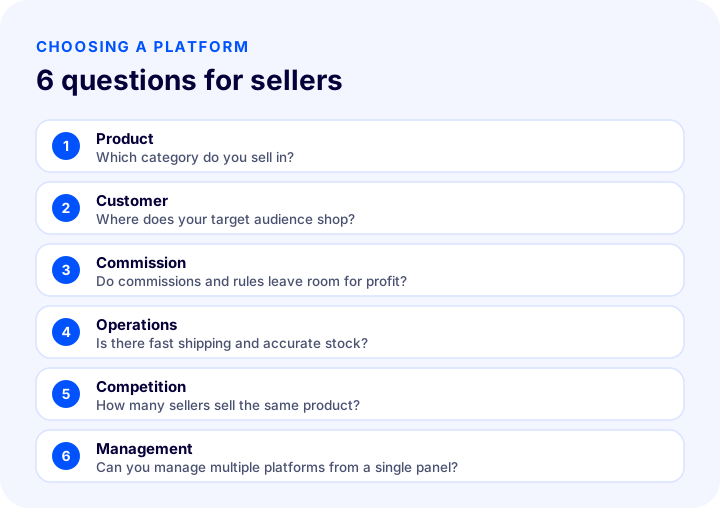
- Which category is your product in? Different platforms are strong in categories such as fashion, electronics, gifts, and food.
- Where does your target customer shop? Even if a platform has traffic, there will be no sales if your customer isn't there.
- What are the commission and rules? Each platform has different commissions, return rules, and payment terms; include them in your profit calculation.
- Is your operational capacity sufficient? Be ready for fast shipping, stock accuracy, and customer questions; platforms give visibility based on performance.
- How intense is the competition? If many sellers offer the same product, you need an advantage other than price to stand out.
- How will you manage it? If you will sell on more than one platform, plan to manage products, stock, and orders from a single panel.
Which Product Group Is Stronger on Which Platform?
Each platform has categories where it stands out. The table below is a general guide to which types of platforms to consider for your product group; it is not a firm rule, and you should check each platform's current category and commission structure.
| Product group | Platform type to consider | Why? |
|---|---|---|
| Clothing and fashion | General marketplaces, the brand's own marketplace | Fashion searches and the shopping audience are concentrated on these platforms |
| Electronics | General marketplaces, global marketplace | Customer base that shops by comparing |
| Gifts, flowers, special-occasion products | Gift-focused platform | Strong demand on special days |
| Food and meals | Food ordering and fast delivery platforms | Delivery speed is decisive |
| Second-hand, real estate, cars | Classified ad platforms | Buyer and seller meet directly |
| Selling abroad | Global marketplace, e-export module | Language, currency, and shipping needs |
For Buyers: How Do You Shop Safely on E-Commerce Sites?
This guide is written mainly for sellers; however, as a shopper you should also follow a few rules for safe shopping:
- Check the site and the seller: Company information, a contact channel, and return terms should be clearly stated.
- Use a secure payment page: Enter your card details only on secure (https) and well-known payment pages.
- Look at reviews and the seller rating: A large number of negative reviews and a low rating are warning signs.
- Know your right of withdrawal and return: Distance sales carry a right of withdrawal granted by legislation; read the terms on the product page for exceptions.
- Compare prices: A price far below the market can be a sign of a fake or faulty sale.
- Keep your documents: Keep the order confirmation, invoice, and correspondence.
What Are Common Mistakes When Choosing a Platform?
- Focusing only on the biggest platform: Competition is also fiercest on the biggest marketplace; less crowded platforms that suit your product may give better results.
- Ignoring commission and return costs: Sales grow but no profit remains.
- Depending on a single platform: A change in the platform's rules or commission affects your entire business.
- Managing stock and price manually: Errors are inevitable when selling on several platforms; automation is needed.
- Having no site of your own: Your customer data and brand stay tied to the platform; set up your own e-commerce site too.
- Not monitoring performance indicators: Time to ship, cancellation rate, and customer rating directly affect visibility.
Should You Sell on a Marketplace or on Your Own E-Commerce Site?
Marketplaces offer ready-made traffic; your own site leaves brand, pricing, and all customer data to you. For most businesses, the healthiest path is to use both: earn revenue quickly by selling on marketplaces, and grow your brand and loyal customer base on your own site.
| Criterion | Marketplace | Your own e-commerce site |
|---|---|---|
| Traffic | Ready-made | You bring it yourself |
| Brand control | The platform's rules apply | Entirely yours |
| Customer data | Limited | Belongs to you |
| Cost | Commission on sales | Infrastructure and marketing costs |
| Speed of getting started | Fast | Takes time |
How Do You Manage Selling on Multiple Platforms?
The biggest challenge of selling on multiple platforms is keeping the stock, price, and order information of the same product up to date everywhere. When managed manually, a product sold on one platform still shows as "available" on another, and cancellations and negative reviews increase. The solution is marketplace integration: products, stock, prices, and orders are managed from a single panel, and changes are reflected on all channels.
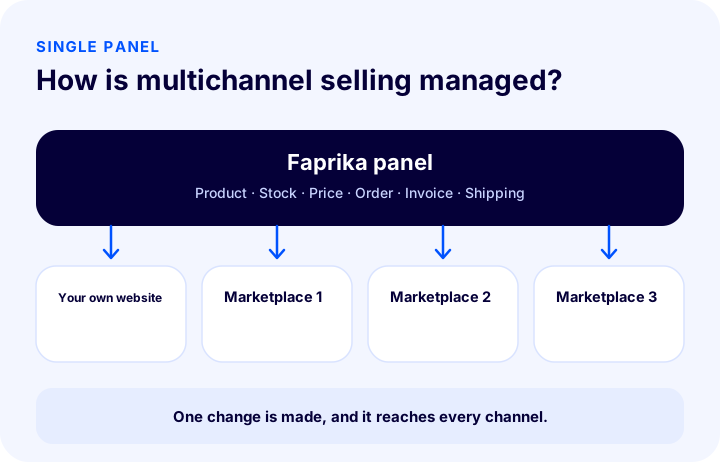
Faprika works integrated with many of the platforms in this guide: it lets you manage your products, stock, and orders from the same panel together with marketplaces and your own e-commerce site. You can see which marketplaces have integrations on the marketplace integration page.
Frequently Asked Questions
Which is the largest e-commerce site in Turkey?
It depends on the criterion you look at; visitor numbers, revenue and seller count each point to different platforms. Among marketplaces, Trendyol, Hepsiburada and n11 are the most frequently mentioned names; Amazon operates in Turkey as a global player.
Which are the most used e-commerce sites in Turkey?
Trendyol, Hepsiburada, n11, Sahibinden.com, Yemeksepeti, ÇiçekSepeti, Getir, LC Waikiki, Pazarama, and Amazon are among the best-known and most used e-commerce platforms in Turkey.
What is the difference between a marketplace and an e-commerce site?
On a marketplace, many sellers sell products on the same platform and benefit from the platform's ready-made traffic; on your own e-commerce site, the brand, pricing, and customer data belong to you, but you bring the traffic yourself.
How do e-commerce sites make money?
Marketplaces generally charge a commission on products sold; there may also be advertising revenue and membership or add-on service fees. On food and fast-delivery platforms, delivery and service fees are also revenue items.
What do you need to sell on a marketplace?
You generally need a business registration (sole proprietorship or company), tax details, a bank account, and to complete the platform's seller application process. The required documents vary by platform.
Can you sell on more than one marketplace?
Yes. You can sell on multiple marketplaces and on your own site at the same time. For consistent stock and prices, it is recommended to manage products, stock and orders from a single panel with marketplace integration.
Which marketplace should a new seller start with?
Start with the platform that best fits your product group and target customer. It is generally healthier to start with one or two marketplaces and measure performance than to launch everywhere at once; later you can add your own e-commerce site and other marketplaces.
How much is the marketplace commission?
The commission rate varies by platform and product category and is published up to date on each platform's seller pages. Always use the current rate when pricing, and calculate net profit including shipping, returns and advertising costs.