
Contents 15 sections
- What Is a Wallet System?
- Why Is a Wallet System Important?
- How Does a Wallet Work?
- How Does Earning from Purchases Work?
- How Is the Refund Amount Transferred to the Wallet?
- How Is the Wallet Balance Calculated?
- What Risks Does a Wallet System Have?
- How Should Customers Be Informed About the Wallet System?
- Which Stores Is a Wallet System Suitable For?
- How Is the Success of a Wallet System Measured?
- What Is the Difference Between a Wallet and a Discount Coupon?
- Common Mistakes When Setting Up a Wallet System
- Wallet System Checklist
- How Do You Set Up a Wallet System with Faprika?
- Frequently Asked Questions
A customer returned a product. How will the money go back to them? To their card, by bank transfer, or as a balance they can use in the store? The same question also comes from the opposite direction: if customers earned a small amount from every purchase and spent it on their next order, wouldn't they come back to your store more often? The answer to both questions meets in the same structure: the customer wallet.
This guide explains what a wallet system is, how a customer balance works in e-commerce, when earning from purchases and transferring refund amounts to the wallet make sense, how it differs from a cash refund, and which risks and legal points to watch. It also includes a tool that calculates the balance amount and a wallet check.
What Is a Wallet System?
A wallet system in e-commerce is a structure that keeps a store-specific money balance in each customer's account. This balance can be earned from purchases or transferred as a refund amount, and it is used as payment on later orders.
A wallet is not a bank account; it is valid only in the store concerned. For the customer it means “my money waiting in the store”, and for the business it means “a balance liability I owe to the customer”. This dual meaning makes the system both powerful and a tool that must be managed carefully.
In Faprika, this structure is offered as Faprika Wallet. With Faprika Wallet, you can let your customers earn money from their purchases and let them shop with that money, building a loyal customer base for your e-commerce site. Transferring refund amounts to customer wallets in return or exchange processes is also a very commonly used option.
Is a Wallet the Same as a Digital Wallet?
No. A digital wallet is a general payment tool that lets a customer use their card and payment details in many stores. A store wallet, on the other hand, is a balance that is valid only on your site and works under your rules. To find out what a digital wallet is Dijital Cüzdan Nedir? in this article.
| Feature | Store wallet | Digital (payment) wallet |
|---|---|---|
| Where it is valid | Only the store concerned | Many stores and apps |
| Who manages the balance? | The store, under its own rules | The wallet provider |
| Purpose | Keeping the customer in the store | Making payment easier |
| Where does the balance come from? | Earnings from purchases, refund transfers | Money the customer loads or a linked card |
Why Is a Wallet System Important?
A wallet is more about keeping a customer than winning one. If a customer has a balance in the store, they have a concrete reason to come back to spend it. This is why a wallet creates the most value in customer loyalty and refund management.
- Triggers repeat purchases: The customer returns to the store to spend their balance.
- Keeps a refund from becoming a loss: If the refund amount stays in the store, the refund can turn into a new sale to the same customer.
- Creates a sense of loyalty: Money earned from purchases shows the customer that they are “valued”.
- Speeds up the process: Transferring to the wallet requires no correspondence with the bank and no waiting.
You can see what makes a customer valuable over the long term in the Customer Lifetime Value article; the wallet is one of the tools that increase this value.
How Does a Wallet Work?
A wallet is a balance fed by two sources and spent in one place. The customer can earn from purchases, in the case of a return the refund amount can be transferred to the wallet, and the accumulated balance is used as payment on the next order. Every transaction appears as a separate line in the customer's account.
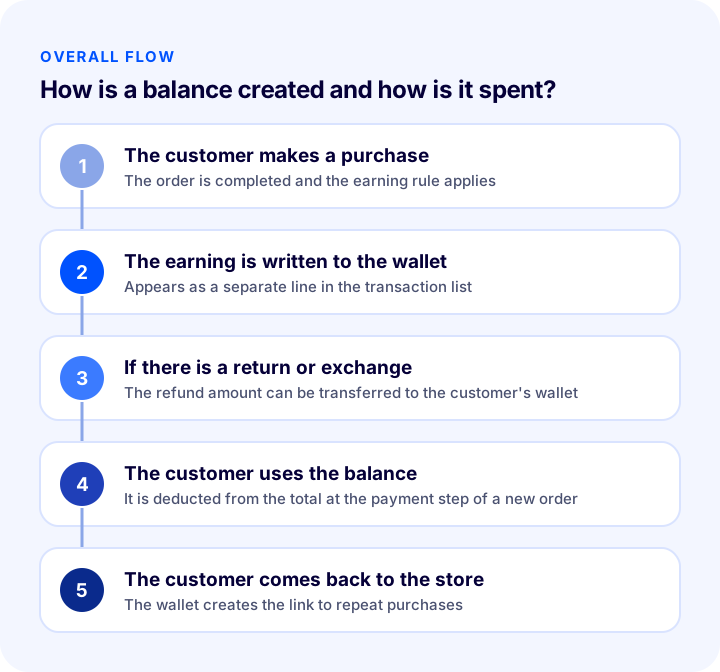
| Step | What happens? | Effect on the balance |
|---|---|---|
| Purchase | The order is completed and the earning rule applies | Increases (earning) |
| Return or exchange | The refund amount is transferred to the wallet | Increases (refund) |
| New order | The customer uses the balance at payment | Decreases (spending) |
This is an overall flow; the earning rate, terms of use and screens are shaped by the rules you set. You can check which details of Faprika Wallet are included in which plan on the e-commerce plans page.
How Does the Customer See the Wallet?
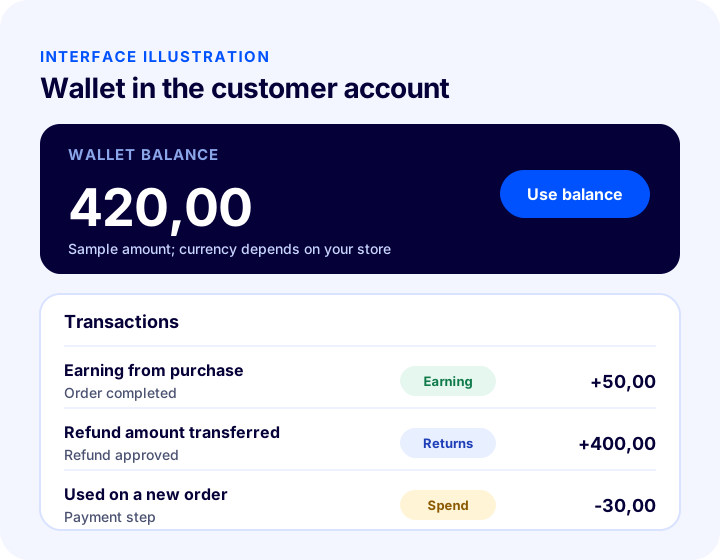
Customers should be able to see their balance and transactions in their account. Transparency is the foundation of a wallet system: if customers cannot understand where the money came from and where it went, they will not trust the balance. The illustration below shows the logic of such an account screen; the amounts are examples only.
How Does Earning from Purchases Work?
Earning from purchases means adding a certain amount to the customer's wallet after each order. The customer can use this money on their next purchase; this way, every order also creates the reason for the next one.
This structure is different from a discount. A discount makes the order cheaper now, while an earning gives the customer a right to a future purchase. The important difference for the business is this: a discount creates a cost at the time of the order, while an earning is spent only when the customer returns. If you want to build the earning structure as part of a loyalty program, the tier and cost logic in the How to Set Up a Loyalty Program? article will also help you.
How Is the Earning Rule Determined?
The earning rule should be based on the business's profit margin. The balance you give the customer should be a reasonable portion of the profit you make on that order; otherwise the loyalty program turns into a discount that eats profit. Before you start, answer these questions:
- What is your profit margin? The earning rate should stay below this margin.
- Which orders will earn? All orders, or only those above a certain amount?
- Are discounted products included? Giving extra earnings on products that already have low margins can be risky.
- Does the balance have an expiry period? If you set a period, tell the customer clearly.
You can learn how profit margin is calculated in the How Is Profit Margin Calculated? article. To see the difference between coupon and wallet earnings, you can also look at the Discount Coupon article.
We recommend readingHow to Set Up a Loyalty Program? A Practical Guide to Points Systems, Tier Design and Cost Calculation in E-Commerce We recommend readingHow to Manage the Return Process in E-Commerce?How Is the Refund Amount Transferred to the Wallet?
Transferring the refund amount to the wallet means that, when a return is approved, the money owed is written not to the customer's card or account but to their wallet balance in the store. The customer uses this money on a new order, while the store keeps the money.
This method is especially natural in exchanges: if a customer wants to return one size and buy another product, writing the refund amount to the wallet and using it right away on a new order is the shortest path. You can find how to design the whole return process in the How to Manage the Return Process in E-Commerce? article.
In Faprika, transferring refund amounts to customer wallets is a very commonly used option. You can see how return operations are carried out in the panel in the Cancellation and Return Operations tutorial.
Should Refunds Be Paid in Cash or Transferred to the Wallet?
Both have their place; the right choice depends on the customer's needs and the store's rules. Transfer to the wallet creates a repeat-sale opportunity for the store and is fast. A cash refund, on the other hand, gives the customer the most confidence and in most cases is their first expectation.
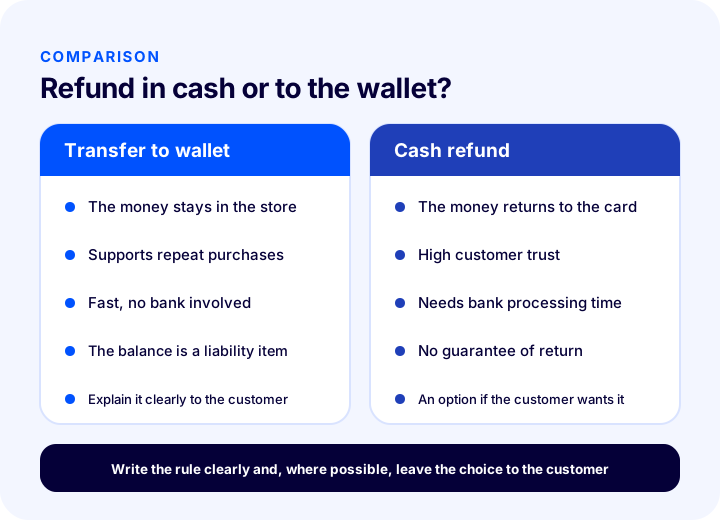
| Criterion | Transfer to wallet | Cash refund |
|---|---|---|
| Where does the money stay? | In the store, in the customer's balance | Returns to the customer's payment method |
| Speed | Instant, no bank process | Depends on bank processing time |
| Repeat purchase | Encourages it | Does not guarantee it |
| Customer trust | High if the rule is clear, low if unclear | Usually high |
| Burden on the business | Creates a balance liability | Creates a cash outflow |
How Is the Wallet Balance Calculated?
A customer's balance is found by subtracting the amount used from the sum of the amount earned and the amount transferred through refunds. For the business, the same number shows the balance liability you owe that customer.
The tool below calculates the customer's current balance from four values: the order amount, the earning rate, the refund transferred to the wallet and the balance used earlier. In the tool, “currency” is written instead of a currency symbol; read it in your own currency.
When interpreting the result, remember that the balance is not an expense but a deferred right to a sale. However, as long as the balance waits unspent, it stays on the business's books as a liability; for this reason, monitor the earning rate and the total pending balance regularly.
What Risks Does a Wallet System Have?
The wallet's main risk is loss of customer trust caused by leaving the rules unclear. The second risk is abuse; the third is where the balance sits in the business's records.
How Can Abuse Be Prevented?
Because the earning can be spent like money, it can make unwanted behavior attractive, such as customers who place an order to generate earnings and then return it. These practices help as precautions:
- Release the earning at the end of the return period: Keeping the earning unspendable while the order can still be returned cuts the “order, earn, return” loop.
- Take back the earning on a return: The balance earned from a returned order should be deducted.
- Watch for abnormal patterns: Many small orders followed by returns is a sign that needs attention.
- Write the terms clearly: The conditions under which the earning is valid should also be known by the customer.
How Should the Balance Be Treated in Accounting and Legal Terms?
The customer's money in the wallet is a liability the business owes to them. How this balance will be tracked in the records, its validity period, the tax aspect of the earning and which payment route the refund amount should return to may vary by business type and current legislation. Do not rely on a firm ruling on these matters; before putting it into practice, confirm with your accountant and, if necessary, your legal advisor.
Do not forget the personal data side either: wallet transactions are the customer's shopping data and are subject to disclosure and data protection rules. For details, see the KVKK Compliance for an E-Commerce Site article.
Recommended readingHow to Achieve KVKK (Turkish Personal Data Protection Law) Compliance for an E-Commerce Site? A Practical Guide to the Privacy Notice, Explicit Consent, Cookies, İYS and Data Subject RequestsHow Should Customers Be Informed About the Wallet System?
If a customer does not know the wallet exists, they will not use it. This is why balance information needs to be shown at the right moments: “you earned this much from this order” on the thank-you page after an order, “the refund amount has been added to your wallet” on refund approval, and “your available balance” on the cart screen.
To have these notifications sent automatically by email, SMS or push, you can use message templates; details are in the What Is a Message Template? article. Messages should be short and should state the amount and the next step (“you can use your balance in your cart”).
Which Stores Is a Wallet System Suitable For?
A wallet creates the most value for stores where repeat purchases by customers are natural. In areas with regular shopping, such as clothing, cosmetics, consumer goods and frequently renewed needs, the balance is spent quickly; for products bought once a year, the balance may wait for a long time.
| Store situation | Is a wallet suitable? | Why? |
|---|---|---|
| Customers shop regularly and often | Very suitable | The balance is spent quickly, repeat orders increase |
| High return and exchange rate | Suitable | The refund amount stays in the store, exchanges speed up |
| Customers shop once a year | Limited | The balance waits a long time, liability builds up |
| Very low margin | Set up carefully | The earning rate may exceed the margin |
If you do not know how often your own customers come back, measure that first; the wallet decision should be based on that number.
How Is the Success of a Wallet System Measured?
The success of a wallet is measured by looking at how much of the balance is spent and how often the customers who spend it come back. Looking only at the balance distributed is misleading; the real question is whether this balance turns into new orders.
- Spend rate: How much of the total balance issued was used on later orders?
- Repeat order rate: Do customers with a wallet order more often than those without?
- Pending balance: How much is the total amount sitting unspent, and for how long has it been waiting?
- Refund-to-wallet rate: In what share of returned orders did the customer choose the wallet?
- Average amount per order: Are orders that use a balance larger?
These indicators show whether the wallet is only a cost item or really a sales tool. You can find how to track the general indicators in the E-Commerce Metrics article.
What Is the Difference Between a Wallet and a Discount Coupon?
A coupon gives a discount under a certain condition; a wallet is the customer's accumulated money. The two are not rivals but complements: a coupon is better suited to new customers or campaigns, and a wallet to keeping existing customers.
| Feature | Discount coupon | Wallet balance |
|---|---|---|
| What does it provide? | A discount on the order | Accumulated money, used at payment |
| Who is it for? | Anyone who knows the code, or a selected group | Each customer's own account |
| When does the cost arise? | On the order where it is used | When the balance is spent, in advance as a liability |
| Best purpose | New customers and campaigns | Loyalty and refunds |
Common Mistakes When Setting Up a Wallet System
Wallet mistakes are usually noticed after the system starts working, through customer complaints. The most common ones are:
- Not writing the rule: If the earning rate and terms of use are unclear, a dispute arises between the customer and the store.
- Ignoring the profit margin: If the rate exceeds the margin, every order makes a loss.
- Forcing refunds only into the wallet: It reduces customer trust and leads to complaints.
- Leaving the balance invisible: If the customer cannot see their balance, they will not use it.
- Not monitoring abuse: The earn-and-return loop can grow unnoticed.
- Not talking to accounting: Recording the balance is a matter that is hard to correct afterwards.
The wallet is only one part of a customer retention strategy. For a broader view, you can read the E-Ticaret Siteleri İçin Müşteri Sadakati article.
Wallet System Checklist
Go through the list below before launching the wallet. The more items you tick, the safer your system becomes for both the customer and the business.
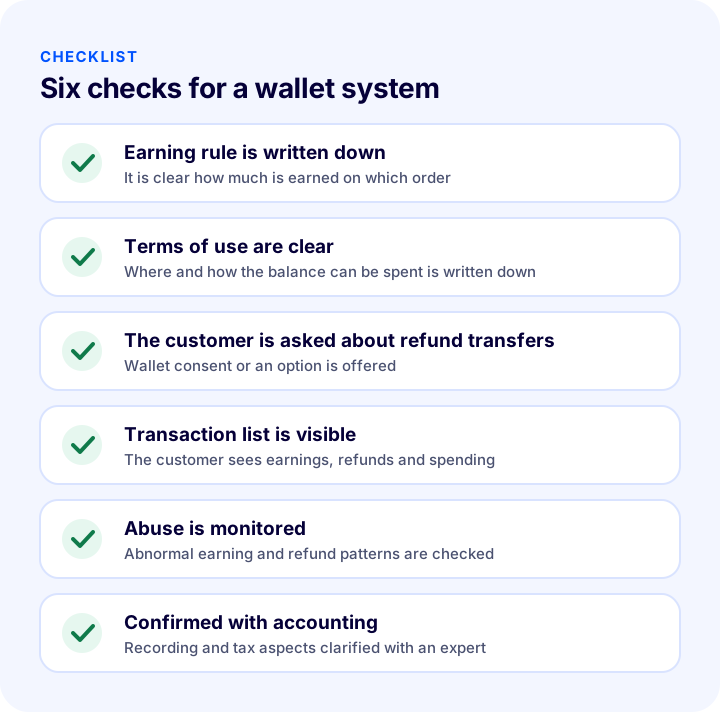
| Stage | Check | Done? |
|---|---|---|
| Earning | Rule is written, rate is below the profit margin | Yes / No |
| Condition | Terms of use are clear to the customer | Yes / No |
| Returns | A cash or wallet option is offered | Yes / No |
| Visibility | Balance is visible in the account, cart and payment | Yes / No |
| Security | Earning is taken back on returns, patterns are monitored | Yes / No |
| Accounting | The recording of the balance was confirmed with an expert | Yes / No |
How Do You Set Up a Wallet System with Faprika?
Faprika places the wallet within customer loyalty and return management. The main capabilities are:
- Earning from purchases: Your customers earn money from their purchases.
- Shopping with the balance: The money earned is used on new orders.
- Refund transfer: In a return or exchange, you transfer the refund amount to the customer's wallet.
- Loyal customer base: The balance becomes a concrete reason to bring customers back to your store.
- Complementary tools: Discount coupons, message templates and return operations work together with the wallet.
You can see which features are included in which plan in the e-commerce plans comparison, and you can talk to our team for further details. You can reach all add-ons on the add-ons page.
Frequently Asked Questions
What is a wallet system?
A wallet system in e-commerce is a structure that keeps a store-specific money balance in each customer's account. The balance can be earned from purchases or transferred as a refund amount, and it is used as payment on later orders.
What is Faprika Wallet for?
With Faprika Wallet, your customers earn money from their purchases and shop again with that money, which builds a loyal customer base. In a return or exchange, the refund amount can also be transferred to the customer's wallet.
Should the refund go to the wallet or be paid in cash?
Both have their place. Transfer to the wallet is fast and supports repeat purchases, while a cash refund gives the customer the most confidence. Where possible, leave the choice to the customer, and consult your accountant or legal advisor about legal requirements.
Is a wallet balance different from a discount?
Yes. A discount makes the order cheaper at that moment, while a wallet balance gives the customer a right to a future purchase and is spent only when the customer returns. For this reason, the balance is tracked as a liability for the business.
How do you prevent abuse in the wallet?
The most common measures are making earnings spendable only after the return period ends, taking back the earning of a returned order, and monitoring abnormal earning and refund patterns. Writing the terms clearly for the customer also reduces disputes.
How is the wallet balance tracked in accounting?
The balance is a liability owed to the customer; how it is recorded, its validity period and its tax aspects may vary by business type and current legislation. Confirm with your accountant before putting it into practice.
You May Also Like
- How to Manage the Return Process in E-Commerce?
- How to Set Up a Loyalty Program? A Practical Guide to Store Points Systems, Tier Design and Cost Calculation in E-Commerce
- What Is a Discount Coupon? How Do You Create a Coupon Code in E-Commerce and Use It Profitably?
- What Is Customer Lifetime Value (CLV) and How Is It Calculated? (Calculator and Examples)