Table of Contents 16 sections
- Which Legal Pages Should an E-Commerce Site Have?
- What Is a Distance Sales Agreement and What Does It Include?
- Why Is a Privacy and Security Agreement Needed?
- What Are the Privacy Notice and Cookie Notice?
- What Does the Membership Agreement Cover?
- What Should the Payment and Delivery Terms Page Include?
- How Should Warranty and Return Terms Be Written?
- What Should the Contact and Business Information Page Include?
- Where Should Legal Pages Appear on the Site?
- Common Mistakes in E-Commerce Legal Pages
- How Much Workload Does Updating Legal Pages Create?
- How Do You Audit Your Legal Page Setup?
- How Often Should Legal Pages Be Reviewed?
- Who Should Prepare the Legal Pages?
- How Do You Manage Legal Pages with Faprika?
- Frequently Asked Questions
An e-commerce site doesn't consist only of product, cart and payment pages. Before entering card details, customers look for whether the business really exists, what they can do if the product turns out to be faulty, and how their personal information will be used. The answers to these questions are in the legal pages. A missing or carelessly prepared legal page both damages customer trust and can put the business in a difficult position. The short answer to the question of e-commerce site legal pages is this: the distance sales agreement, pre-contract information, privacy and security, membership agreement, payment and delivery terms, warranty and return terms, privacy notice and cookie notice, and contact and business information pages should each be live in the right place, complete and up to date.
In this guide, we explain what each legal page covers, where it should appear on the site, which mistakes are common and how to keep these pages up to date over time. Of the two tools in the post, one lets you calculate the annual workload needed to review your pages regularly, and the other lets you audit your current legal page setup with eight questions. Important note: This post provides general information and is not legal advice; the scope of agreement texts, mandatory content and time limits are determined by legislation and may change. Consult your legal advisor for legal requirements.
Which Legal Pages Should an E-Commerce Site Have?
The legal pages of an e-commerce site are the agreement and disclosure texts a customer turns to when making a purchase decision and later when learning about their rights. They don't appear under the same headings on every site, but most stores have eight core pages.
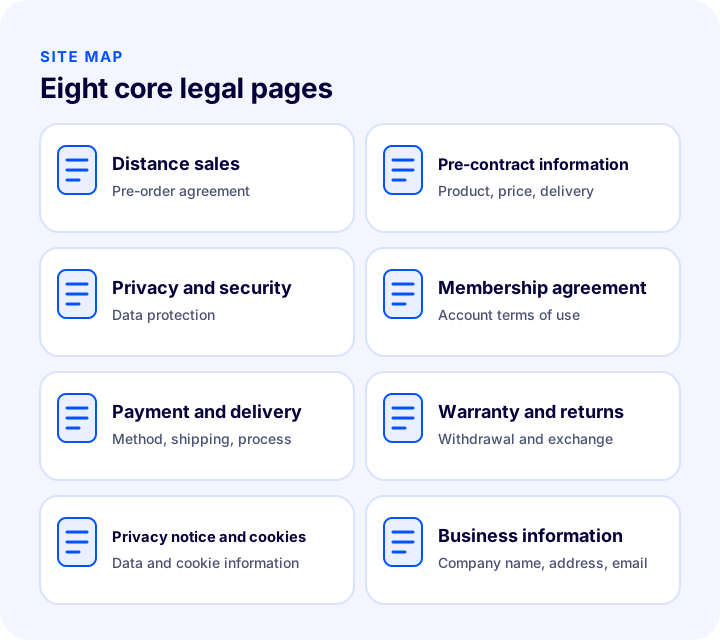
| Page | What does it tell you? | When does the customer read it? |
|---|---|---|
| Distance sales contract | Rights and obligations of seller and buyer | Before completing the order |
| Pre-contract information | The product's key features, price, delivery and withdrawal information | Before completing the order |
| Privacy and security | How data is collected and protected | When signing up and paying |
| Membership agreement | The site's terms of use and account rules | When signing up |
| Payment and delivery | Payment methods, shipping and delivery process | When deciding and after the order |
| Warranty and returns | Returns, exchange and withdrawal process | When deciding and when facing a problem |
| Privacy notice and cookie notice | Processing of personal data and use of cookies | When entering the site and filling in forms |
| Contact and business information | The business's name, address and contact channels | When looking for trust |
Why Do Legal Pages Matter?
Legal pages are a two-way trust tool: they show the customer clearly what they are buying, and give the business a written framework to turn to in the event of a dispute.
- They increase customer trust: A site with clearly visible return terms, delivery process and business information is perceived as more trustworthy than an unknown one.
- They reduce uncertainty: If customers can find the answer to "what happens if the product doesn't arrive?" before ordering, the support team gets fewer questions.
- They protect the business: Clear and accessible agreements show what the parties accepted in the event of a dispute.
- They support conversion: A customer who hesitates at the payment step usually looks for returns and delivery information; if they can't find it, they may abandon the cart.
What Is a Distance Sales Agreement and What Does It Include?
A distance sales agreement is a contract that puts in writing the rights and obligations relating to a sale made by seller and buyer without meeting face to face, through remote means of communication such as the internet. On most e-commerce sites, the customer confirms this text before completing the order.
The agreement generally includes the following headings; the mandatory scope is determined by legislation and should be clarified with your legal advisor:
- Parties: The seller's company name, address, tax information and contact details, and the buyer's name and address.
- Subject of the agreement: The sale and delivery of the ordered product or products.
- Order and product information: Product name, quantity, price, shipping fee and total amount.
- Payment and delivery: The payment method, delivery address and how the delivery is made.
- Withdrawal and returns: How the buyer exercises the right of withdrawal and how the returns process works.
- Disputes: The avenues to turn to in the event of a disagreement.
Is the Pre-Contract Information Form the Same as the Distance Sales Agreement?
The two complement each other but are not the same document. Pre-contract information presents the customer, before the order, with the product's key features, its price, delivery terms and withdrawal information; the distance sales agreement is the binding text based on this information. On many sites, both are shown together at the payment step and accepted with a single checkbox.
| Feature | Pre-contract information | Distance sales contract |
|---|---|---|
| Purpose | Giving information before purchase | To set the rights and obligations of the parties |
| Content | Product, price, delivery, withdrawal information | Parties, subject, payment, delivery, withdrawal, disputes |
| Where it is seen | Payment step | Payment step and after the order |
| Order information | Filled in according to the customer's cart | Filled in according to the customer's order |
Why Is a Privacy and Security Agreement Needed?
The privacy and security page describes what information the business collects from the customer, what it uses it for and how it protects it. Because information such as name, phone, address and email is required to place an order, customers want to know whether this information is safe.
- Information collected: Which information is taken at the registration, order and form stages.
- Purpose of use: Purposes such as delivering the order, customer service and permitted communication.
- Sharing: Which parties, such as the carrier and the payment provider, the information is shared with and on what grounds.
- Security measures: A general description of the technical and administrative measures taken to protect data.
- Communication preference: The choice of whether to receive campaign and informational messages and how to change this choice.
Statements about card information storage and payment security should be written especially carefully: describing a protection the site doesn't actually provide as if it did is misleading. Compare the text with how your site and payment infrastructure actually work.
Recommended readingHow to Ensure KVKK Compliance for an E-commerce Site? A Practical Guide to Privacy Notices, Explicit Consent, Cookies, IYS and Data Subject RequestsWhat Are the Privacy Notice and Cookie Notice?
The privacy notice (data disclosure text) is an information text that lets the person whose personal data is processed learn who is processing it, for what purpose, on what legal basis and with which rights. The cookie notice explains which cookies the site uses and why.
The privacy agreement and the privacy notice are often confused. While the privacy page generally describes the protection of data, the privacy notice is a separate text that meets the legal obligation to inform about the processing of personal data. Which texts must be published separately varies with legislation and your business's situation; work with your legal advisor on this.
- Where should the privacy notice appear? Next to the membership, contact and request forms, and in the footer.
- Where should the cookie notice appear? In the cookie banner shown on first entry to the site, and as a separate page in the footer.
- Customer choice: For non-essential cookies, it is important that the customer can make a choice and change that choice later.
What Does the Membership Agreement Cover?
The membership agreement, or site terms of use, sets the rules a customer follows when creating an account and using the site, and the limits of the service the business offers. Continuing to use the site generally means accepting these terms, so they should be presented visibly at the sign-up step.
- Account responsibility: Rules on the member keeping their account information safe.
- Accurate information: The expectation that the information given at registration is correct and up to date.
- Usage limits: How the site and its content may be used and what is prohibited.
- Intellectual property: Who owns the images, text and brands on the site.
- Right to change: That the business may update the terms and how this will be announced.
On sites where membership is not mandatory, customers can place an order without signing up. In this case, which agreement is confirmed at which step should be considered separately.
We recommend readingWhat Is Guest Checkout? Mandatory Registration in E-Commerce, Guest Payment and Encouraging Registration: A Practical GuideWhat Should the Payment and Delivery Terms Page Include?
The payment and delivery page explains how the customer can pay, how and when the order will arrive and what happens if there is a problem. Customers look for this page more than any other before placing an order.
- Payment methods: Credit card, bank transfer and other methods offered, along with installment options.
- Payment refund on order cancellation: How the payment is refunded in case of cancellation or a stock problem.
- Shipping and delivery: Which carrier is used, the preparation time and delivery regions.
- Shipping fee: Who pays it and in which cases it is free.
- Check on delivery: What the customer should do if the package is damaged.
If concrete information such as times and fees is stated on this page, it must match the business's actual practice exactly; for example, if the preparation time stated on the site is shorter than the real time in the warehouse, customer expectations cannot be met. Verify with your operations team before writing figures.
How Should Warranty and Return Terms Be Written?
The warranty and return terms page explains how the customer can return a product, in which cases an exchange or refund can be made and what happens if the product is faulty. Because the period and exceptions for the right of withdrawal are set by legislation, the statements on this page must not conflict with legislation; prepare the text together with your legal advisor.
- How a return is started: Through which channel and with what information the customer opens a return request.
- Condition of the product: Under what conditions a returned product is accepted.
- Non-returnable products: If there are product types that may fall outside the scope of returns under legislation, stating this clearly.
- Shipping fee: Who bears the cost of the return shipment.
- Payment refund: By which method and at what stage the money is refunded.
- Warranty certificate: How the certificate and the service process work for products under warranty.
What Should the Contact and Business Information Page Include?
The contact and business information page shows the channels through which the customer can reach the business and who the business is. When a customer has a problem, they want to know who to turn to; this page is one of the most concrete signs of trust.
- Trade name: The official name of the business.
- Address: A full address and, if needed, a map or directions.
- Tax information: Tax office and number; consult your legal and accounting advisors about which information to publish.
- Contact channels: Phone, email and, if available, live support or a form.
- Working hours: When customer service can be reached.
- Bank details: Account details if payment by bank transfer is accepted.
Why Must This Information Be Consistent on Every Page?
If the company name, address and phone are written differently on different pages, the customer can't tell which is correct and thinks the business is careless. Manage the information in one place and use the same version on the other pages.
Where Should Legal Pages Appear on the Site?
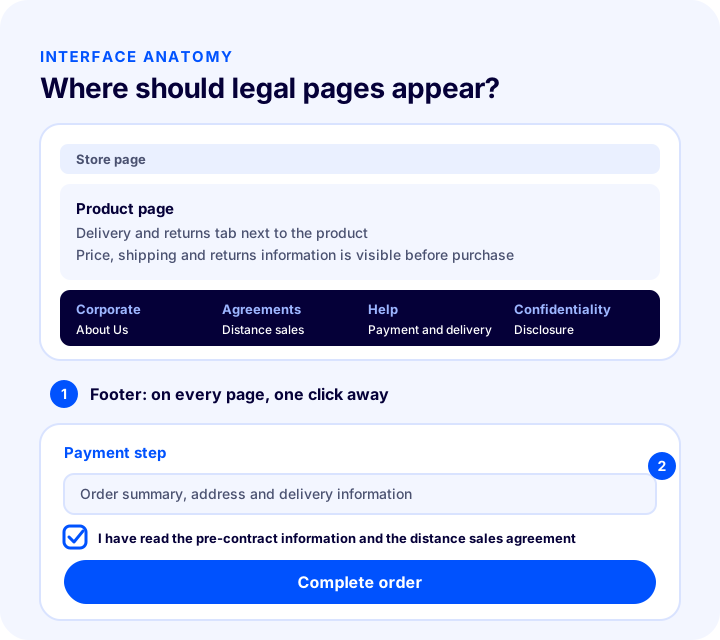
Legal pages have two main places: the footer and the payment step. Because the footer appears on every page, the pages can be reached from anywhere; the payment step is the critical point where the customer confirms the agreement.
| Location | Which pages? | Why there? |
|---|---|---|
| Footer (on every page) | All legal pages | The customer reaches them with one click at any time |
| Payment step | Pre-contract information and distance sales agreement, with a checkbox | Consent is obtained before purchase |
| Membership form | Membership agreement, privacy notice | The customer is informed before data is collected |
| Product page | Delivery and returns summary | Provides information at the moment of decision |
| Cookie banner | Cookie notice | A choice is taken on first entry to the site |
| Form and request fields | Link to the privacy notice | Information is given before the form is submitted |
How Should the Consent Checkbox at the Payment Step Work?
The order should not be completed without the checkbox being ticked, so that the customer can't proceed without reading the agreement; the text should also be presented through a link or window the customer can open and read. Not having the checkbox pre-ticked is a good practice to show that the customer gave conscious consent. For detailed requirements, consult your legal advisor.
- Name it clearly: Use a clear sentence such as "I have read and accept the pre-contract information and the distance sales agreement."
- Provide access to the text: Let the customer see the text without navigating to a new page.
- Show order-specific text: The agreement should show the customer's cart and address.
- Record the consent: It should be possible to keep a record showing which customer confirmed which text on which date.
Common Mistakes in E-Commerce Legal Pages
Most problems in legal pages stem not from ignorance but from haste and neglect. The mistakes below are especially common on newly built sites.
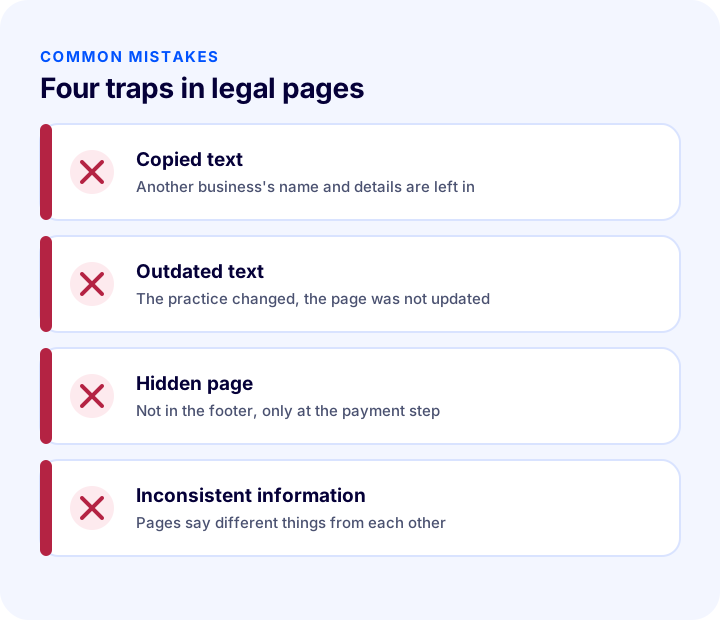
- Copying another business's text: The company name, address or product type remains that of the other business; the text doesn't reflect your actual practice.
- Not filling in the blanks in a sample text: Placeholders such as "……" and "XXXX" staying on the page is one of the most visible causes of lost trust.
- Not updating old text: The carrier, payment method or return process has changed but the page stays the same.
- Not putting the page in the footer: The customer can't find the return terms before placing an order.
- Skipping the checkbox: The customer can order without seeing the agreement, and no record of consent remains.
- Contradictions between pages: The returns page says one thing and the agreement says another.
- Preparing once and leaving it: As legislation and the business change, the texts must change too.
- Statements that don't reflect practice: Promising a security measure or convenience that isn't actually provided.
How Much Workload Does Updating Legal Pages Create?
Regularly reviewing legal pages is a time and cost item that depends on how many pages you have and how long you spend reviewing each. The tool below calculates the total time and internal cost based on your annual number of reviews. The values are examples; enter your own page count, time and hourly cost.
The main lesson the tool shows is that the workload grows linearly with the number of pages: merging pages that repeat the same information and managing shared information (company name, address, contact) in one place reduces both time and the risk of errors.
Okumanızı öneririzE-Ticaret Sitesi Güvenlik SistemleriHow Do You Audit Your Legal Page Setup?
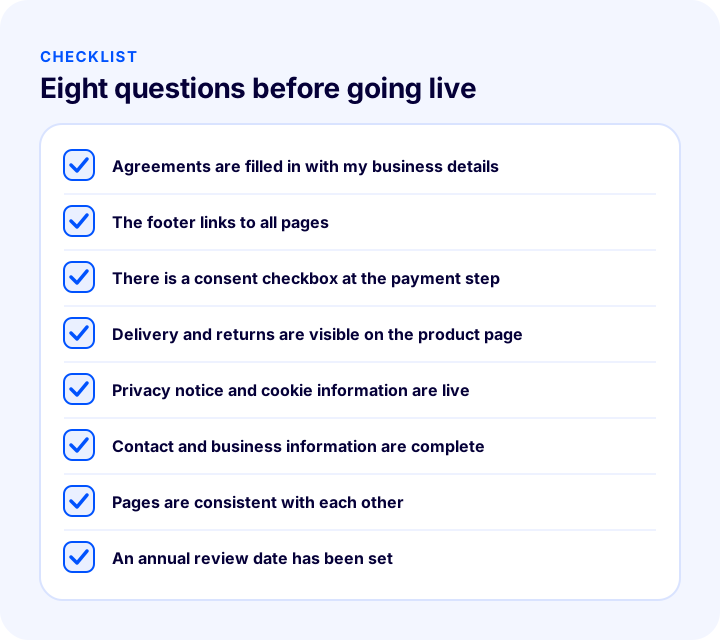
The tool below questions your current legal page setup with eight questions. Check the items that apply to you; the tool tells you how well the setup is in place. This audit is not a legal assessment; it only helps you see what is missing.
How Often Should Legal Pages Be Reviewed?
Legal pages are not texts to be written once and forgotten; they should be updated when something changes in your business or in legislation. There is no fixed "this many times a year" rule; the pace of change in your business determines the frequency.
| Trigger | Which page is affected? |
|---|---|
| The carrier or delivery process changed | Payment and delivery, pre-contract information |
| A payment method was added or removed | Payment and delivery, distance sales agreement |
| The returns or exchange practice changed | Warranty and returns, distance sales agreement |
| A new tracking code or tool was added | Cookie notice, privacy notice |
| Company name, address or contact information changed | All pages and business information |
| A legislative change | Pages determined by your legal advisor |
Who Should Prepare the Legal Pages?
Preparing legal pages with a legal advisor, or at least having them approved, is the safest route. Ready-made sample texts save time but don't fit every business exactly: the type of product sold, the delivery method, the payment infrastructure used and the data processed all differ.
- Ready-made samples are a starting point: Don't publish a sample text without adapting it to your own business.
- Fill in the business details yourself: The company name, address, tax information and contact channels must be specific to your business.
- Compare with practice: Every promise in the text must have a counterpart in operations.
- Ask for legal review: Get expert opinion especially on withdrawal, returns and personal data.
Consult your legal advisor for legal requirements. The information in this post outlines a general framework; the scope of agreements, mandatory content and time limits are determined by legislation and may change over time.
How Do You Manage Legal Pages with Faprika?
In the Faprika panel, you can create and edit information pages such as About Us, Contact Us, Terms of Use and Privacy Agreement. The training content also emphasizes that these pages, which customers can review, strengthen trust in the site.
- Custom page management: The panel lists existing pages; clicking a page opens the editing area, and "Add New" creates a new page. There are Page Information and SEO Information areas.
- Text editing: In the page content you can make text bold, underline it, add links, add images and set the font.
- Showing in the footer: When the "Active" option is checked, the page appears in the footer area; you can choose which footer column and in what position it appears.
- Showing in the menu: If you wish, the page can also be shown in the navigation menu.
- Product detail tab: Informational pages such as "Delivery and Returns" can appear as a tab on the product detail page.
- Language selection: A page can be created with Turkish or English content; for additional languages, you can contact the support team.
- Sample agreement texts: Faprika's training pages include sample texts for membership, payment and delivery, privacy and security, warranty and returns, and the distance sales agreement.
The sample agreement texts have blank fields where business details are to be written; these texts should not be published as they are, but adapted to your own business, product and practice and, if necessary, reviewed with your legal advisor. To add the texts as pages in the panel and place them in the footer, see Custom Page Management; for a general overview of page, menu and showcase management, see the Content Management training. For sample texts, you can review the distance sales, membership, payment and delivery, privacy and security and warranty and returns pages. For features that may vary by plan, see the plans page.
You can find how to plan the setup cost together with other cost items in our post How Much Does It Cost to Build an E-Commerce Site? A 2026 E-Commerce Site Cost and Line-by-Line Budget Guide, and the personal data side in our post How Do You Ensure KVKK Compliance for an E-Commerce Site? A Practical Guide to the Privacy Notice, Explicit Consent, Cookies, IYS and Data Subject Requests.
Frequently Asked Questions
Which legal pages should an e-commerce site have?
Most e-commerce sites have a distance sales agreement, pre-contract information, privacy and security, a membership agreement, payment and delivery, warranty and returns, a privacy notice and cookie notice, and contact and business information pages. The mandatory scope is determined by legislation; consult your legal advisor.
Are the distance sales agreement and pre-contract information the same thing?
No, they complement each other. Pre-contract information presents the product's key features, the price, delivery and withdrawal information before purchase; the distance sales agreement is the binding text that sets out the rights and obligations of the parties. On most sites, both are confirmed together at the payment step.
Where should legal pages appear on the site?
All legal pages should be reachable from the footer on every page; the pre-contract information and distance sales agreement should be presented with a consent checkbox at the payment step. A summary of delivery and returns should also appear on the product page, and the membership agreement and privacy notice on the registration form.
Can I use ready-made agreement templates as they are?
We don't recommend it. Sample texts are a starting point; they should be filled in with details specific to your business, such as your company name, address, product type, delivery and returns practice, and aligned with your actual practice. If possible, review them with your legal advisor.
How often should legal pages be updated?
There is no fixed frequency. They should be updated when shipping, payment method, returns practice, tracking codes or business information change and when legislation changes; they should also be reviewed as a whole at regular intervals.
How do you add legal pages in Faprika?
In the panel's custom page management, a page is created with "Add New"; enter the page name and content, mark it "Active" to show it in the footer, and choose the footer column and order. Faprika's training pages include sample texts for membership, payment and delivery, privacy, returns and distance sales; these should be adapted to your business.
You May Also Like
- What Is a Distance Sales Agreement? A Guide to Pre-Contract Information, Right of Withdrawal and Returns for E-Commerce Sites (2026)
- How Do You Ensure KVKK Compliance for an E-Commerce Site? A Practical Guide to the Privacy Notice, Explicit Consent, Cookies, IYS and Data Subject Requests
- What Is Guest Checkout? Mandatory Registration in E-Commerce, Guest Payment and Encouraging Registration: A Practical Guide
- How Much Does It Cost to Build an E-Commerce Site? A 2026 E-Commerce Site Cost and Line-by-Line Budget Guide