Contents 13 sections
- What Are ChatGPT Ads?
- How Do ChatGPT Ads Work?
- How Do ChatGPT Ads Differ from Other Ad Channels?
- How to Run a ChatGPT Ad from Turkey
- How to Measure Results in ChatGPT Ads
- Are ChatGPT Ads Worthwhile for E-Commerce Businesses?
- 30-Day Test Plan for ChatGPT Ads
- Which Products Can Stand Out in Which Chats?
- How to Write a ChatGPT Ad
- Visibility Without Ads: How to Appear in AI Answers
- 6 Common Mistakes in ChatGPT Ads
- Getting Ready for ChatGPT Ads with Faprika
- Frequently Asked Questions
The number of people who ask an AI assistant "which product should I buy?" instead of searching before deciding to shop grows every day. These chats are now ad space too: OpenAI began showing ads in ChatGPT in the US in early 2026, then expanded to Europe and Asia, and ChatGPT ads opened to advertisers in Turkey in mid-September 2026. A business established in Turkey can now open its own ad account and run campaigns inside ChatGPT.
As with every new ad channel, the first question is the same: does this channel make sense for my business, or is it too early? In this guide we explain what ChatGPT ads are, how they work, who sees them, how to run ads from Turkey, how to measure them and, most importantly, when they make sense for e-commerce businesses. At the end of the article you will also find a 30-day test plan that can be run on a small budget.
Note: The information in this article is based on OpenAI's statements to advertisers as of October 2026. The ad product is in beta; terms, formats and rules may change. Check the current terms in the ads manager before opening a campaign.
What Are ChatGPT Ads?
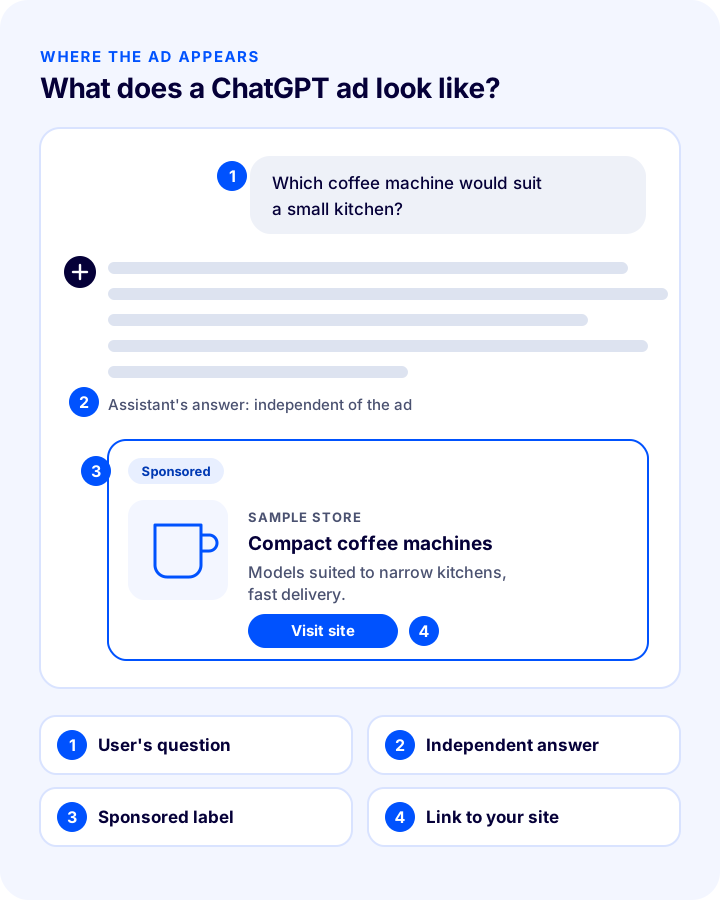
ChatGPT ads are ads labeled "sponsored" that appear below the answer in OpenAI's chat assistant ChatGPT when a product or service is relevant to the user's current chat. Advertisers set up their campaigns themselves through OpenAI's ads manager (Ads Manager) or run them through an agency.
Three features set ChatGPT ads apart from other digital ads:
- It matches the context of the chat, not a keyword: The ad is chosen by the topic of the chat, not by a single word the user typed.
- It sits below the answer, not inside it: The ad is always visually separated from the answer and marked as sponsored.
- It does not influence the answer: According to OpenAI, ads run on systems separate from the chat model; advertisers have no way to shape, rank or change ChatGPT's answer.
How Do ChatGPT Ads Work?
ChatGPT ads are shown below the answer, to an eligible user in an eligible conversation, when the topic of the user's chat matches the topic of the advertiser's campaign. When the user clicks the ad, they go to the advertiser's website; the measurement code on the site matches conversions after the click, such as a purchase or a form, to the ad.
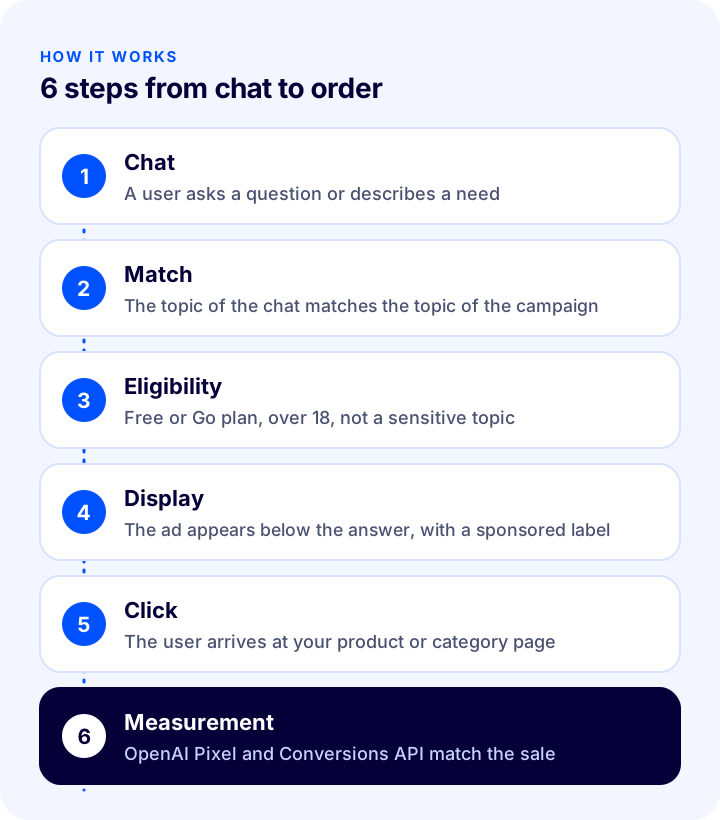
- Chat: The user asks ChatGPT a question or describes a need.
- Matching: The topic of the chat is matched with the topics of running campaigns.
- Eligibility: The user's plan, age and the topic of the chat are checked to see whether they are suitable for an ad.
- Display: If eligible, the ad is shown below the answer as sponsored.
- Click: The user clicks the ad and goes to the advertiser's website.
- Measurement: The measurement code on the site matches conversions such as purchases to the ad click.
Who Sees Ads, and Who Doesn't?
According to OpenAI, ads are shown only to users of ChatGPT's Free and Go plans. There are no ads on Plus, Pro, Business, Enterprise and Edu accounts. Ads are not shown to accounts determined to be under 18.
In Which Chats Do Ads Not Appear?
Ads are not shown in chats about sensitive or regulated topics such as personal health, mental health and politics. Political ads are not currently allowed. Advertisers in regulated sectors such as health and finance can run ads only if they meet strict eligibility requirements.
Is User Data Shared with Advertisers?
No. According to OpenAI, ads are selected using information that stays within ChatGPT, and chats are not shared with advertisers. Users can dismiss an ad, find out why they are seeing it, turn off ad personalization and delete the data used for ads. The advertiser sees the conversions measured on its own site and the aggregated reports in the ad manager; it does not see the content of the chat.
How Do ChatGPT Ads Differ from Other Ad Channels?
ChatGPT ads appear at a moment of need, like search ads, but they look at the whole context of the chat instead of a keyword; unlike social media ads, they do not try to catch attention but to answer the question being asked at that moment. Since it is still a new channel, there is little past data to compare against.
| Feature | Search ads | Social media ads | ChatGPT ads |
|---|---|---|---|
| Match | Keyword | Interests and audience | Context of the chat |
| User's intent | Searching | Browsing | Asking for advice, comparing |
| Ad placement | Search results | Feed, stories, video | Below the answer, labeled sponsored |
| Maturity of the channel | Mature, lots of data | Mature, lots of data | New, beta, little data |
| Who it reaches | Everyone who searches | Platform users | Only users of the Free and Go plans, over 18 |
| Measurement | Tag and conversion APIs | Pixel and conversion APIs | OpenAI Pixel and Conversions API |
How to Run a ChatGPT Ad from Turkey
To run a ChatGPT ad from Turkey, you open an account in the OpenAI ad manager (ads.openai.com) with a legal entity established in Turkey that will be invoiced, complete identity verification, add a payment method and create a campaign. An agency or intermediary is not required; a business can use the ad manager itself if it wishes.
- Open an account: Open the ad account in the name of the legal entity that will run the ads and be invoiced. Select Turkey as the country.
- Verify your identity and add payment: Enter the business details and the payment method. The billing currency is determined by the account.
- Set up measurement: Before the campaign, add the OpenAI Pixel to your site or send events from the server with the Conversions API; define conversion events such as purchase, add to cart and form.
- Create the campaign: Select the objective (traffic or conversion), the budget and the bid type. ChatGPT ads can be bought per click (CPC) and per thousand impressions (CPM).
- Prepare the ad content: Define the ad text that describes your product or service and the page that opens when it is clicked.
- Launch and monitor: Ads must comply with OpenAI's ad policies; after the campaign goes live, closely watch impressions, clicks and conversions in the first days.
How Is Measurement Done in ChatGPT Ads?
Measurement in ChatGPT ads is done with the OpenAI Pixel added to your site and the Conversions API, which sends events from the server. When an ad is clicked, a click reference is appended to the end of the landing page address; the pixel stores this reference in a first-party cookie and matches later purchase or form events to the click.
- Use the pixel and the API together: Events sent from the server fill in the ones lost to browser restrictions. If you send the same event through both routes, use the same event ID so it is not counted twice.
- Choose the right events: In e-commerce the main event is the purchase; in a new channel with little data, intermediate events such as add to cart and moving to the payment step also speed up learning.
- Do not strip URL parameters: A setup on the landing page that removes the parameters at the end of the address, or loses them in a redirect, breaks measurement.
- Compare with your own reports: Regularly compare the conversions in the ad manager with the order and source reports in your store panel.
Do ChatGPT Ads Make Sense for E-Commerce Businesses?
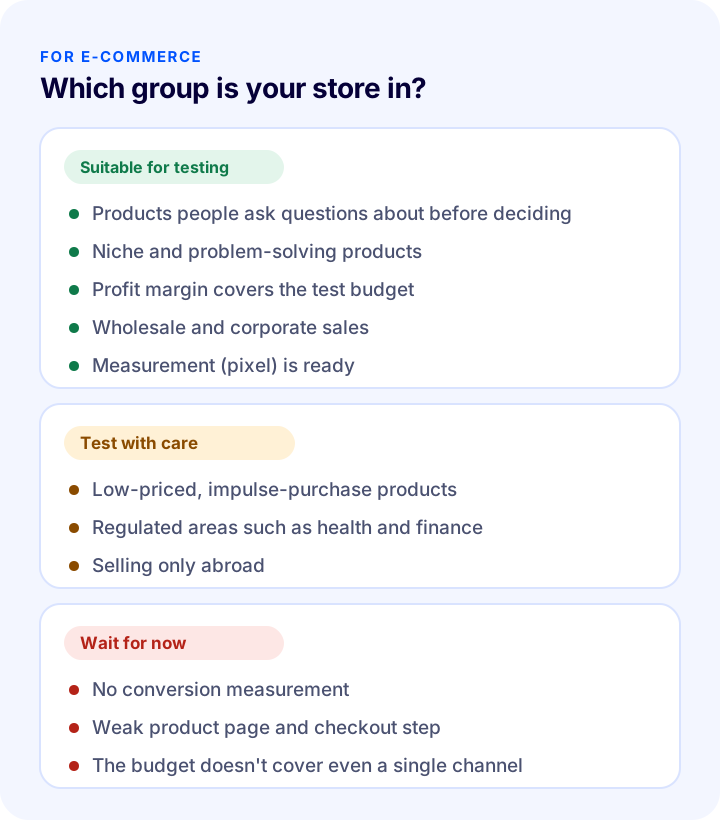
Short answer: For a store with measurement in place, a profit margin that allows testing ads, and a product that people ask questions about, it makes sense to test ChatGPT ads with a small budget. For a store with no measurement, a very limited budget, or one that only sells cheap, impulse-bought products, it is wiser to wait for now and strengthen its existing channels.
Stores Suited to Testing
- Those who sell products people ask questions about before deciding: Products people consult about with "which one should I buy?", such as electronics, home appliances, baby products, sports equipment and furniture, fit the chat context best.
- Those who offer a solution to a specific need: Niche products, products that require expertise and products that solve a problem come up naturally in chats.
- Those with a sufficient average basket and profit margin: In a new channel, the cost per click and conversion rate are uncertain at first; on products with thin margins, a test budget quickly turns into a loss.
- Those who sell B2B: Businesses also use AI assistants when researching suppliers and solutions; wholesale and corporate products are good candidates for testing.
- Those whose measurement is ready: Stores that can add the pixel to their site and send their conversions as events start learning from day one.
Those Who Should Test with Care
- Those who sell low-priced, impulse-bought products: Nobody has a long chat about an accessory that costs a few hundred liras; for these products, social media and marketplace ads are usually more efficient.
- Regulated sectors: Running ads in areas such as health and finance is subject to additional eligibility requirements, and ads are not shown in chats on these topics.
- Those who sell only abroad: Since new accounts can run ads only in their own country at first, targeting abroad may not open up right away.
Those Advised to Wait for Now
- Those without measurement: A store that cannot measure conversions will never know whether the ads worked.
- Those whose basic channels are not yet in place: A site with weak product pages, a poor mobile experience or a problematic payment step cannot turn visitors into sales, whichever channel they come from.
- Those with a very limited budget: Considering the minimum daily budget and the learning period, a store whose budget does not already stretch across a single channel should first grow its proven channels.
| Question | If your answer is "yes" |
|---|---|
| Do your customers ask questions about your product before buying? | The chat context fits your product. |
| Can you add the pixel and conversion events to your site? | You can learn from the test. |
| Can your profit margin bear a few weeks of test budget? | The test will not put you at a loss. |
| Are your product pages and payment step working smoothly? | Incoming traffic can convert into sales. |
| Do you know the cost of your current ad channels? | You have a benchmark to compare ChatGPT ads against. |
If you answer "yes" to at least four of these five questions, you are in a good position to start a small test.
We recommend readingE-Commerce Product Page: What Should It Look Like?30-Day Test Plan for ChatGPT Ads
The safest way to test ChatGPT ads is to run a four-week trial after setting up measurement, with a small number of products or categories, a predetermined budget and a success criterion. The goal is not to make a profit in the first month, but to learn whether the channel works for your products.
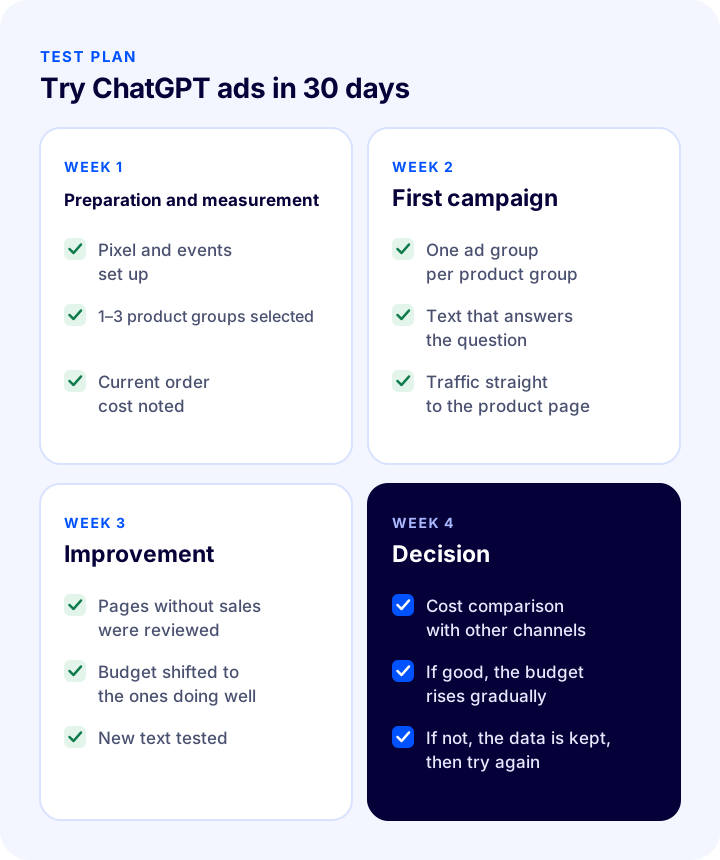
- Week 1, preparation and measurement: Set up the OpenAI Pixel and conversion events, and verify them with a test order. Choose the 1–3 product groups that will go into the test; the ones that get the most questions and have the best margins are ideal. Note the cost per order in your existing channels.
- Week 2, first campaign: Open separate ad groups for the product groups you selected. In the ad text, write the question the product solves and its standout benefit; send the person who clicks not to the home page but directly to the relevant product or category page.
- Week 3, improvement: Review the landing pages of ads that get clicks but bring no sales. Shift the budget of low-performing ad groups to the ones doing well, and try a new ad text.
- Week 4, decision: Compare the cost per order and the return with your other channels. If it is comparable or better, increase the budget gradually; if not, keep your measurement data and try again in a few months.
Which Products Can Stand Out in Which Chats?
Since ChatGPT ads are matched with the context of the chat, when planning your campaign think about the questions your customers will ask the assistant instead of a keyword list. The table below includes examples of how the link between a chat and a product can be built:
| User's chat (example) | Matching product or page | Information the ad should give |
|---|---|---|
| "Which coffee machine suits a small kitchen?" | Compact coffee machines category | Size, ease of use, delivery time |
| "What should I put in the hospital bag for a newborn?" | Ready-made hospital bag set | What the set contains, completing it in a single order |
| "What shoes should someone who is just starting to run buy?" | Beginner-level running shoes | Who they suit, ease of size exchange |
| "Where can I buy cups in bulk for our café?" | Wholesale or dealer page | Wholesale price, minimum order quantity, delivery time |
| "A meaningful gift for my mother's birthday" | Personalized gifts category | Personalization, gift wrapping, on-time delivery |
What these examples have in common is that the user is trying to make a decision. When your ad carries the information that helps with that decision, the likelihood of a click goes up.
How to Write a ChatGPT Ad
A good ChatGPT ad is short, concrete text that answers the need in the chat directly, says who it suits, and takes the person who clicks straight to the relevant product or category page. It does not shout; it simply makes the next step easier.
| Weak ad text | Strong ad text | Why? |
|---|---|---|
| "Big sale! Shop now." | "Compact coffee machines for small kitchens: models narrower than 30 cm, next-day shipping." | It answers the need and offers a concrete benefit. |
| "The best baby products are here." | "Ready hospital bag set: essentials for mother and baby in a single pack." | It completes the question the user asked. |
| "Wholesale cup sales." | "Wholesale cups for cafés and restaurants: carton prices, special pricing with dealer registration." | It says who it is for and the condition. |
The texts in the table are examples only. Every piece of information you write in the ad (shipping time, set contents, dimensions) must appear in the same way on the landing page; an inconsistency between the ad and the page lowers both trust and conversion.
Visibility Without Ads: How to Appear in AI Answers
Since ChatGPT ads do not influence the answer, having your brand and products appear naturally in AI assistants' answers is a separate job. This visibility is earned not with an ad budget but with your site's content and structure:
- Content that answers questions: Write guides and category texts that turn the questions your customers ask into headings and give a clear answer right below.
- Structured data: Structured data such as product, frequently asked questions and the content map (breadcrumb) makes it easier for machines to understand what your page is about.
- Rich product pages: Product descriptions with size, material, usage and comparison information give both the customer and AI more to work with.
- A summary file for AI: Files such as llms.txt are a new way of summarizing your site's key pages for AI tools.
Advertising and organic visibility are not rivals: ads let you test today, while content brings ad-free traffic over the long term.
Okumanızı öneririzLLMs.txt Nedir? Yapay Zeka ve E-Ticaret Rehberi6 Common Mistakes in ChatGPT Ads
- Launching a campaign without setting up measurement: The data from the first days is lost, and wrong decisions are made about the channel.
- Sending traffic to the home page: A visitor who arrives with a specific question will leave if they cannot find the product they are looking for.
- Testing all products at once: The budget is spread thin, and you cannot tell which product suits the channel.
- Reusing search ad copy as is: Short, keyword-focused copy falls flat in a conversational context.
- Deciding in the first week: New channels have a learning period; a channel should not be shut down or scaled up based on a few days of data.
- Cutting back other channels: The test budget should be set aside as a separate trial budget, not taken from the budget of proven channels.
Getting Ready for ChatGPT Ads with Faprika
The prerequisite for getting value from ChatGPT ads is a site with measurement in place, strong product pages, and the ability to turn incoming visitors into sales. These are the tools you can use for this preparation in the Faprika e-commerce infrastructure (you can see which feature starts in which plan on the e-commerce plans page):
- CSS / Script management screen: You can add measurement codes such as the OpenAI Pixel to your site from the panel.
- Landing pages: With page, landing, survey and application pages, you can send ad traffic to topic-specific pages.
- Bulk SEO and meta information updates: You manage the titles and descriptions of your product and category pages in bulk.
- Cart reminders and marketing automation: To win back visitors who came from an ad and left items in the cart, you can set up personalized coupon and reminder flows with cart reminders and Roket marketing automation.
- Speed: A content delivery network (CDN) is active in all plans; pages open quickly from servers close to the visitor.
Frequently Asked Questions
Are ChatGPT ads available in Turkey?
Yes. ChatGPT ads opened to advertisers in Turkey in mid-September 2026. A legal entity established and invoiced in Turkey can open its own account in the OpenAI ads manager and run campaigns inside ChatGPT.
How do you run ads on ChatGPT?
You open an account on behalf of the business in the OpenAI ads manager (ads.openai.com), complete identity verification and a payment method, set up measurement on your site with the OpenAI Pixel or Conversions API, and then create a campaign by defining the goal, budget, bid format and ad copy.
Who sees ChatGPT ads?
Ads are shown only to users over 18 who use ChatGPT's free (Free) and Go plans. There are no ads on Plus, Pro, Business, Enterprise and Edu accounts. Ads also do not appear in chats about sensitive topics such as health, mental health and politics.
Do ChatGPT ads influence the answers?
According to OpenAI, no. Ads run on systems separate from the chat model, are shown below the answer labeled as sponsored, and advertisers have no ability to shape, rank or change ChatGPT's answers.
How much do ChatGPT ads cost?
Ads are bought with a cost-per-click (CPC) or cost-per-thousand-impressions (CPM) bid; cost varies with competition and the campaign. The ads manager applies a minimum daily budget based on the account's currency; for accounts billed in dollars, this amount is 25 dollars.
Do ChatGPT ads make sense for e-commerce?
Testing with a small budget makes sense for stores that have measurement set up, whose profit margin allows a test budget, and that sell products customers ask questions about before buying. Stores without measurement, with a very limited budget, or that sell only cheap, impulse-purchase products are better off first strengthening their existing channels.