Contents 14 sections
- What Is a Distance Sales Contract?
- What Is the Difference Between the Pre-Contract Information Form and the Distance Sales Contract?
- What Information Should the Pre-Contract Form and the Contract Contain?
- What Is the Right of Withdrawal and How Long Does It Last?
- How Is the Right of Withdrawal Exercised and What Should the Seller Do?
- What Happens If the Product Is Out of Stock or Cannot Be Delivered?
- Who Pays for Returns? (2026 Change)
- In Which Cases Can the Right of Withdrawal Not Be Used?
- How Should the Distance Sales Contract Be Shown on the Payment Page?
- Which Headings Should a Distance Sales Contract Sample Include?
- 8 Common Mistakes in Distance Sales Contracts
- Distance Sales Contract Checklist
- Returns and Order Processes with Faprika
- Frequently Asked Questions
Anyone who opens an e-commerce site runs into two documents: the pre-contract information form and the distance sales contract. Often they are copied from another site, placed on the payment page and never looked at again. Yet these two texts set the rules of your relationship with the customer; when they are incomplete or wrong, the withdrawal period gets longer, return costs fall on the seller and the burden of proof in disputes weighs on you.
In this guide we explain, from the e-commerce business's point of view, what a distance sales contract is, how it differs from the pre-contract information form, what information the contract and the form must contain, the 14-day right of withdrawal, the cases where it cannot be used, return and refund periods, and the changes that took effect on 1 January 2026.
Note: This article is for general information only and is not legal advice. The information is based on Law No. 6502 on Consumer Protection and the Distance Contracts Regulation as in force in October 2026. We recommend having your contract texts reviewed by a lawyer for your business.
What Is Distance Sales Contract?
A distance sales contract is a sales contract concluded between a seller and a consumer without them being physically together, using remote communication means such as the internet or the telephone. Every order placed on an e-commerce site is a distance contract. These contracts are governed by Article 48 of Law No. 6502 on Consumer Protection and by the Distance Contracts Regulation published in the Official Gazette of 27 November 2014.
The regulation obliges the seller to inform the consumer before the order, to deliver the order within a set period, to grant the right of withdrawal and to make refunds within set periods. The distance sales contract text is the written presentation to the customer of how these obligations apply to your store.
Okumanızı öneririzE-Ticaret Mevzuatı Nedir?What Is the Difference Between the Pre-Contract Information Form and the Distance Sales Contract?
The pre-contract information form contains the information that must be given to the consumer before the contract is concluded, that is, before payment is made. The distance sales contract is the contract itself, formed with the order. In practice both are shown at the payment step and submitted for the customer's approval; after the order they are also sent to the customer on a durable medium (for example email).
| Pre-contract information form | Distance sales contract | |
|---|---|---|
| When? | Before the contract is concluded, before payment | With the order |
| Purpose | The consumer decides on an informed basis | To set the rights and obligations of the parties |
| Approval | The consumer must confirm being informed | Accepted with the order |
| If missing | Without confirmation, the contract is considered not concluded | Rights are determined by the provisions of the regulation |
Under the regulation, the seller is responsible for proving that the consumer confirmed receiving the pre-contract information; if confirmation is not obtained, the contract is considered not concluded. For this reason, the payment step should include a confirmation field showing that the form has been read.
We recommend readingWhat Is the Pre-Contract Information Form?What Information Should the Pre-Contract Form and the Contract Contain?
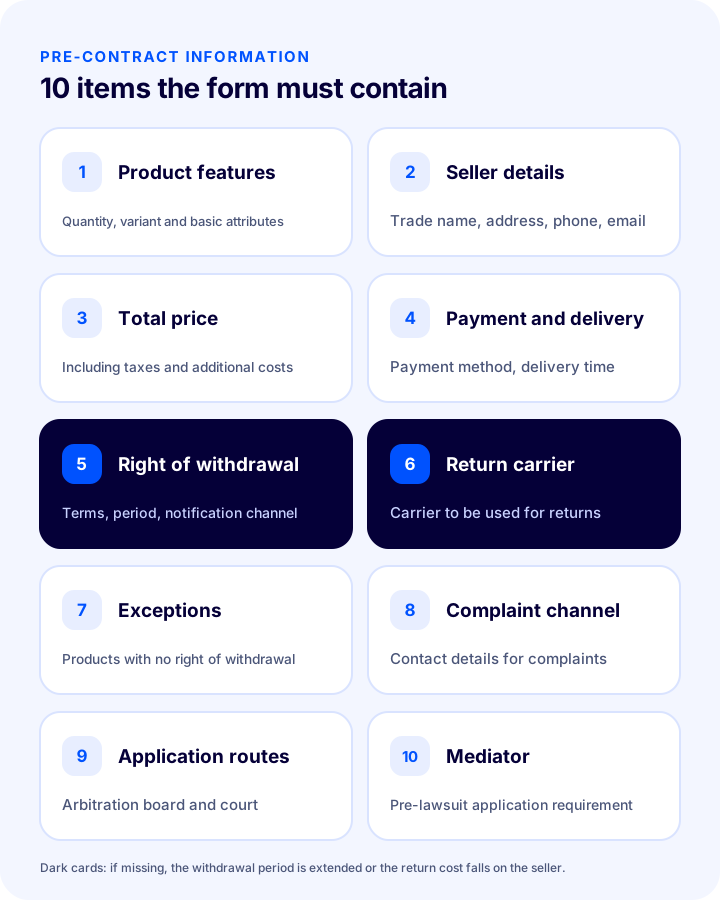
The pre-contract information and the contract must include: the product's main features, the seller's identity and contact details, the total price including taxes, payment and delivery information, the conditions, duration and method of exercising the right of withdrawal, the return carrier, the cases where there is no right of withdrawal, and the routes available in a dispute.
| Information | Description |
|---|---|
| Basic features of the product or service | What the product is, its features, quantity and variant details |
| Seller identity | Trade name, MERSIS number if any, full address, telephone and email |
| Complaint applications | Contact details where the consumer can send complaints |
| Total price | Total price including taxes, and any additional costs such as shipping |
| Payment, delivery and performance | Payment method, delivery time and method |
| Right of withdrawal | Conditions, duration and method of use, and the address or channel for the notice |
| Return carrier | Carrier (shipping company) to be used for returns |
| Cases without a right of withdrawal | If the product falls under an exception, this must be stated clearly |
| Guarantees | Any guarantees required from the consumer, and their conditions |
| Digital content | Where applicable, the functionality of the digital content and the hardware and software it is compatible with |
| Application routes | The right to apply to the Consumer Arbitration Committee and the Consumer Court; the requirement to apply to a mediator before filing a lawsuit |
The regulation requires this information to be given clearly, understandably and legibly, in at least 12-point size, in writing or on a durable medium. In online sales, key information such as the product's main features, the total price and delivery must be shown immediately before payment; any delivery restrictions and accepted payment methods must also be stated at the start of the order process at the latest.
What Is the Right of Withdrawal and How Long Does It Last?
The right of withdrawal is the consumer's right to withdraw from a distance contract within 14 days without giving any reason and without paying a penalty. For goods, the 14-day period starts on the day the goods are delivered to the consumer or to a third party designated by the consumer; for services, it starts on the day the contract is concluded.
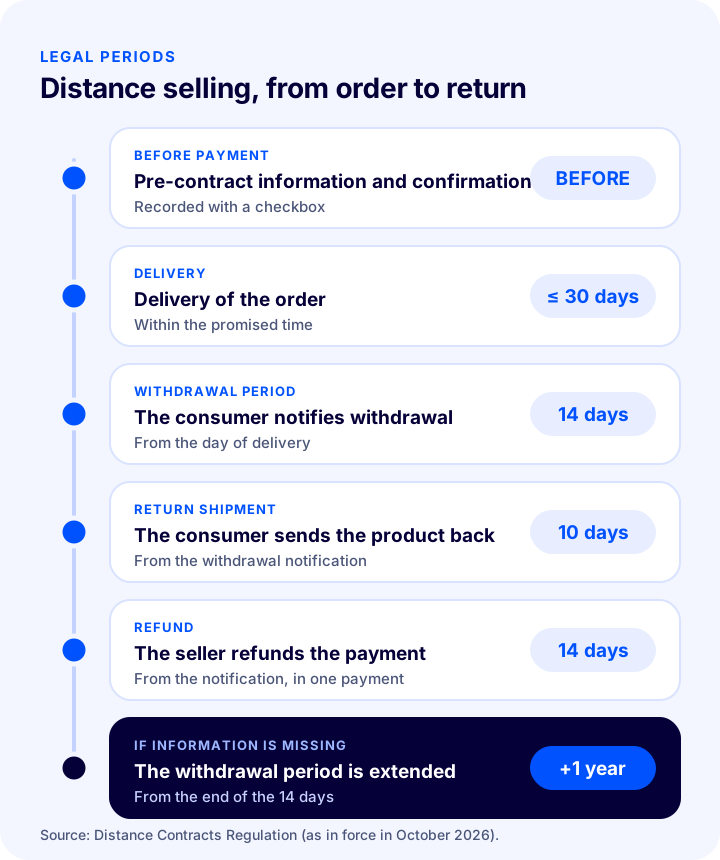
- Delivery time: The seller must deliver the order within the promised time and in any case within 30 days at the latest.
- Withdrawal period: 14 days from delivery. Within this period the consumer gives notice of withdrawal in writing or on a durable medium.
- Returning the product: Unless the seller offers to collect the product itself, the consumer sends the product back within 10 days of the withdrawal notice.
- Refund: Within 14 days of receiving the withdrawal notice, the seller refunds all payments collected, including delivery costs, using the payment method the consumer used and at no cost.
If the consumer is not properly informed about the right of withdrawal, the 14-day period does not start and the consumer can exercise the right for one year after the end of the withdrawal period. If the information is provided within this time, the 14 days run from the day it is provided. This is the most expensive consequence of an incomplete contract for the seller.
Okumanızı öneririzE-Ticarette Etkili İade Süreci Yönetimi Nasıl Olmalıdır?How Is the Right of Withdrawal Exercised and What Should the Seller Do?
The consumer exercises the right of withdrawal by notifying the seller, before the period expires, in writing or on a durable medium (for example email or the return request form on your site). It is enough for the notice to be given within the period; the product does not have to reach the seller within it. The consumer can also exercise the right of withdrawal after the contract is concluded but before the product is delivered.
On the seller's side, the process works through these steps:
- Receive and confirm the notice: When you receive the withdrawal notice through a channel on your site, immediately send the consumer confirmation that it has reached you.
- Communicate the return method: Send the customer the return carrier you stated in the pre-contract information and, if any, the return code.
- Receive and check the product: The consumer sends the product back within 10 days of the notice.
- Refund the payment in one go: Refund all payments you collected within 14 days of the notice, using the payment instrument the customer used and without charging extra costs, in a single payment.
- Correct the invoice: Prepare the return documents according to your accounting process.
Who is responsible for loss of value if the product has been used?
If the consumer used the product during the withdrawal period in line with its operation, technical features and instructions for use, they are not responsible for the resulting changes and deterioration. Trying on a pair of shoes at home, for example, falls within this scope. For this reason, a blanket statement in the contract such as “opened products are not accepted for return” is not a valid restriction for products outside the exceptions.
What Happens If the Product Is Out of Stock or Cannot Be Delivered?
The seller must deliver the order within the promised time, and for goods this period is at most 30 days. The regulation does not treat the product being out of stock as making performance impossible; in other words, saying “it is out of stock” does not by itself release the seller from liability. This is why the accuracy of the stock information you sell on is a legal matter.
If fulfilling the order truly becomes impossible, the seller must notify the consumer in writing or on a durable medium within three days of learning of it, and refund the payments collected. In practice this means the following: if your marketplace, store and website stocks are kept separately, the same product can be sold twice, which leads to both cancellations and customer complaints.
Okumanızı öneririzE-Ticaret Sitesi Açmak İçin Gerekli BelgelerWho Pays for Returns? (2026 Change)
As of 1 January 2026, no return cost can be charged to the consumer when the product is returned with the carrier the seller specified in the pre-contract information. Return costs also cannot be requested from the consumer if no return carrier was specified in the pre-contract information. This rule was introduced by the amendment published in Official Gazette No. 32909 of 24 May 2025.
This change has two consequences for e-commerce businesses:
- Specify and state your return carrier: State clearly in the pre-contract information which shipping company will be used for returns; give the customer a return code or an agreed return method.
- Include return cost in pricing: Since return shipping is now the seller's cost, add this cost to your profit calculation in categories with high return rates, and prioritize measures that reduce returns (accurate product information, size charts, realistic images).
In Which Cases Can the Right of Withdrawal Not Be Used?
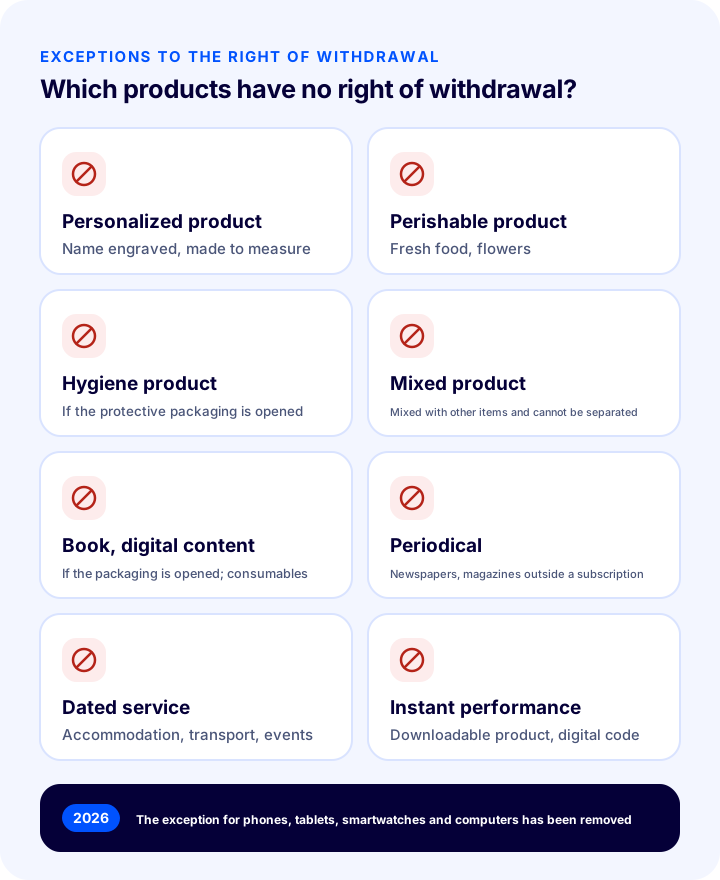
According to Article 15 of the Distance Contracts Regulation, unless the parties agree otherwise, the right of withdrawal cannot be used for custom-made products, perishable products, hygiene products whose packaging has been opened, products that mix with other products after delivery, books, digital content and computer consumables whose packaging has been opened, periodicals, services provided on a specific date, electronic services performed instantly, and services whose performance begins with the consumer's approval.
| Exception | E-commerce example |
|---|---|
| Goods whose price depends on fluctuations in the financial markets | Products such as gram gold |
| Goods prepared according to the consumer's wishes or personal needs | A gift with a printed name, a made-to-measure product |
| Goods that may spoil quickly or whose expiry date may pass | Fresh food, flowers |
| Goods whose protective packaging has been opened after delivery and whose return is unsuitable for health and hygiene reasons | Cosmetics and underwear with opened packaging |
| Goods that mix with other products after delivery and by their nature cannot be separated | Mixed bulk products |
| Books, digital content and computer consumables with opened packaging | Software box or cartridge with opened packaging |
| Periodicals such as newspapers and magazines, other than subscriptions | Single-issue magazine |
| Services that must be performed on a specific date or period, such as accommodation, transport and entertainment | Event ticket |
| Services performed instantly in an electronic environment and intangible goods delivered instantly | Downloadable digital product, code |
| Services whose performance begins with the consumer's approval before the withdrawal period expires | An installation or consulting service that has already started |
2026 change: The withdrawal exception previously included in the regulation for mobile phones, smartwatches, tablets and computers was repealed as of January 1, 2026. Stores that sell these products need to review their contracts and return processes in line with the current rule.
Okumanızı öneririzE-Ticarette İadesi Olmayan ÜrünlerHow Should the Distance Sales Contract Be Shown on the Checkout Page?
The pre-contractual information form and the distance sales contract must be displayed at the payment step, before the order is confirmed, in a way the customer can read, and the customer's reading and approval of them must be recorded with a separate consent field. After the order is completed, a copy of the texts must be sent to the customer by email.
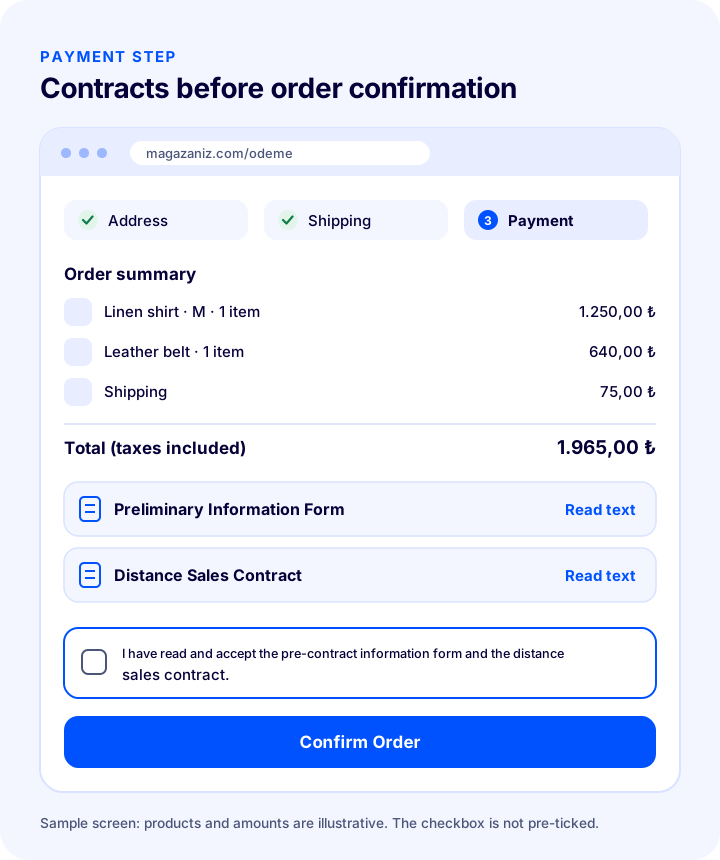
- Fill in the texts with the order details: The contract must be shown together with the customer's name, address, the products in the cart and the total amount.
- Show it legibly: The text should not be squeezed into a small box; it should be easy to read in a pop-up window or on the page.
- Get separate consent: The statement "I have read and approve the pre-contractual information form and the distance sales contract" must be obtained with a checkbox that is not pre-ticked.
- Send a copy: The texts must be delivered to the customer in the order confirmation email or as an attachment to it.
- Keep the record: The regulation requires the seller to keep the information and documents relating to each transaction for three years; this includes the record showing when and for which text the approval was obtained.
Which Headings Should a Distance Sales Contract Template Include?
Instead of copying another site's text, start from a blank template: in our distance sales contract template tutorial you will find a fillable template, from the parties to the dispute clause. Fill in the template according to your own operations using the headings below; when you write your store's real information under each heading, most of the inconsistencies found in copy-pasted texts disappear.
| Title | What should it contain? |
|---|---|
| Parties | The seller's trade name, address and contact details; the buyer's name, delivery address and billing address |
| Subject of the contract | The products in the order, quantities, variants and sale prices |
| Payment | Payment method, installment information if any, total amount including shipping |
| Delivery | Delivery time, delivery method and shipping information |
| Right of withdrawal | Period, notification channel, return carrier, return address and refund period |
| Exceptions to the right of withdrawal | The product groups sold in your store that fall under an exception |
| Disputes | Applications to the Consumer Arbitration Committee, the consumer court and a mediator |
| Entry into force | That the contract is formed upon order confirmation and the channel through which a copy will be sent |
Sales to corporate customers who buy for commercial or professional purposes are not considered consumer transactions; however, if you sell to both individual and corporate customers on the same site, the safest approach is to show the consumer-facing texts in full with every order. It is also important that the language you use in the contract is plain: alongside legal terms, use short sentences that directly answer the customer's question, "how do I return the product, and when will I get my money?" Write the same information consistently on your site's returns and exchanges page as well; when the two texts contradict each other, this ambiguity may be interpreted against you in a dispute.
The seller's fixed details can stay as static text; the buyer's details, products and amounts, however, should be filled in automatically for every order. That way, the customer sees the contract that belongs to their own order.
We recommend readingDistance Sales Contract Template8 Common Mistakes in Distance Sales Contracts
- Copying another site's text: The carrier, delivery time and return address will not match your operations.
- Giving incomplete information about the right of withdrawal: The 14-day period does not start and may be extended by up to one year.
- Not specifying the return carrier: From 2026, the consumer cannot be charged for return costs.
- Providing the consent checkbox pre-ticked: It cannot be proven that the customer gave their approval knowingly.
- Presenting a non-excepted product as excepted: The exceptions in the regulation are limited; the statement "no returns" cannot be written for every product.
- Not updating old texts: The 2026 changes concerning electronic devices and return costs are not included in old contracts.
- Leaving out the mediator application information: The pre-contractual information must also state, among the dispute routes, the requirement to apply to a mediator before filing a lawsuit.
- Delaying the refund: The refund must be made within 14 days of the withdrawal notice and by the same payment method.
Distance Sales Contract Checklist
Review your contract and pre-contractual information texts using the list below.
- Are the seller's trade name, address, phone and email up to date?
- Are the product details and the total price including taxes shown with the order?
- Does the delivery time not exceed 30 days at most?
- Are the conditions, period and notification channel for the right of withdrawal stated in writing?
- Are the return carrier and return method specified?
- Are the products covered by an exception stated correctly and clearly?
- Is there information on the Consumer Arbitration Committee, the consumer court and the mediator?
- Is there a consent field that is not pre-ticked at the payment step?
- Are the texts sent to the customer by email after the order?
- Are approval records kept for three years?
Returns and Order Processes with Faprika
To apply the periods and rules you write in your contract in practice, the Faprika e-commerce platform includes the following tools (you can see which feature starts in which plan on the e-commerce plans page):
- Return management: You manage returns from the panel and process credit card refunds from the panel.
- Order and return statuses: You create your own order and return statuses and follow the process step by step.
- Automatic e-Invoice and e-Archive: Invoices for orders are issued automatically.
- Shipping integrations: You manage shipments and tracking information with your carrier from the panel.
- Cookie management: You manage visitors' cookie preferences.
- Guest checkout: Customers can place an order without registering; the payment step gets shorter.
Frequently Asked Questions
What is a distance sales contract?
A distance sales contract is a sales contract that the seller and the consumer conclude through remote means of communication such as the internet or the telephone, without being physically present together. Every order placed on an e-commerce site is a distance contract and is subject to Law No. 6502 and the Distance Contracts Regulation.
Is a Distance Sales Contract Mandatory on an E-Commerce Site?
Every e-commerce site that sells to consumers must provide the information listed in the regulation as pre-contractual information before the contract is concluded, ensure that the consumer confirms they have been informed, and deliver the contract information to the consumer on a durable medium. If confirmation is not obtained, the contract is deemed not to have been concluded.
How long is the withdrawal period?
The withdrawal period is 14 days and, for goods, starts on the day the product is delivered to the consumer. If the consumer is not properly informed about the right of withdrawal, the period does not start and the consumer can exercise the right for one year after the period would have ended.
How soon must the seller issue the refund?
Within 14 days of receiving the withdrawal notice, the seller must refund all payments collected, including delivery costs, using the payment method the consumer used and at no cost. The consumer must also return the product within 10 days of the notice.
Who pays for return shipping?
As of 1 January 2026, no return cost can be charged to the consumer when the product is returned with the carrier the seller specified in the pre-contract information, or when no return carrier was specified in it.
Is there a right of withdrawal for mobile phones and computers?
The withdrawal exception in the regulation for mobile phones, smartwatches, tablets and computers was repealed as of 1 January 2026. For these products, the right of withdrawal can be exercised under the conditions set out in the law.