Contents 15 sections
- What Is Order Splitting?
- Why Is Order Splitting Needed?
- What Criteria Is an Order Split By?
- How Does a Split Order Appear to the Customer?
- How Is Order Splitting Managed on a Marketplace?
- How Is the Effect of Order Splitting on Shipping Cost Calculated?
- Order Splitting Needs Check
- How Do You Set Up Order Splitting Rules Step by Step?
- Which Businesses Benefit Most from Order Splitting?
- How Is a Split Order Managed in the Warehouse?
- How Do You Measure Success in Order Splitting?
- Common Mistakes in Order Splitting
- Order Splitting Checklist
- Order Splitting with Faprika
- Frequently Asked Questions
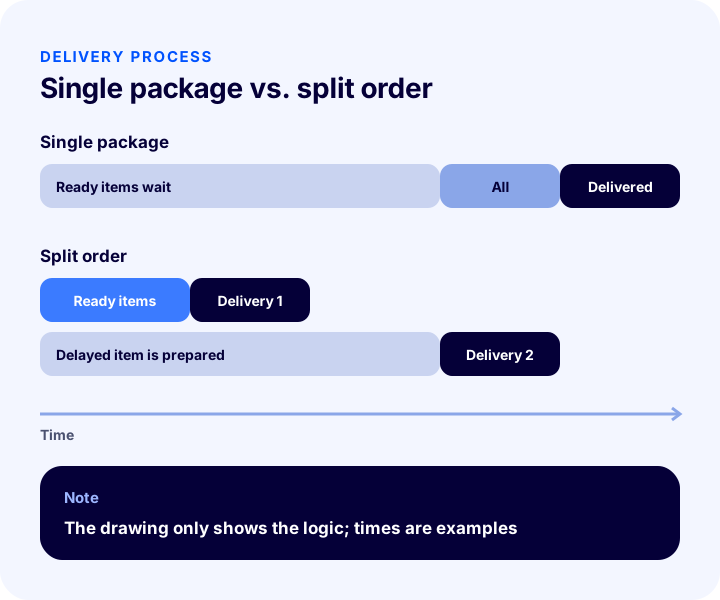
A customer placed an order with three items. Two are on the shelf and one is in another warehouse or with a supplier. If you wait for the third item to ship everything in one package, the ready items sit in the warehouse for days; the customer waits, opens a support request or cancels the order. The short answer to what is order splitting is this: separating the products in a single order into multiple packages by criteria such as stock, lead time, weight or warehouse, and shipping each part separately.
In this guide we explain step by step what order splitting is, when it is needed, how a split order is handled for tracking, invoicing and returns, how it affects shipping cost and how to set up the rules. Of the two tools in this article, one shows the effect of splitting on shipping cost and the other checks how much your store needs order splitting.
What Is Order Splitting?
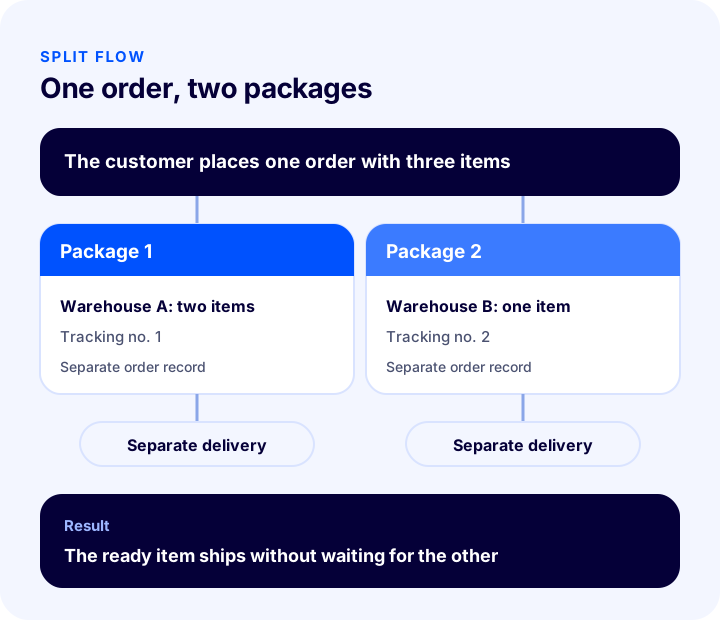
Order splitting is dividing an order into more than one shipment. The customer places a single order; behind the scenes the store splits it into parts according to the status of the products. Each part leaves in its own package, from its own warehouse if needed, with its own carrier tracking number.
For the customer it means “my ready items arrived right away, the rest came later.” For the store it means shipping an in-stock item without waiting for another one to arrive, relieving the warehouse and shortening delivery time.
Are Order Splitting, Partial Shipment and Multi-Package the Same Thing?
The three concepts are close but different. Not confusing one with another makes it easier both to give the customer the right information and to set up operations correctly.
| Concept | What does it tell you? | Example |
|---|---|---|
| Order splitting | The order is divided into separate shipments by rules; each part is tracked separately | Two items leave from different warehouses with separate tracking numbers |
| Partial shipment | Only the ready part of the order is shipped, the rest later | Ready item today, missing item when stock arrives |
| Multi-package | A single shipment is placed in more than one box | A large item in two boxes, one tracking number |
Why Is Order Splitting Needed?
A single-package setup is simple, but not every order is simple. Items may be in different warehouses, with different suppliers or have different preparation times. Gathering the whole order into one package then means being tied to the speed of the slowest item.
- Does not hold ready items: An in-stock item ships to the customer without waiting for the missing one.
- Shortens delivery time: The customer gets part of the items early, and the feeling of waiting fades.
- Manages shipping cost: Large and bulky items can be shipped separately and directed to a suitable carrier and desi.
- Reduces the risk of damage: Not putting fragile and heavy items in the same box can reduce damage.
- Makes multi-warehouse operations possible: If items are in different warehouses or stores, each can ship from its own location.
- Prevents cancellation: It stops the whole order from being canceled because of a single missing item.
What Criteria Is an Order Split By?
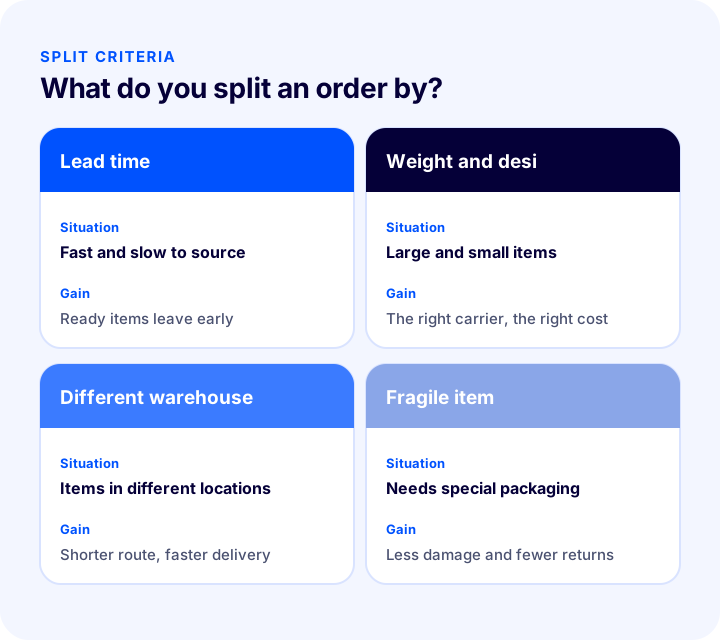
A splitting rule is a criterion of the form “separate the order in this case.” Four criteria cover most businesses' real needs.
1. By Lead Time of the Products
If some items in the same order are sourced quickly and others slowly, the system divides the order into different shipments. The customer receives the quickly sourced items sooner; the whole order does not wait for the late item.
2. By Weight and Desi
Bulky and heavy items are shipped separately to optimize transport cost and reduce the risk of damage. Small and light items can be prepared as a different package. For the desi concept, see our article Desi Calculation: How Is Shipping Desi Calculated? (Calculator and Examples).
3. When Shipping from Different Warehouses Is Required
If the items in an order are in different warehouses or stores, the order is organized so that each item leaves from its own location. In multi-warehouse businesses this shortens the shipping route and the time.
4. Fragile Products or Those Needing Special Packaging
Putting breakable, liquid or special-packaging items in the same box as others raises the risk of both damage and returns. Packing these items separately makes safe delivery easier.
| Criterion | When does it apply? | Gain |
|---|---|---|
| Lead time | Items have different ready times | The ready item leaves early |
| Weight and desi | Large and small item in the same order | The right carrier, the right cost |
| Different warehouse | Items in different locations | Shorter route, faster delivery |
| Fragile item | Special packaging is required | Less damage and fewer returns |
How Does a Split Order Appear to the Customer?
Order splitting creates confusion if the customer is not informed. The customer placed one order; they will see two separate carrier tracking numbers, two separate deliveries and sometimes two different days. That is why splitting should be considered together with the right communication.
- Separate tracking for each part: The customer should be able to see where each package is separately.
- Advance notice: The order confirmation or shipping notification should clearly say the order will arrive in more than one package.
- A notification for each package: Handed to carrier and delivered updates should go out separately for each part.
- Consistent order number: Parts should be linked to the main order; the customer should understand which package belongs to what.
- Short, clear language: Clear wording such as “Your order will arrive in two packages; the first has been shipped” reduces support requests.
How Do Invoicing and Returns Work?
A split order appears to the customer as “two packages” in their place; however, commercial documents and return rules differ from country to country. Confirm with your accounting lead whether the parts will be shown with separate invoices or a single document. On the returns side, being able to return each part separately is convenient for the customer; they do not have to send back the whole order to return a single item.
Okumanızı öneririzE-Ticarette Etkili İade Süreci Yönetimi Nasıl Olmalıdır?How Is Order Splitting Managed on a Marketplace?
When marketplace orders are split, two systems must be updated together: your own order system and the marketplace panel. Done by hand, entering the tracking numbers of the parts into the marketplace one by one, and processing them without mixing up which package is which part, is time-consuming and error-prone.
- A separate record for each part: Each part of a split order should be tracked with its own order record.
- Passing the tracking number to the marketplace: Each part's shipping information must be passed to the marketplace correctly.
- Alignment with the carrier: A shipping record must be opened for each package and a suitable carrier chosen.
- Automation: If the splitting rule and synchronization do not run automatically, operations quickly get tangled at high volume.
To choose the carrier for marketplace orders automatically by rules, see our article What Is Automatic Carrier Assignment? How to Automate Carrier Selection by Order: Scenarios, Priority Order, Cost Calculator and Needs Check; when the two work together, each part leaves from the right place with the right carrier.
How Is the Effect of Order Splitting on Shipping Cost Calculated?
Splitting an order does not always lower shipping cost. Sometimes sending a large, heavy item with an economical carrier reduces the total; sometimes two separate packages cost more than one. Before deciding, you need to put the cost of both options side by side. The tool below calculates the monthly difference and the average per package from the single-package fee and the fees of the two split packages. The values are examples; enter the fees from your own carrier agreement.
What the tool shows is that the cost effect of splitting is not a fixed rule; it varies with products, desi and your carrier. That is why, when setting up a rule, you should first compare a few representative orders.
Order Splitting Needs Check
The tool below checks your store with eight questions. Tick the items that fit you; the tool tells you how much you need order splitting.
How Do You Set Up Order Splitting Rules Step by Step?
A good splitting setup relies on a few clear rules. Complicated rules that split every item on its own inflate both cost and operations.
- Identify the problem: Find the common cause of orders that are late, canceled or arrive damaged.
- Choose the criterion: Decide the criterion that solves the problem (lead time, warehouse, desi, fragility).
- Write the rule clearly: Define one-sentence rules such as “items in this warehouse go in a separate package.”
- Set a threshold: Set a lower limit that prevents splitting for small items.
- Connect the shipping and tracking flow: Make sure each part's carrier and tracking number are clear.
- Prepare the customer notification: Write an explanatory message template for split orders.
- Start with a limited trial: Observe the rule on a small number of orders.
- Monitor and improve: Update the rule based on delivery time, cost and complaint data.
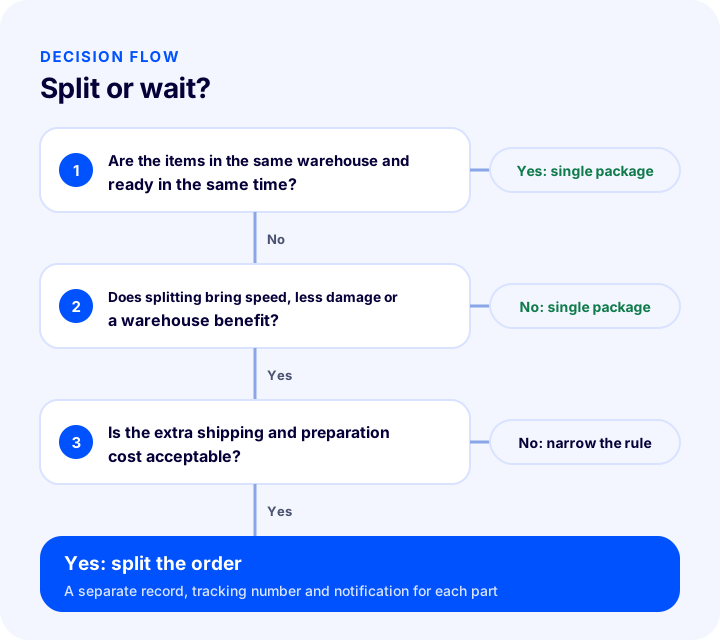
Split or Wait?
You do not need to make a splitting decision for every order. A simple decision flow gives the right answer in most cases.
Which Businesses Benefit Most from Order Splitting?
Order splitting does not produce the same value for every business. It brings clear benefit where the product range is wide, stock is scattered or preparation times differ; in a store that sells uniform, small items from a single warehouse, it is often not needed.
| Business profile | Why does splitting help? |
|---|---|
| A business with more than one warehouse or store | Each item leaves from its own location, shortening route and time |
| A seller who ships directly from the supplier | An item from their own stock does not wait for the item coming from the supplier |
| A store selling large items such as furniture and appliances | Large items go with a logistics company, small items with a carrier |
| A store selling fragile items (glass, ceramics, electronics) | Delicate items are packed separately and with care |
| A brand that produces to order | Ready items ship immediately, items in production ship when ready |
| A small store shipping a single type of item from one warehouse | Usually not needed; a single-package setup is enough |
How Is a Split Order Managed in the Warehouse?
Order splitting shows up not only in software but in the warehouse as well. If the picking, packing and labeling team cannot clearly see that an order has been divided into several parts, the parts get mixed up, a package ships incomplete or the same item is prepared twice.
- See each part as a separate work order: In the picking list, each part should appear on its own line with its own code.
- Print the label per part: Each package should carry its own shipping label and a number pointing to the main order.
- Make it clear at the packing station: The person packing should see at a glance which part of the order this package is.
- Match the parts leaving from different warehouses: If items leave from different locations, each location's team prepares only its own part.
- Keep counts up to date: In a split order, stock is reduced as each part ships; movements must be recorded to avoid count differences.
How Do You Measure Success in Order Splitting?
Once the rules are set up, track their effect with a few indicators. All of them can be derived from existing order and shipping data.
- Average delivery time: Has the delivery time of the first part of split orders become shorter?
- Cancellations due to waiting: Have orders canceled because of a single missing item decreased?
- Shipping cost per order: How has splitting affected the average shipping cost?
- Damage and returns: Have the damage and return rates dropped for fragile items?
- Support requests: Has “Where is the rest of my order?” increased or decreased?
- Split order rate: What share of orders is split, and is that where you expected?
Common Mistakes in Order Splitting
- Not informing the customer: If it is not explained that one order arrives in two packages, it is mistaken for an incomplete delivery.
- Splitting every order: Needless splitting creates extra shipping and preparation cost.
- Combining the parts under one tracking number: The customer cannot see where each package is.
- Forgetting to pass it to the marketplace: If the tracking of the parts does not reach the marketplace, the order looks delayed.
- Not testing the rule: A faulty rule can split hundreds of orders wrongly.
- Not thinking about the return flow: Being able to return each part separately must be clear from the start.
- Not informing the warehouse team: If a split order is not clearly visible to the picking and packing team, parts get mixed up.
- Not measuring results: If the cost and speed effect of splitting is not monitored, the value of the rule is unknown.
Order Splitting Checklist
| Title | To check |
|---|---|
| Problem | Is the problem that splitting will solve clear? |
| Criterion | Is the splitting criterion (sourcing, warehouse, desi, fragility) defined? |
| Threshold | Is there a splitting limit for small items? |
| Tracking | Does each part have its own order record and tracking number? |
| Marketplace | Are the parts passed to the marketplace and carrier automatically? |
| Customer | Is there an explanatory notification for split orders? |
| Returns | Can each part be returned separately? |
| Warehouse | Does the picking and packing team see the parts clearly? |
| Cost | Is the effect of splitting on shipping cost measured? |
| Report | Are delivery time, cancellations and damage monitored? |
Order Splitting with Faprika
In Faprika, this is done with the Order Splitting System. Which plan includes it varies by plan; for details, see the e-commerce plans and Order Splitting System pages.
- Automatic splitting by set criteria: The system analyzes the order contents and splits the order according to the set rules, making shipping faster and more flexible.
- By lead time: If some items in the same order are sourced quickly and others slowly, the order is divided into different shipments.
- By weight and desi: Bulky and heavy items are shipped separately to optimize transport cost and reduce the risk of damage.
- Shipping from different warehouses: If items are in different warehouses or stores, the suitable warehouse or store is chosen and the order is organized to leave from the relevant location.
- Each part is tracked separately: When an order is split, a separate order record is created for each part, the parts are synchronized with marketplaces and separate carrier tracking numbers are assigned.
- Alignment with marketplaces and carriers: Orders from marketplaces are split automatically; shipping processes run in sync with carriers.
- Together with automatic carrier assignment: To send each part with a suitable carrier, it can be used together with Automatic Carrier Assignment, and for multi-warehouse operations with the WMS Warehouse Management System.
For stock movement between stores, see also our article How to Transfer Between Warehouses? Stock Transfer Step-by-Step Guide.
Frequently Asked Questions
What is order splitting?
Order splitting means separating the products in a single order into multiple packages by criteria such as stock status, lead time, weight, desi or warehouse, and shipping each part separately. Each part is tracked with its own order record and tracking number; the ready item ships without waiting for the other.
When is an order split?
Splitting makes sense when items are in different warehouses, lead times differ, large and small items are in the same order, or fragile items must be packed separately. It is also used to manage shipping cost and the risk of damage.
How does the customer track each part of a split order?
A separate tracking number is assigned to each part, and notifications such as handed to carrier and delivered go out separately for each package. Telling the customer in advance that the order will arrive in more than one package reduces support requests.
Does splitting an order reduce shipping cost?
Not always. Sending a large, heavy item with an economical carrier can lower cost; in some cases two separate packages cost more than one. Before deciding, compare the single-package and split fees.
Can marketplace orders also be split?
Yes, but tracking for the parts must be processed correctly in both your system and the marketplace. In the Faprika Order Splitting System, orders from marketplaces are split automatically; a separate order record is created for each part and synchronized with the marketplaces.
How are returns handled for a split order?
Because each part is tracked as a separate order record, parts can be returned individually; the customer does not have to send back the whole order to return a single item. Return and document rules vary by country, so confirm them with your accounting lead.
You May Also Like
- What Is Automatic Carrier Assignment? How to Automate Carrier Selection by Order: Scenarios, Priority Order, Cost Calculator and Needs Check
- What Is E-Commerce Order Management? A Step-by-Step Guide from Order to Delivery
- How to Transfer Between Warehouses? Stock Transfer Step-by-Step Guide
- Desi Calculation: How Is Shipping Desi Calculated? (Calculator and Examples)