Contents 17 sections
- What Is a Discount Coupon?
- What Is a Discount Coupon Used For?
- What Are the Types of Discount Coupons?
- How to Create a Coupon Code?
- How to Set the Coupon Amount Based on Profit Margin?
- Percentage Coupon or Fixed Amount Coupon?
- Open-to-All Coupon or Personal Coupon?
- How to Prevent Coupon Abuse?
- In Which Situations Should a Coupon Be Used?
- How to Announce a Coupon Code?
- What Is Coupon Dependence and How Do You Prevent It?
- How to Prepare a Sample Coupon Plan?
- How to Measure Coupon Performance?
- Common Mistakes in Coupon Campaigns
- Discount Coupon Checklist
- Coupon and Campaign Management with Faprika
- Frequently Asked Questions
The coupon is one of the oldest but most misused marketing tools of e-commerce. A well-designed coupon brings the first order, turns a product left in the cart into a sale, and wins back a customer who has drifted away. A badly designed one gives a needless discount to a customer who would have bought anyway, leaks onto coupon sites, and quietly erodes profit.
In this guide, we explain with examples the concept of the discount coupon, the coupon types, how to create a coupon code step by step, how to set the coupon amount based on profit margin, and how to measure coupon performance.
What Is a Discount Coupon?
A discount coupon is a campaign tool that lets a customer get a discount, free shipping or a gift product on their order by entering a code at the payment step or by using a benefit assigned to their account. A coupon code is the string of letters and numbers that carries this benefit; for example, the code “HOSGELDIN10” could mean 10% off the first order.
Coupons fall into two groups: public coupons are campaign codes that many customers can use, while personal coupons are codes generated for a single customer, usually for one use only. Unlike a campaign discount, the discount is not applied to everyone automatically; it goes only to the customer who knows the code or who has been sent one.
What Is a Discount Coupon Used For?
A coupon is used to trigger a specific customer behavior; a coupon with no clear goal is just a price cut.
- Wins the first order: A welcome coupon gives a first-time visitor who doesn't yet trust the store a reason to take the first step.
- Recovers abandoned sales: A coupon sent to a customer who added a product to the cart and left can turn hesitation into a sale.
- Brings back customers who drifted away: A personal coupon for a customer who hasn't ordered for a long time can turn them back into an active customer.
- Raises the average cart value: A coupon for orders above a certain amount nudges customers to add one more product to their cart.
- Makes channels measurable: Giving each channel its own code makes it easier to see how many orders each channel brings in.
- Collects email addresses and consent: A coupon given to people who leave their email in a pop-up is the most common way to grow a newsletter list.
What Are the Types of Discount Coupons?
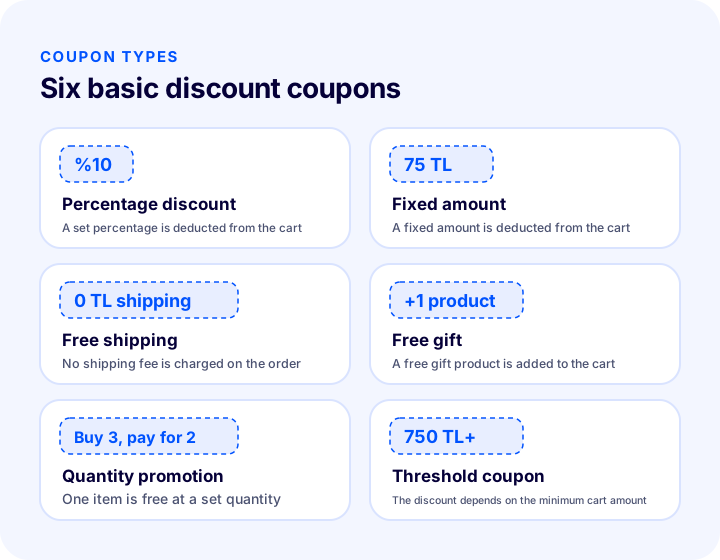
In e-commerce, six basic coupon types are used: percentage discount, fixed-amount discount, free shipping, free gift, quantity offer, and a tiered coupon tied to the minimum cart amount.
| Type | Example | Best used for | Watch out |
|---|---|---|---|
| Percentage discount | 10% off | Welcome, win-back | On a big cart, the discount grows too |
| Fixed amount | 75 TL off | Raising the average cart value | On a small cart the percentage gets very high; a minimum is a must |
| Free shipping | Free shipping | Reducing cart abandonment | The shipping cost comes out of the margin |
| Free gift | A sample is added to the cart | Launching new products, clearing stock | The cost of the gift must be factored in |
| Quantity promotion | Buy 3, pay for 2 | Consumables and complementary products | Cheap and expensive products shouldn't be mixed |
| Threshold coupon | 75 TL off 750 TL and above | Increasing the average cart value | The threshold should sit slightly above the current average |
How Do You Create a Coupon Code?
Creating a coupon code is more than typing in a discount amount; you also have to decide who can use the coupon, under what condition, for how long, and how many times. The following seven settings are the decisions to make for every coupon:
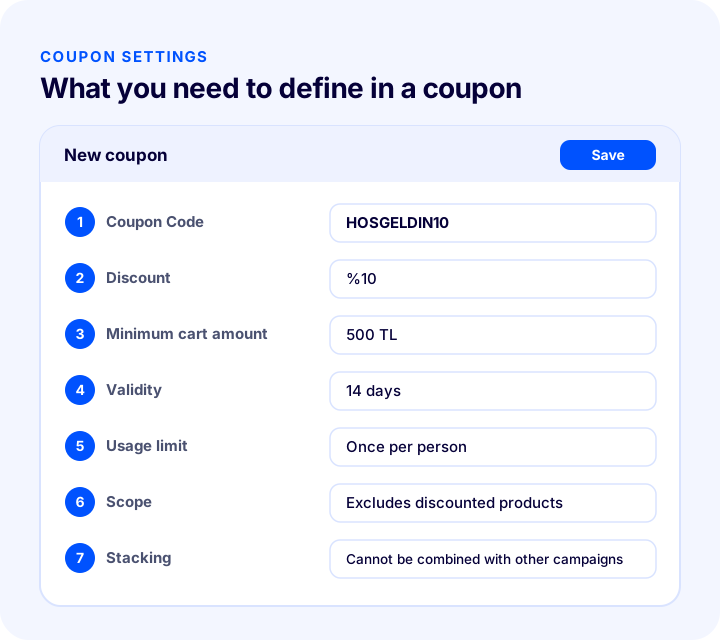
- Coupon code: Choose a short, readable code that describes the campaign. For personal coupons, the code should be generated randomly by the system.
- Discount: The type (percentage, fixed amount, shipping, gift) and the amount. How to set the amount based on your profit margin is explained below.
- Minimum cart amount: The lowest cart value at which the coupon is valid. Without a minimum, fixed-amount coupons make small orders unprofitable.
- Validity: Start and end dates. A short window creates urgency; a coupon with no expiry leaks over time and gets forgotten.
- Usage limit: The total number of uses and the number of uses per person. A welcome coupon should be limited to one use per person.
- Scope: The categories, brands, or products the coupon applies to. Products that are already discounted or have a very low margin can be excluded.
- Stacking: Whether the coupon can be used together with other campaigns and coupons. Stacked discounts can lead to a total discount far higher than expected.
How Do You Set the Coupon Amount Based on Profit Margin?
The coupon amount is a portion of the profit left from the order, so the maximum discount you can offer is found by subtracting order costs from the gross profit per order. If the coupon exceeds this amount, the order loses money.
Example: For an order with a cart value of 600 TL and a gross profit margin of 40%, the gross profit is 240 TL. If 55 TL goes to shipping and packaging, 185 TL is left from the order.
| Coupon | Discount | Left from the order | Result |
|---|---|---|---|
| No coupon | 0 TL | 185 TL | Profit |
| 10% off | 60 TL | 125 TL | Profit |
| 20% off | 120 TL | 65 TL | Low profit |
| 30% off | 180 TL | 5 TL | Break-even |
| 35% off | 210 TL | −25 TL | Loss |
In this example, every coupon above 30% makes the order lose money. However, if the coupon's goal is to win the first order and the customer keeps buying again, the low profit on the first order can be made up by later orders; this calculation should be made together with customer lifetime value.
When Does a Coupon Pay for Itself?
A coupon is profitable if the profit from the extra orders it brings covers the discount it gives on orders that would have come anyway. In the example above, suppose a 10% coupon brings 200 orders and 120 of them would have been placed without the coupon: the discount on those 120 orders is 120 × 60 = 7,200 TL. The profit from the 80 extra orders the coupon brings is 80 × 125 = 10,000 TL. In this case the coupon leaves a net profit of 2,800 TL; if the number of extra orders fell below 58, it would lose money.
We recommend readingProfit Margin Calculation: How to Calculate Profit Margin in E-Commerce (Calculator and Examples)Percentage Coupon or Fixed-Amount Coupon?
A percentage coupon looks attractive on small carts, but the discount grows as the cart grows; a fixed-amount coupon keeps the discount from growing on large carts, but stays proportionally very high on small ones.
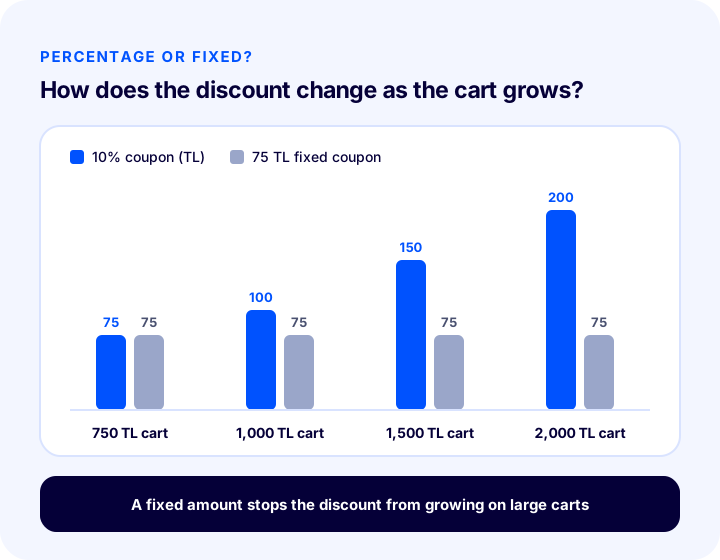
On a 750 TL cart, both give a 75 TL discount. On a 2,000 TL cart, the 10% coupon gives 200 TL off while the fixed coupon stays at 75 TL. So:
- A percentage coupon is suitable when you want to send customers the message “the more you buy, the more you save” and your product prices are close to one another.
- A fixed-amount coupon is suitable when cart sizes vary widely and you want to protect your margin on large orders; it must always be used together with a minimum cart amount.
- Setting a maximum discount cap (e.g., at most 150 TL) on a percentage coupon combines the strengths of both approaches.
Public Coupon or Personal Coupon?
A public coupon reaches a wide audience quickly but is hard to control; a personal coupon goes only to the targeted customer and cannot be abused.
| Topic | Public coupon | Personalized coupon |
|---|---|---|
| Example | YAZ15 campaign code | Single-use random code |
| Reach | Social media, newsletter, ads | Email, SMS, customer account |
| Leakage risk | High; may end up on coupon-sharing sites | None; the code works for only one person |
| Measurement | By channel | By customer |
| Best used for | Campaign periods, channel measurement | Welcome, cart recovery, win-back |
When a public code ends up on coupon-sharing sites, a customer who is already about to buy searches for a code at checkout and gets a discount. That is why high-discount codes should be short-lived and limited in number, and permanent discounts should be given through personal coupons.
How Do You Prevent Coupon Abuse?
Coupon abuse is when a coupon is used by people it wasn't meant for, or more times than intended. The most common forms and the measures against them are:
- Reuse through different accounts: The same person signing up repeatedly with different email addresses to get the welcome coupon. Alongside a per-person limit, checking orders placed with the same delivery address or phone number makes this visible.
- Code sharing: A code that should be personal being shared in public places. Single-use codes tied to the customer remove this risk.
- Gaining from coupons through returns: A product bought with a coupon is returned and the customer tries to reuse the coupon. Whether the coupon used in a returned order is given back should be defined as a rule in advance.
- Stacking coupons: Applying more than one code to the same order. The stacking rule must be clearly defined for every coupon.
These measures don't make the coupon less attractive; they simply ensure it reaches the intended customer, in the intended numbers.
When Should You Use a Coupon?
A coupon has the greatest effect at specific moments in the customer journey. The most productive uses are:
| Moment | Coupon | Purpose |
|---|---|---|
| New sign-up | Welcome coupon | Winning the first order |
| Product left in the cart | Cart reminder coupon | Completing an unfinished sale |
| After delivery | Thank-you coupon | Driving the second order |
| No orders for a long time | Win-back coupon | Bringing back customers who drifted away |
| Leaving an email | Pop-up coupon | Growing the newsletter list |
| Campaign period | Public code | Quick revenue and traffic |
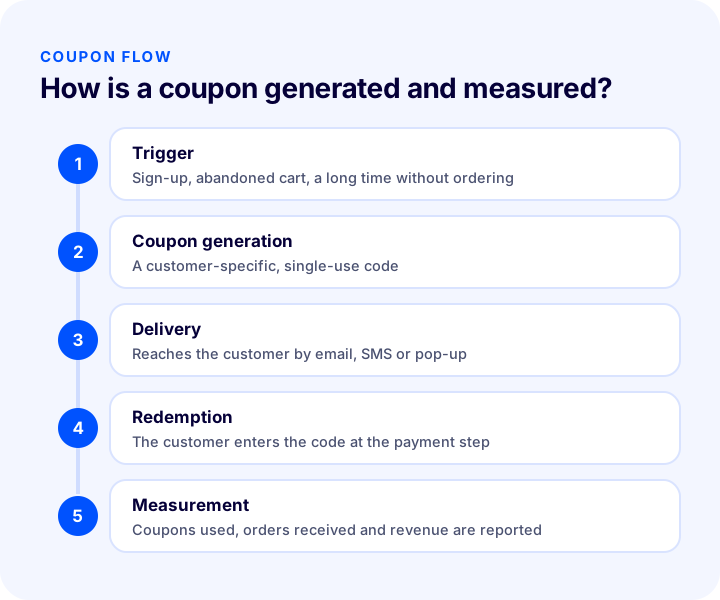
What these moments have in common is that the coupon can be sent automatically in response to a customer behavior. Manually managed coupon campaigns fall behind over time, while automatic trigger-based coupons reach every customer at the right time.
We recommend readingWhat Is Customer Lifetime Value (CLV) and How Is It Calculated? (Calculator and Examples)How Do You Announce a Coupon Code?
The channel through which a coupon is announced determines who will use it. The same coupon reaches different customers on different channels, so the channel is chosen according to the coupon's purpose.
- Email: The main channel for personal coupons. State the discount and the expiry date clearly in the subject line, and show the code near the top of the email in a copyable form.
- SMS: Suitable for short-term, urgent offers; it is sent only to customers who have given messaging consent. Keep the message short and put the code on a line of its own.
- On-site announcement bar: The simplest way to show a public campaign code to all visitors; it also keeps them from leaving the site to look for a code at checkout.
- Pop-up: Used to give a coupon to people who leave their email. It is less intrusive when shown after the visitor has browsed the site a little, not as soon as the page opens.
- Social media: Codes made exclusively for followers let you measure which account brings in orders.
- Shipping package: A second-order coupon given on a small card placed in the package reaches the customer while they are holding the product.
What Is Coupon Dependency and How Do You Prevent It?
Coupon dependency is when customers learn not to shop without a coupon. In a store that sends coupons constantly and at predictable intervals, customers wait for the next coupon; sales without coupons drop and the discount becomes a permanent part of the price.
To prevent this, coupons should be tied to specific behaviors: first order, an abandoned cart, a long period without shopping. For customers who shop regularly, perks that affect the margin less, such as early access, a free gift, or free shipping, can be offered instead of a discount. The share of orders placed with a coupon should be monitored every month; if this share keeps rising, coupon frequency should be reduced.
How Do You Prepare a Sample Coupon Plan?
Thinking of coupons as a plan rather than individual campaigns prevents them from overlapping and the total discount from getting out of control. The table below is an example of a store's always-on coupon plan; the rates are given as examples only:
| Coupon | To whom? | Offer | Validity | Rule |
|---|---|---|---|---|
| Welcome | New member | %10 | 14 days | Once per person, excluding discounted products |
| Cart recovery | Left products in the cart | Free shipping | 3 days | Only for those who didn't click the first reminder |
| Second order | Those whose first order was delivered | %5 | 30 days | Once per person |
| Win-back | Those who haven't ordered in 60 days | %15 | 7 days | With a minimum cart amount |
| Campaign code | Everyone | 75 TL off 750 TL and above | For the duration of the campaign | Cannot be combined with other coupons |
How Do You Measure Coupon Performance?
A coupon's success is measured not by how many times it was used, but by how profitably it brought in orders that wouldn't have come without it. The metrics to track are:
- Redemption rate: The ratio of coupons used to coupons sent. If it is low, the offer or the timing is wrong.
- Share of orders with a coupon: How much of total orders come in with a coupon. If this share keeps rising, customers may be learning not to shop without a coupon.
- Revenue per coupon: The total revenue of orders with coupons divided by the number of coupons used.
- Total discount cost: The total discount given through coupons; it should be evaluated together with profit, not with revenue.
- New customer rate: How many of the orders coming in with a coupon are first orders. This rate should be high for a welcome coupon.
- Repeat orders after the coupon: Whether customers who came with a coupon place a second order without one; it shows whether the coupon won lasting customers.
Common Mistakes in Coupon Campaigns
- Fixed-amount coupon with no minimum: A 75 TL coupon becomes a 75% discount on a 100 TL order.
- Coupon with no expiry: A code without an end date is still being used months later and disrupts the campaign calendar.
- Welcome coupon with no per-person limit: The same person can use it repeatedly with different email addresses.
- Coupon stacking with campaigns: When a coupon is also applied to a discounted product, the total discount can exceed the margin.
- The same coupon for every customer: A discount given to a customer who already shops regularly is money spent on a sale that wasn't won.
- Sending coupons constantly: The customer learns to wait for the coupon, and sales without coupons fall.
- Not measuring the coupon: If usage and profit aren't tracked, you won't know which coupon worked.
Discount Coupon Checklist
| Check | Why does it matter? |
|---|---|
| Are the coupon's purpose and target customer clear? | A coupon with no target is just a price cut. |
| Is the discount amount below the order's profit? | A coupon that exceeds it makes the order lose money. |
| Does the fixed-amount coupon have a minimum cart amount? | On small orders the percentage gets very high. |
| Has the validity date been set? | A coupon with no expiry leaks and gets forgotten. |
| Is there a per-person usage limit? | It prevents abuse. |
| Are low-margin and discounted products excluded? | Stacked discounts wipe out the profit. |
| Are there look-alike characters in the code? | A wrong entry turns into a complaint. |
| Will usage and profit be measured? | A coupon that is not measured cannot be improved. |
Coupon and Campaign Management with Faprika
On the Faprika e-commerce platform, campaign setups are managed through the campaign module, while personalized and automated coupons are managed through the Roket marketing automation add-on.
- Campaign module: Unlimited campaign setups; campaigns based on cart total and cart subtotal, buy X pay for Y, free gift products, shipping campaigns, campaigns by payment type, and special campaigns by month, week, day or hour.
- Gift cards and loyalty points: Creating gift cards, gift card campaigns and loyalty point campaigns give customers value to use on their next purchase.
- Personalized coupons (Roket): The “Generate Coupon” step in an automation creates a discount coupon specific to the customer; the code is written automatically into the following email and SMS messages.
- Ready-made scenarios (Roket): Welcome coupon, two-step cart recovery, “We Miss You” win-back coupon and post-delivery thank-you coupon; you set the duration and the discount.
- Visibility for the customer (Roket): Customers see the discount, its expiry date and its status on the “My Coupons” page in their account; the admin panel has a “Roket Coupons” tab on the customer card.
- Coupon via pop-up (Roket): When a visitor leaves their email, you can choose to show them a coupon code.
- Measurement: Roket shows the results of each automation: sends, opens, clicks, orders, revenue, and coupons generated and used; the campaign discount report also lists how much discount and sales each campaign brought.
You can see which campaign feature is included in which plan in the comparison table on the e-commerce plans page.
Frequently Asked Questions
What is a discount coupon?
A discount coupon is a campaign tool that lets a customer get a discount, free shipping or a gift product on their order by entering a code at the payment step or by using a benefit assigned to their account. It can be open to everyone or personal.
How do you create a coupon code?
When creating a coupon code, you define the code itself, the discount type and amount, the minimum cart amount, the validity date, the usage limit, the products and categories it applies to, and whether it can be combined with other campaigns. The code should be short, readable and free of easily confused characters.
Is a percentage coupon or a fixed amount coupon better?
A percentage coupon gives more discount as the cart grows; a fixed amount coupon protects the margin on a large cart but raises the rate on a small one. A fixed amount coupon is safer when combined with a minimum cart amount, and a percentage coupon when combined with a discount cap.
How is the coupon amount determined?
The coupon amount should not exceed what is left of the gross profit per order after order costs such as shipping and packaging are deducted. On a 600 TL cart with a 40% margin and 55 TL in order costs, 185 TL remains; in this example, a coupon above 30% turns the order into a loss.
What is a single-use coupon?
A single-use coupon is a code generated for one customer that can be used only once. It does not leak onto coupon-sharing sites, cannot be abused, and lets you measure which customer used the coupon.
How is the success of a coupon campaign measured?
You track the redemption rate, the share of orders with a coupon, revenue per coupon, total discount cost, the new customer rate, and whether customers who came with a coupon place repeat orders without one.