
Contents 13 sections
- What Is Affiliate Marketing?
- Why Is Affiliate Marketing Important for E-Commerce?
- Can Affiliate Marketing Be Combined with Dropshipping?
- Which Businesses Is Affiliate Marketing Suitable For?
- How Is Affiliate Commission Determined?
- How Is a Partner's Commission Calculated?
- How Is Affiliate Performance Measured?
- How Do You Set Up Affiliate Marketing in the Faprika Panel?
- How Do You Find and Manage Affiliate Partners?
- What Are Common Mistakes in Affiliate Marketing?
- Affiliate Marketing Checklist
- How Do You Manage Affiliate Marketing with Faprika?
- Frequently Asked Questions
Is it possible to pay only when a sale happens instead of spending the ad budget in advance? Affiliate marketing does exactly that: a person or organization that promotes your brand to their own audience earns a pre-agreed commission on the sales they bring, and you pay only when a real sale occurs. For small businesses it is a measurable way to reach a wide audience; for large ones it is a way to manage a network of dealers and commission agents in one system.
In this guide we explain what affiliate marketing is, who it suits, how to set commission, the parent and sub-partner structure, how sales brought in by a partner's referral link are tracked, and how to set up affiliate marketing step by step in the Faprika panel. Of the two tools in the article, one calculates a partner's monthly commission and the other audits the readiness of your affiliate program with eight questions. Commission and tax arrangements depend on legislation; consult your financial advisor for exact practice. This article provides general information and is not financial advice.
What Is Affiliate Marketing?
Affiliate marketing is a business model in which an e-commerce site pays a commission for every sale to a person or organization that promotes its products to their own audience. The partner does not sell the products in their own name; they direct customers to your store through the special link or account they are given. When the sale is completed, they earn a commission at a pre-agreed percentage or fixed amount.
How Does Affiliate Marketing Work?
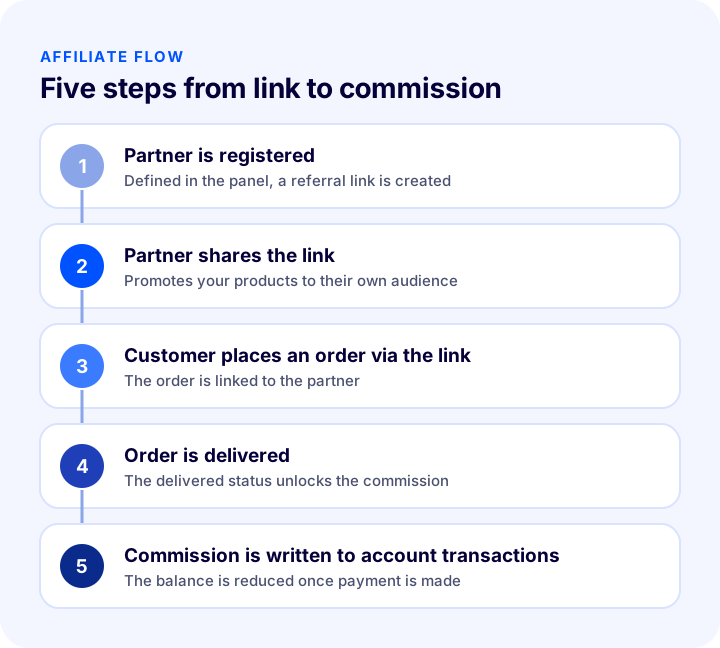
The logic has four steps: a partner is defined and given a special link, the partner shares this link with their audience, a customer arrives via the link and places an order, and the order is linked to the partner; when the order is delivered, the commission is credited to the partner's account. Payment is made on the schedule you set, for example on the statement cut-off date.
Who Is an Affiliate Partner?
An affiliate partner can be anyone with their own audience: a video creator who reaches your product's user base, an influencer, a blogger, a commission agent, or a customer you want to give a dealership to. What matters is that their audience is interested in your product and that the sales they bring can be measured.
| Partner type | How do they earn you sales? | Best suited for |
|---|---|---|
| Influencer | Promotes your product to their audience | Brand awareness and first sale |
| Content creator | Links to you in review and guide content | Buyers at the decision stage |
| Commission agent | Brings sales from their own circle of customers | Steady, repeat sales |
| Dealer | Creates orders on behalf of their customers | Wholesale and regional sales |
Why Is Affiliate Marketing Important for E-Commerce?
Affiliate marketing is not just an advertising method; it is a measurable, risk-sharing model that ties growth to sales:
- Cost tied to sales: Commission arises only when a sale happens; there is no spend without a return.
- Reaching a new audience: The partner's own audience brings buyers you couldn't reach to your store.
- Trust: An audience trusts the recommendation of someone they know more than an ad.
- Measurability: It is clear how much each partner brings in; unproductive partners are quietly phased out.
- Network effect: With the parent and sub-partner structure, the partner network can grow by bringing in its own partners.
- Fit with the dealer model: For a business that wants to work with dealers or commission agents, the same system keeps commissions organized.
Can Affiliate Marketing Be Combined with Dropshipping?
Yes. In the dropshipping model you ship products directly from the supplier to the customer, while affiliate partners promote these products. Both offer low startup costs and a low operational load. Combined, you can open your product catalog to a wide audience without carrying stock, paying commission only when a sale happens.
| Topic | Dropshipping | Affiliate marketing | Together |
|---|---|---|---|
| Product | Goes from supplier to customer | Partner promotes | A wide catalog without carrying stock |
| Cost | Arises at the time of sale | Commission arises with the sale | Very low fixed costs |
| Risk | Low stock risk | Low advertising risk | Both are tied to sales |
In this combination you need to calculate the margin carefully: after adding up the supply cost, shipping, payment commission and partner commission, there must still be profit left.
We recommend readingProfit Margin Calculation: How to Calculate Profit Margin in E-Commerce (Calculator and Examples)Which Businesses Is Affiliate Marketing Suitable For?
Affiliate marketing doesn't suit every business equally; the product must be promotable, the margin must leave room for commission, and the sale must be traceable. The model generally works well in the following situations:
- Visual and easy-to-explain products: Products whose use can be shown and reviewed fit naturally into partners' content.
- Sufficient profit margin: The model is sustainable for products that leave a share for commission after costs.
- Products that are bought repeatedly: Once a customer is won and buys again, the partner's contribution pays off in the long run.
- Businesses with a dealer and commission agent network: Suitable for those who want to manage their existing sales network in one system, with records.
- Brands seeking a new audience: For new and mid-sized stores that want to tie their ad budget to sales, it is a risk-sharing route.
For products with very low margins and intense price competition, commission can wipe out profit. In such cases it is safer to define commission only for high-margin products or to choose a small fixed amount per item.
How Is Affiliate Commission Determined?
Commission should be attractive enough to motivate the partner and balanced enough not to damage your profit margin. Too low a commission won't attract good partners; too high a commission turns every sale into a loss. The starting point is to calculate the share you can pay out of the product's profit margin.
Percentage or Fixed Amount Per Item?
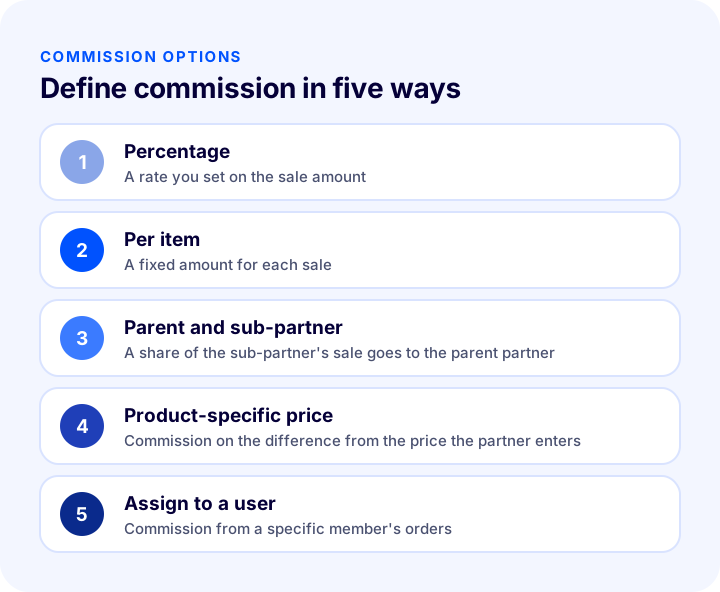
Faprika has two options for the commission calculation type. When “Percentage” is selected, the commission is calculated as the percentage you set of the sale amount. When “Per item” is selected, the commission value you set stays the same for every sale, whatever the sale amount.
| Calculation type | How does it work? | When is it suitable? |
|---|---|---|
| Percentage | The set rate of the sale amount | A fair share across products with very different prices |
| Per item | The same fixed amount on every sale | A simple, predictable share for similarly priced products |
What Is the Parent and Sub-Partner Structure?
A partner can sit under another, parent partner. In this case, the sub-partner commission value set for the parent partner is also credited to the parent partner from the sub-partner's sales. This structure encourages the partner network to grow on its own. When the “earn from one sub-seller” option is on, the partner can create only one sub-level partner and earns commission only from that one; when it is off, they earn commission from all the sub-partners they create.
How Is a Partner's Commission Calculated?
Commission is the total of the delivered orders linked to the partner, according to the commission rule. In Faprika, orders linked to a partner appear in the partner's account transactions after the order moves to the delivered status; an order that is not delivered earns no commission. The tool below calculates a partner's commission based on the number of orders they bring per month, the delivery rate and the commission rule.
The commission the tool gives is only the commission cost; product cost, shipping and payment commission are deducted separately. For order values below the fixed amount, a per-item commission can become a proportionally higher share; evaluate this against the product's price range.
How Is Affiliate Performance Measured?
To see whether the program is working, you need to read together the orders each partner brings, their delivery rate and the commission they generate. Looking only at the number of orders is misleading: a partner who brings many orders, most of which can't be delivered, can cost more than a partner who brings few but clean orders.
| Indicator | What does it tell you? | How to interpret it? |
|---|---|---|
| Orders per partner | Sales volume the partner brings | Support low-volume partners or end the collaboration |
| Delivered order rate | Share of sales that turns into commission | If low, the product or audience is a mismatch |
| Commission / revenue | Weight of commission in revenue | If it exceeds the margin, review the commission |
| Average order value | Value of the customer the partner brings | If high, give the partner more support |
| Repeat customers | Loyalty of the customer the partner brings | If high, build a long-term partnership |
By exporting account transactions to Excel, you can produce a comparison table per partner. A short monthly review makes it easier to decide which partner to grow and which to stop.
How Do You Set Up Affiliate Marketing in the Faprika Panel?
In Faprika, affiliate marketing is managed from the Users section of the control panel. You define the partner, enter their commission, share the referral link and track commissions from account transactions.
How Do You Add a New Affiliate Partner?
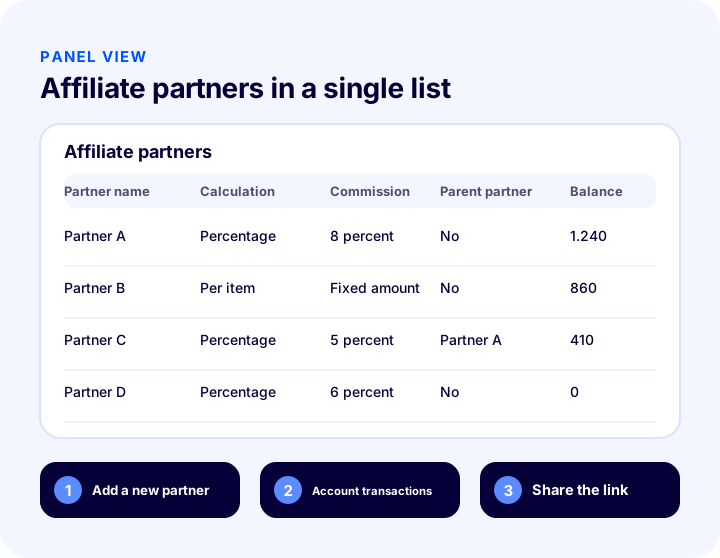
In the control panel, go to Users and then Affiliate Marketing; on the page that lists your affiliate partners, create a new partner with the “Add New” button. On the page that opens, you fill in the following fields:
- Affiliate partner name: The partner's name.
- Referral URL name: The referral name, if any; the name that appears at the end of the link.
- Parent affiliate partner: If the partner will sit under another partner, you select one of the registered partners.
- Calculation type and commission value: You set the commission per item or as a percentage.
- Sub-commission value: If you selected a parent partner, the share given to the parent partner from sub-partners' sales.
- Admin note: Private notes about the partner.
- Earn from one sub-seller: Lets the partner receive commission from only one sub-partner.
- Calculate based on the product-specific price entered: If the product price can be entered by the partner, it makes the commission calculated on this price.
How Is the Referral Link Used?
When the partner is saved, a link called “Referral URL” is created under “Affiliate Partner Information”. The partner uses this link in their content and posts; purchases that come through the link are reflected in the partner's commission at the set rate. For partners who promote products to their own audience, this single link is the identifier that determines whom a sale belongs to.
How Do You Manage Account Transactions and Payments?
After you save the partner, the “Account Transactions” tab opens under “Affiliate Partner Information”. The orders the partner brought appear here; records can be exported to Excel and filtered by date added. When you need to pay the partner on their statement cut-off date, you enter the payment amount with a minus sign and a description in the amount field. For example, if you will pay 40 to a partner whose balance is 54, you write −40 as the amount; once you add it, the partner sees their updated balance.
For orders linked to the partner to appear in account transactions, the order's shipping status must be “delivered”. This rule prevents paying commission on orders that are not delivered or are returned.
How Do You Assign an Affiliate Partner to a Specific User?
Commission doesn't work only through the link; it can also be assigned to a specific user. In the Users section you select a member or create a new one and assign them as an affiliate partner. Commission arises after delivery from every order this member creates. When the assigned user logs in to the site, they reach the “Affiliate Marketing” page from the user information under My Account, and see the orders made through them and the commission they have earned. This suits a dealer or wholesale customer model.
How Does Commission Based on a Product-Specific Price Work?
When the product's selling price is allowed to be entered by the partner, commission can be calculated differently. In product management, the “customer can enter the selling price” option is turned on in the product's price details, and a minimum and maximum price range is set. For example, if the product's selling price is 125 and the customer buys it at 175, the partner receives the set commission on 125, and the remaining 50 is automatically calculated by the commission system and added to the account. This way, the difference on sales made within the set price range is also recorded.
| Step | Where in the panel? | Result |
|---|---|---|
| Adding a partner | Users, Affiliate Marketing, Add New | The partner and referral link are created |
| Commission definition | Calculation type and commission value | Percentage or per-item commission |
| Parent partner | Parent affiliate partner and sub-commission value | A share of the sub-partner's sale goes to the parent partner |
| Sales tracking | Account Transactions tab | Delivered orders are listed |
| Payment record | Negative value in the amount field | Balance drops, the partner sees it |
| Assign to a user | Users tab | Commission from the member's orders |
How Do You Find and Manage Affiliate Partners?
To find partners, first think of people whose audience overlaps with your product: content creators interested in your product category, industry communities, existing loyal customers and individuals who want to work on commission. For promotion, give the partner product information, visuals and clear terms; explain in writing how much commission they earn on which products, when it will be paid and in which cases commission will not arise.
- Clear terms: The commission rate, delivery rule and payment day should be told to the partner up front.
- The right product: Point each partner to the product that suits their audience.
- Regular payment: Paying commission on the promised day protects trust.
- Performance tracking: Read regularly how many orders each partner brings.
- Campaign support: A coupon or campaign made for the partner increases conversion.
What Are Common Mistakes in Affiliate Marketing?
- Setting commission without looking at the margin: Profit falls or a loss arises on every sale.
- Not giving the terms in writing: Disputes arise over delivery, returns and the payment date.
- Not tracking: An unproductive partner quietly takes up space, and a good partner goes unnoticed.
- Delaying payment: Trust is lost and the best partners leave.
- Giving the same commission on all products: Low-margin products lose money.
- Not accounting for returns: If you pay on an undelivered order, the cost balloons.
- Leaving the partner unsupervised: Misleading promotion damages brand trust.
Affiliate Marketing Checklist
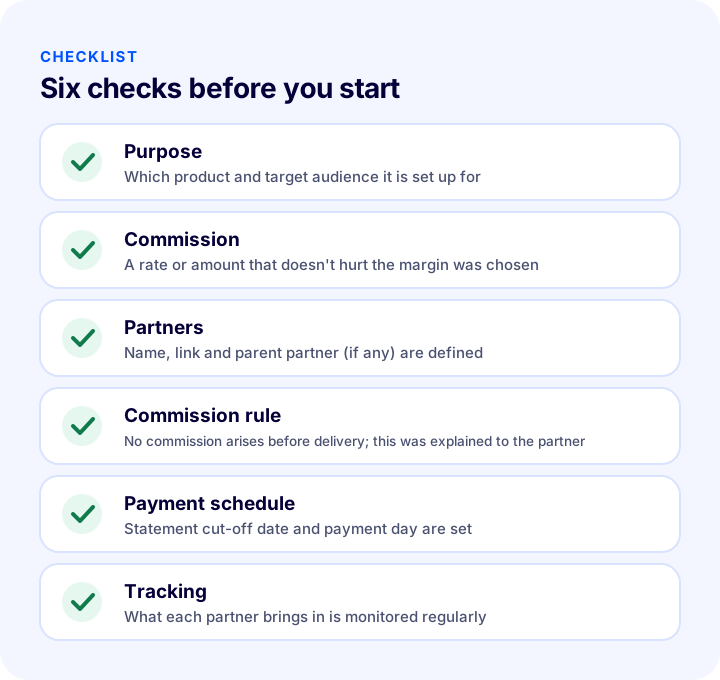
The list below summarizes the basic items to complete before the program starts.
| Stage | Check | Done? |
|---|---|---|
| Planning | Product and target audience defined | Yes / No |
| Planning | Commission chosen by calculating from the product margin | Yes / No |
| Setup | Partner defined, commission type and value entered | Yes / No |
| Setup | Parent partner and sub-commission defined if needed | Yes / No |
| Rule | Explained that commission arises after delivery | Yes / No |
| Payment | Statement cut-off date and payment day are set | Yes / No |
| Tracking | Account transactions are checked regularly | Yes / No |
How Do You Manage Affiliate Marketing with Faprika?
Faprika offers affiliate marketing inside your site: partner definition, referral link, commission calculation and account transactions all sit in the same panel. This way you manage your dealer, commission agent or influencer network without using a separate tool.
With affiliate marketing in Faprika, you can use the following options:
- Partner management: You add partners, take notes and generate referral links.
- Commission type: You define commission as a percentage or per item.
- Parent and sub-partner: You build a multi-level partner structure with the sub-commission value.
- Account transactions: You track the partner's orders, export them to Excel and record payments with a negative amount.
- User assignment: You assign a dealer or wholesale customer as a partner, and the partner sees their own commission in their account.
- Product-specific price: You reflect the difference arising from the price the partner enters in the commission.
You can see which features are included in which plan in the e-commerce plans comparison. For step-by-step usage, see the affiliate marketing training page.
We recommend readingWhat Is B2B E-Commerce? How to Set Up a Wholesale Site: A Step-by-Step GuideFrequently Asked Questions
What is affiliate marketing?
Affiliate marketing is a business model in which you pay a commission for every sale to a person or organization that promotes your products to their own audience. The partner brings customers through a special link or account; when the sale is delivered, the commission is credited to the partner's account.
How is affiliate commission calculated?
In Faprika, commission is set as a percentage or per item. With the percentage type, the commission is the rate you set on the sale amount; with the per-item type, the same fixed amount is earned for each sale. Calculate the commission backward from the product's profit margin.
When is an affiliate's commission earned?
When an order linked to a partner moves to the delivered status, the commission appears in the partner's account transactions. An order that is not delivered earns no commission. Explain this rule to the partner clearly from the start.
What do parent and sub-partner mean?
A partner can sit under another partner. The sub-partner commission value set for the parent partner is then also credited to the parent partner from the sub-partner's sales. This structure encourages the partner network to grow.
How do you record a payment to an affiliate partner?
In the account transactions area, you enter the payment amount with a minus sign in the amount box, along with a description. For example, if you paid 40 to a partner with a balance of 54, you enter −40; the partner sees their updated balance in their own account.
Can a dealer or wholesale customer be an affiliate partner?
Yes. In Faprika you can assign a member as an affiliate partner; commission arises after delivery from every order this member creates, and the member sees their orders and commission in their own account. You can see which plans include this feature in the plan comparison.
You May Also Like
- How to Do E-Commerce Without Capital? 7 Ways to Start on a Low Budget
- What Are User Groups?
- Profit Margin Calculation: How to Calculate Profit Margin in E-Commerce (Calculator and Examples)
- How to Set Up a Loyalty Program? A Practical Guide to Store Points Systems, Tier Design and Cost Calculation in E-Commerce