
Contents 13 sections
- What Is Commission-Based Sales?
- Which Business Models Use Commission-Based Sales?
- How Does Commission-Based Sales Work?
- How Is Commission Distributed in a Dealer and Sub-Dealer Chain?
- How Is Commission Calculated in Commission-Based Sales?
- What Is an Account Statement and Why Does It Matter in Commission-Based Sales?
- How Is the Commission Rate Determined?
- How Can Abuse Be Prevented in Commission-Based Sales?
- When Is Commission-Based Sales Suitable, and When Not?
- Common Mistakes in Commission-Based Sales
- Commission Model Checklist
- Commission-Based Sales with Faprika
- Frequently Asked Questions
Selling your products only through your own channel eventually hits a ceiling. Selling through dealers, sub-dealers and sales representatives widens your reach, but every intermediary expects to be paid for their effort. The real challenge is not making the sale; it is tracking, without errors, whom the sale belongs to, how much is earned and when it will be paid.
In this guide commission-based sales is covered from start to finish: what it is, which business models use it, how commission is distributed in a dealer and sub-dealer chain, how it is calculated, why account statements and reconciliation are critical, the logic behind setting rates and how abuse is kept in check. There is also a small tool that calculates your commission and a checklist to test your commission model. The setup side of the dealer model is covered in E-Ticaret Bayilik Sistemi Nasıl İşler?, and link-based partnerships are covered in What Is Affiliate Marketing? ; here we focus on commission calculation and account reconciliation without repeating them.
What Is Commission-Based Sales?
Commission-based sales is a model in which an intermediary who sells a product or service (dealer, sub-dealer, sales partner, representative) is paid a set share of each sale. The intermediary brings in the sale, the seller delivers the product, and commission is calculated on the sale amount at a rate agreed in advance.
The model has three core elements: attribution, which shows who brought in the sale; the rule (rate, scope, return treatment), which sets how earnings are calculated; and the record (account statement), where the calculated amount is shown to the intermediary. If any one is missing, trust erodes even if the model runs. Without attribution there are disputes, with an unclear rule there are wrong calculations, and without a record the intermediary can’t know what they earned.
The difference between commission-based sales and a salaried sales representative is how risk is distributed. With a fixed salary there is a cost even when nothing sells; with commission, the cost arises only when a sale is made. That makes it especially attractive for businesses with a wide product range that want to extend regional reach and can’t build sales coverage with their own team.
Which Business Models Use Commission-Based Sales?
Commission-based sales is not a single model but a shared payment structure used with different types of intermediaries. Who the intermediary is changes how commission is tracked and how long the relationship lasts.
| Model | Who is the intermediary? | How is the sale tracked? | Difficulty of tracking commission |
|---|---|---|---|
| Dealer sales | A business worked with continuously under contract | Order placed through the dealer’s account | Medium: rate and discount rules may change |
| Sub-dealer sales | The second tier attached to a dealer | Order placed through the sub-dealer’s account | High: the share must be distributed across tiers |
| Sales partner (affiliate) | A content creator or site that shares a link | Referral link and cookie | Medium: needs an attribution window and cancellation tracking |
| Field representative | A salesperson who visits the customer | Order opened in the representative’s name | Low: single tier, specific customers |
| Referral program | Existing customer | Referral code | Low: mostly a one-time reward |
This article centers on the dealer and sub-dealer chain, because that is where commission gets most tangled. For details on link-based partnership programs, see the article that explains ortaklık programlarını nasıl kullanacağınızı .
Okumanızı öneririzE-Ticaret Bayilik Sistemi Nasıl İşler?How Does Commission-Based Sales Work?
Commission-based sales works through these steps: the sale is attributed to an intermediary, the sale amount is reduced to a net figure according to the rule, the rate is applied and the result is posted to the intermediary’s account. When every order follows the same sequence, the outcome is predictable.
- The order is attributed to the intermediary: If the order is placed through a dealer’s or sub-dealer’s account, attribution is clear automatically. For indirect methods such as a referral link, the attribution rule is defined separately.
- The amount to calculate on is determined: Which items of the order count toward commission is set by the rule. In most models, shipping and tax are left out.
- Returns and cancellations are deducted: No commission arises on amounts that are not delivered or are returned, or it is clawed back.
- The rate is applied: The net amount is multiplied by the rate defined for the intermediary. The rate can be the same for all intermediaries or vary by dealer, product or tier.
- The commission is posted to the record: The calculated amount is booked to the intermediary’s account as a receivable, and which order it arose from stays traceable.
- Reconciliation is performed: At set intervals the account statement is checked by both sides and discrepancies are resolved.
- Payment or offsetting is made: The commission is paid out or deducted from the intermediary’s debt.
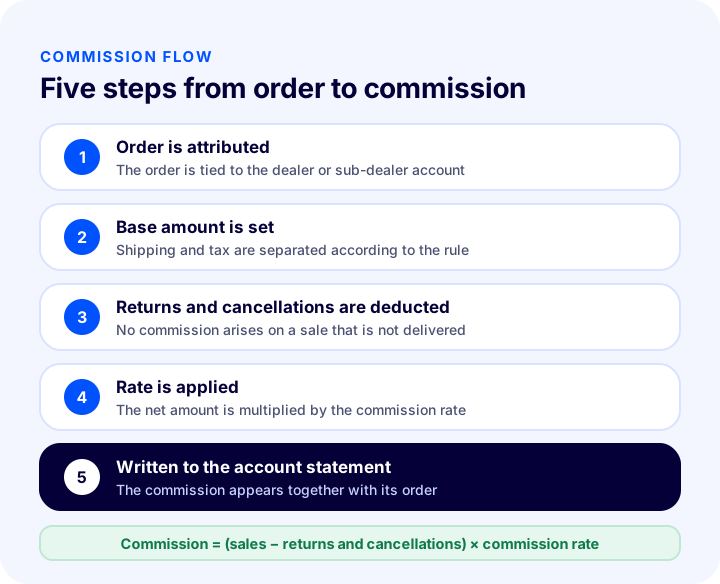
The most fragile link in this flow lies between steps four and five: if the calculation is right but the result is not posted or shown to the intermediary, the system doesn’t build trust. In models run on hand-kept spreadsheets, errors usually start here.
How Is Commission Distributed in a Dealer and Sub-Dealer Chain?
In a dealer and sub-dealer chain, commission is posted to the tier that made the sale and, where needed, shared with upper tiers. Who gets which share must be set before the order is placed; a share discussed afterwards causes disputes.
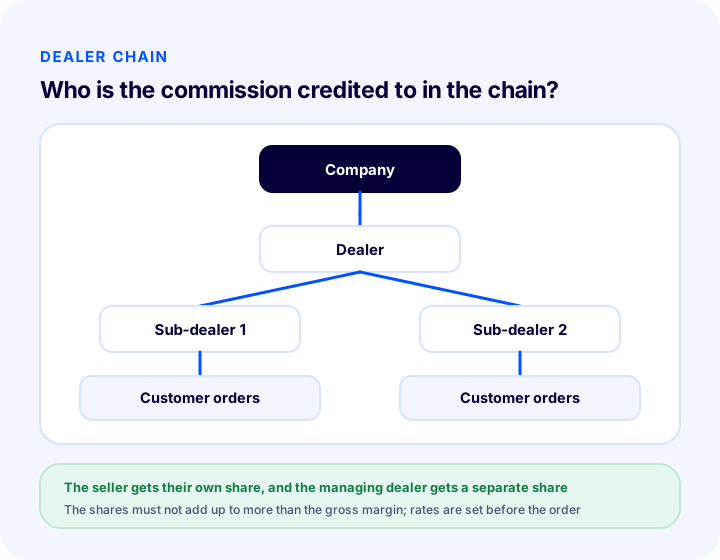
Single tier: commission only for the seller
In the simplest structure, only the dealer or sub-dealer who made the sale earns commission. The calculation is simple and easy to check. If a dealer has no sub-dealers beneath it, or sub-dealers are tied directly to the company, this structure is enough.
Multiple tiers: a share for the upper tier too
If a dealer recruits and manages its own sub-dealers, it will want a share of their sales too. In that case every sale creates two commissions: the sub-dealer’s share and the share of the dealer who manages it. There are two risks here. First, the shares may add up to more than the company’s profit margin; second, as tiers multiply, the calculation becomes hard to follow. That is why, in a multi-tier structure, rates are first tested against the total and then distributed.
Common situations in the chain
- If a sub-dealer switches dealers: Commission on past orders stays with the old dealer, and new orders are posted under the new structure. The start date of the rule must be on record.
- If the customer is known to both tiers: The account that placed the order is what counts; whoever the customer record belongs to, commission goes to the one who placed the order.
- If a bulk order is split among sub-dealers: Each sub-dealer’s share must be posted separately; otherwise it gets lost inside a single line.
- If a special price is defined: If both commission and a discount apply to a product sold at the dealer’s special price, the same margin has been spent twice. Which one applies must be stated clearly.
How Is Commission Calculated in Commission-Based Sales?
Commission is calculated by multiplying the net sale amount by the commission rate: commission = (sale amount − returns and cancellations) × commission rate. The formula is simple; the difficulty is in deciding which amount counts as “net” and in applying the same rule to every order.
Decide up front how each item that determines the net amount is treated. The table below summarizes the most common items and the usual approach; your business model and contract decide the outcome.
| Pens | Question | Common approach |
|---|---|---|
| Product price | Counts toward commission? | Yes, the main basis amount |
| Shipping cost | Is it included? | Usually no |
| Tax | Included or excluded? | Excluding it keeps things consistent |
| Discounts and coupons | Deducted before or after? | The amount the customer paid is the basis |
| Returns | Is commission clawed back? | Yes, in proportion to the returned amount |
| Cancellation | Does commission arise? | No, no commission on a sale that isn’t delivered |
| Partial return | In full or in part? | Only in proportion to the returned item |
The tool below runs this logic with your own values. Enter the number of sub-dealers, monthly sales per dealer, the commission rate and the return rate; see the total commission and the share per dealer. The values are examples; replace them with your own data.
Keep two points in mind when reading the result. First, as the return rate rises, commission falls linearly; in categories with high return rates, the intermediary’s commission comes out lower than expected at period end, and that surprise creates disputes. Second, total commission should be tested against the company’s gross margin; however attractive the rate, if it exceeds the margin, the model is not sustainable.
What Is an Account Statement and Why Does It Matter in Commission-Based Sales?
An account statement is a summary in which a dealer’s or sub-dealer’s debit and credit movements with the company are listed in date order. In commission-based sales, commissions are posted on the credit side of this statement, so the intermediary sees for themselves what they earned from which order.
The value of an account statement shows up in three ways. Transparency: the intermediary sees their balance without asking, so the sales team isn’t burdened. Reconciliation: at period end both sides look at the same record, which shortens “according to my calculation” arguments. Traceability: any commission item can be traced back to the order it came from.
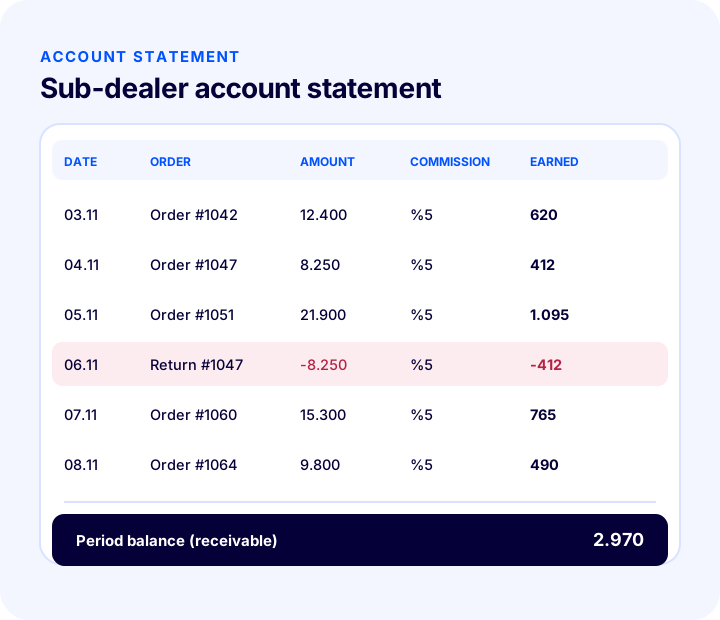
A good statement contains this information:
- Date and order reference: Every line must be linkable to an order.
- Basis amount: The net amount the commission is calculated on, not the gross.
- Applied rate: If the rate changed during the period, it must be visible which line was calculated at which rate.
- Entitlement and reversal lines: Amounts deducted because of returns appear as separate lines and are never reduced silently.
- Payment and offset entries: Amounts paid or deducted from a balance show how they affect the balance.
- Period balance: The receivable or payable remaining at the end of the period appears as a single figure.
How to Set the Commission Rate
The commission rate is set where the share you can give the intermediary out of a product's gross margin is both attractive to them and sustainable for your business. Instead of copying a figure from the market, work backwards from your own margin.
Three approaches are common, and they are often combined:
| Approach | How does it work? | When is it suitable? |
|---|---|---|
| Flat rate | The same rate for all intermediaries and products | At the start, when product margins are similar |
| Rate by category | A higher rate on higher-margin products | When margins differ clearly between categories |
| Tiered rate | The rate rises as sales volume grows | When you want to encourage the intermediary to sell more |
| Intermediary-specific rate | A separate agreement for each intermediary | When you have few, strategic intermediaries of different sizes |
When setting the rate, work through these steps in order: work out the gross margin of your product groups, consider the share of returns and cancellations, factor in campaigns and discounts, determine the share you can give the intermediary from what remains, and finally test that the margin is still positive in the worst case (high returns, heavy discounting). How the rate behaves during campaign periods should also be in writing; kampanya yönetimi is exactly where it meets commission-based sales.
Changing the rate often damages the intermediary's trust. If a change is needed, make it effective from a future date, notify the intermediary in advance, and show on the statement from which date the new rate applies.
How to Prevent Abuse in Commission-Based Sales
Abuse in commission-based sales means steering sales artificially or attributing them wrongly in order to increase the commission earned. Controls exist not to accuse the intermediary but to protect the honest one.
The most common cases and the measures against them:
- Placing orders for oneself: An intermediary can place orders in their own name or in relatives' names and collect commission. The rule should state whether commission is paid on their own orders; if it is not, you need a criterion to tell them apart.
- Inflating through cancellations and returns: Placing an order and then returning it to collect the commission earned. Finalizing the commission only after the return period largely prevents this.
- Attribution conflict: The same customer being attributed to more than one intermediary. The attribution rule (first, last, or the one who placed the order) must be single and written down.
- Off-policy discounts: The intermediary giving the customer a discount out of their own commission and breaking price discipline. The pricing policy should be stated in the contract.
- Abnormal activity: An intermediary suddenly reaching a very high volume or concentrating on a single customer. Comparing volume and return rate period by period reveals such deviations.
When Is Commission-Based Sales Suitable, and When Not?
Commission-based sales suits cases where the product can be sold by an intermediary and the brand can be represented externally. If the margin is thin, returns are high, or the product does not depend on the intermediary's pitch, the model may not deliver the expected benefit.
| When it is suitable | When to be careful |
|---|---|
| The gross margin is wide enough to cover the commission | The margin is very thin and the commission eats up the profit |
| The product sells through the intermediary's pitch and relationships | The product already sells on its own and the intermediary's contribution is limited |
| The goal is to expand regional or sector reach | Brand control and price discipline cannot be ensured |
| A dealer and sub-dealer structure already exists | There are many intermediaries but no process to manage them |
| The commission earned can be calculated and shown automatically | The calculation depends on manually maintained spreadsheets |
The last row matters most: calculating commissions by hand becomes unsustainable as the number of intermediaries grows. A spreadsheet is enough when you have a handful of dealers; with twenty or fifty sub-dealers, wrong calculations, late payments, and disputes every month are unavoidable. You can find how to set up the dealer structure on the B2B side in the B2B e-commerce guide, and the economics of wholesale in the buying and selling wholesale products article.
Common Mistakes in Commission-Based Sales
In commission-based sales, mistakes usually come not from the choice of rate but from vague rules and a record that is not transparent. The mistakes below are the most common.
- Leaving the rule verbal: If the rate, scope, and return treatment are not in writing, two different recollections clash in every dispute.
- Calculating on the gross amount: A commission calculated before returns and cancellations are deducted has to be clawed back later and alienates the intermediary.
- Hiding the commission from the intermediary: Reporting a single figure at month-end breeds suspicion instead of trust. A commission that is not visible line by line cannot be checked.
- Stacking discounts and commission: The same margin is spent twice, and the product can end up sold at a loss.
- Changing the rate without notice: A retroactive change pushes the intermediary toward a competitor.
- Postponing reconciliation: In a reconciliation held six months later, it is impossible to remember which order was linked to what; set up a monthly or periodic routine.
- Ignoring the chain: If the sub-dealer and dealer shares are not considered together, the total commission exceeds the margin.
- Never auditing for abuse: A system nobody looks at tests even the most honest intermediary.
Commission Model Checklist
The eight items below show whether your commission model is sound. Tick each item to see your score, and note the unticked ones as gaps.
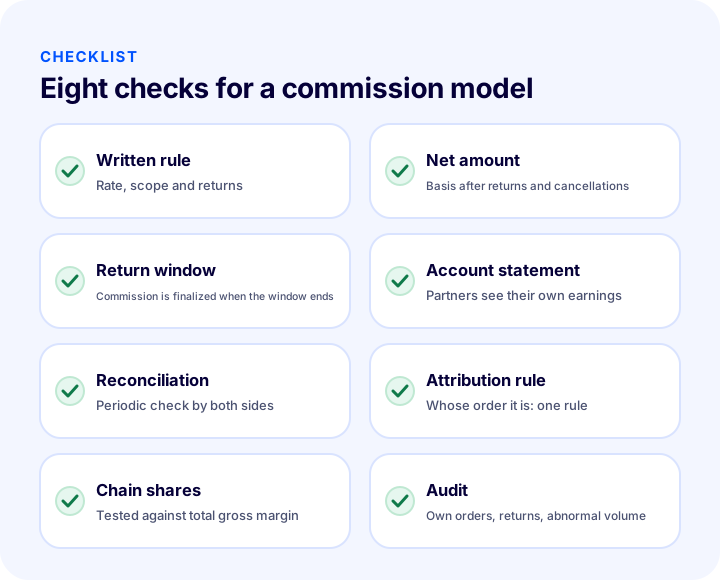
| Field | Check | Done? |
|---|---|---|
| Rule | Rate, scope, and returns are written down | Yes / No |
| Base amount | Net amount after returns and cancellations | Yes / No |
| Finalization | Commission is finalized after the return period | Yes / No |
| Account statement | The intermediary sees their own commission line by line | Yes / No |
| Reconciliation | Periodic mutual check is carried out | Yes / No |
| Attribution | Who an order is credited to follows a single rule | Yes / No |
| Chain | Dealer and sub-dealer shares tested against the margin | Yes / No |
| Audit | Self-orders, returns, and volume are monitored regularly | Yes / No |
Commission-Based Sales with Faprika
Faprika's Commission-Based Sales System is for businesses that have a dealer and sub-dealer structure and want these intermediaries to earn from the sales they make. Sub-dealers' commissions are calculated automatically and shown in their account statements, so commission calculation no longer depends on manual spreadsheets.
The fourth item of the checklist in this article, the intermediary seeing their own commission, is exactly the problem this feature solves. When the commission is calculated and written to the statement automatically, the reconciliation period gets shorter and the margin for error shrinks.
To see how the feature is offered by plan, visit the e-commerce plans page; to learn how to adapt it to your own dealer structure, use the information form. Just get in touch with our team for details.
Frequently Asked Questions
What is commission-based sales?
Commission-based sales is a model in which an intermediary who sells a product (dealer, sub-dealer, sales partner, representative) is paid a set share of each sale. Once the sale is completed, the rate is applied to the net amount and the commission is posted to the intermediary’s account.
How is commission calculated in commission-based sales?
Commission is calculated by multiplying the commission rate by the net amount left after returns and cancellations are deducted from the sale amount. Whether items such as shipping and taxes are included is set in advance by rule.
How is commission shared between a dealer and a sub-dealer?
The commission is posted to the tier that made the sale; if a dealer manages its own sub-dealers, a separate share can be defined for the dealer as well. The shares must not exceed the gross margin in total, and the rates must be set before orders are placed.
What is an account statement used for in commission-based sales?
An account statement lists the intermediary’s receivables and payables with the company in date order. Commissions are posted on the receivable side of this statement, so the intermediary sees earnings line by line and, at period end, both sides reconcile against the same record.
How can abuse be prevented in commission-based sales?
Keeping the attribution rule single and in writing, finalizing commission only after the return period, defining a rule for intermediaries’ own orders and comparing return rates and volume period over period greatly reduces abuse. Transparent records also protect honest intermediaries.
Does Faprika have a commission-based sales system?
Yes. Faprika's Commission-Based Sales System is for businesses with a dealer and sub-dealer structure; sub-dealers' commissions are calculated automatically and shown in their account statements. To see how the feature is offered by plan, visit the e-commerce plans page, or contact our team for details.