
Contents 12 sections
- What Is a Backlink?
- Why Do Backlinks Matter?
- How Do You Tell a Quality Backlink from a Weak One?
- What Are Dofollow and Nofollow?
- E-Commerce Sites: How Do They Earn Backlinks Naturally?
- What Should You Avoid When Earning Backlinks?
- How Do You Monitor Your Backlink Profile?
- What Is a Broken Link Opportunity?
- Common Mistakes in Backlink Work
- Backlink Checklist
- Preparing for Backlink Work with Faprika
- Frequently Asked Questions
You have written your store's product pages with care, organized your categories and improved your site speed; yet you notice that a site that put in less effort on the same topic appears ahead of you. Often the reason behind this gap is something independent of on-page work: the links other sites give to your pages. Search engines judge the value of a page not only by what the page says about itself, but also by what other pages say about it.
In this guide we explain what a backlink is, that is, what a backlink is, why it matters and how to earn one for an e-commerce site, in plain language. We cover ways of telling quality links from weak ones, the logic of dofollow and nofollow, natural earning methods (original guide content, data content, partners and supplier pages, press, customer stories, brand mentions, product and category page value), shortcuts to avoid, how to monitor your link profile and the broken link opportunity. At the end there is a checklist, notes about Faprika and a six-question FAQ.
What Is a Backlink?
A backlink is a link that a page on another website gives to a page on your site. In English it is called a backlink, and in Turkish “geri bağlantı”, “dış kaynaklı bağlantı” or “gelen bağlantı”; the page giving the link is the source, and the page the link goes to is the target.
For example, if a lifestyle blog links to your care products category in a post it wrote about shoe care, that is a backlink for you. The same link is an “outbound link” for the blog owner. In other words, the same link is named differently depending on which side you stand on. Links between your own pages, on the other hand, do not count as backlinks; these are called internal links and are a separate topic. For details, see our article on what an internal link is.
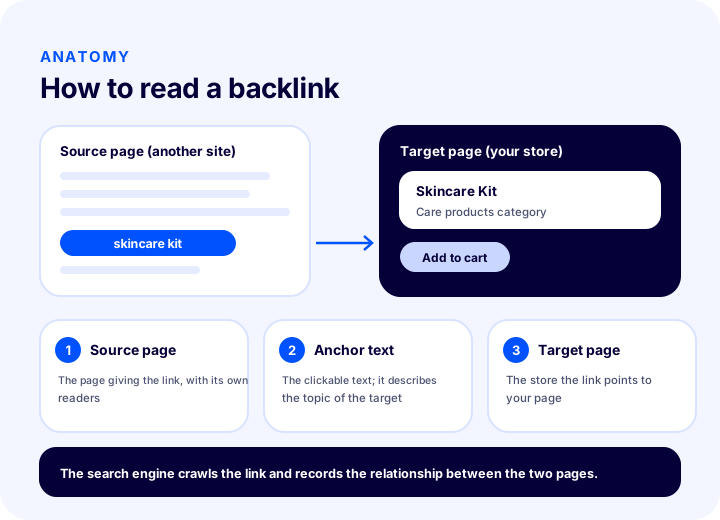
As the illustration shows, a backlink consists of three parts: the source page giving the link, the clickable link text (anchor text) and the target page the link goes to. When the search engine crawls the source page, it sees the link, records its relationship with the target page and gets a clue from the anchor text about what the target is about.
What is anchor text?
Anchor text is the clickable text visible on the link. Empty phrases such as “click here” say nothing about the target; a descriptive phrase such as “leather shoe care kit”, on the other hand, tells both the reader and the search engine what the target contains. You cannot determine how others link to you, but it is a healthy sign when the anchor text is natural and varied. If your brand name, the page topic, empty phrases and bare addresses appear in a mix, the profile looks natural.
Why Do Backlinks Matter?
Backlinks matter because search engines use them as a sign that a page is considered trustworthy and useful by other sites. In addition, a link contributes not only to rankings but also to visitor flow, brand recognition and the discovery of new pages.
We can group these contributions under four headings:
- Trust and reputation signal. A relevant and respected page mentioning you is like a reference given to your site from the outside. Search engines count it among the signs they use when deciding whether your page deserves to be highlighted. Remember that it is not decisive on its own; it is evaluated together with content quality, page experience and topical fit.
- Discovery. Search engine bots reach new pages by following links. An incoming link to a new category or guide article can help the page be found sooner. A sitemap is complementary in this respect; for details, see the article on what a sitemap is.
- Direct visitors. A well-placed link brings relevant readers to your store regardless of rankings. If this visitor is someone looking for a product, they are also close to buying.
- Brand awareness. When your name is mentioned with a link in an article or guide, it helps your target audience get to know you. A gradual increase in brand searches can be an indirect result of links.
Links also have a “value transfer” dimension. When a page links to you, it passes part of its own reputation on to your page through that link; how much is passed depends on the quality of the source and the placement of the link. This is why the value of a link depends on the strength and topical relevance of its source; the number of links alone means little.
We recommend readingHow to Set Up E-Commerce SEO SettingsHow to Tell Quality Backlinks from Weak Ones
A quality backlink is a link placed naturally within the flow of an article, from a relevant, trustworthy page that has real readers. A weak link comes from irrelevant pages, pages with no readers, or pages created only to hand out links.
When evaluating a link, ask these questions: Is this page read by real people? Is its topic related to our business? Does the link sit within the text and complete a sentence, or is it squeezed into a list of links? Do other trustworthy pages besides us link to this site?
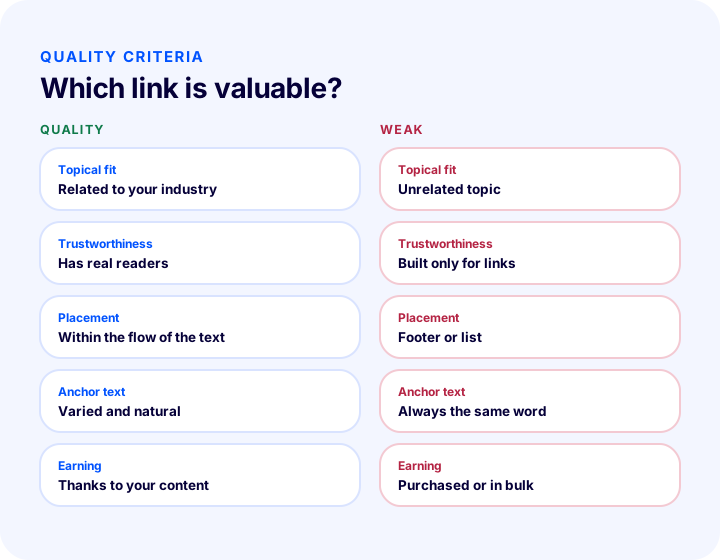
We also summarize the criteria from the illustration in the table below, because seeing them side by side makes the decision easier.
| Criterion | Quality link | Weak link |
|---|---|---|
| Topical fit | The source page is related to your industry or product range | The source page is unrelated to your topic |
| Trustworthiness | The source is a well-known, regularly updated site with its own readers | The source site was built only to collect links |
| Placement | The link sits within the flow of the text, where it completes a piece of information | The link sits in a footer area or in a long list of links |
| Anchor text | Natural, varied and consistent with the context | The same keyword repeats in every link |
| Scanner | There are people who actually read the page and can click | Nobody reads the page; it is auto-generated |
| How it was earned | Given without you asking, thanks to your content | Obtained through payment or bulk exchange |
An important point here: lacking one criterion does not make a link worthless, but links that meet none of the criteria often provide no benefit and can even carry risk. If most of your link profile consists of relevant, natural sources, it is not a problem to see an occasional irrelevant or weak link; such links are part of the nature of the web.
What Are Dofollow and Nofollow?
Dofollow is the usual case, where a link tells the search engine “follow and evaluate this target”; nofollow, with a marker added to the link, says “do not treat this link as an endorsement.” There is no separate tag for dofollow: if a link has no special marker, this is the default behavior.
The behavior of a link is determined by the rel attribute in the link tag. The addresses in the example below are for illustration only:
<a href="https://magazaadresiniz/bakim-urunleri">Bakım ürünleri</a>

<a href="https://magazaadresiniz/bakim-urunleri" rel="nofollow">Bakım ürünleri</a>

<a href="https://magazaadresiniz/bakim-urunleri" rel="sponsored">Bakım ürünleri</a>

<a href="https://magazaadresiniz/bakim-urunleri" rel="ugc">Bakım ürünleri</a>
The first link is a regular link. The second is nofollow; the third is “sponsored”, used to mark paid or advertising links; and the fourth is “ugc”, used for links in places with user contributions such as comments and forums.
| Link type | What does it mean? | When is it seen? |
|---|---|---|
| Regular (dofollow) | The link is followed and evaluated normally | In editorial content, in links given voluntarily |
| nofollow | The link is not counted as an endorsement; the search engine may use it as a hint | For links you do not trust or do not want to endorse |
| sponsored | A paid, advertising or partnership link | In sponsored posts, in ad placements |
| ugc | A link contributed by users | In comment, forum and Q&A areas |
In practice, it is enough to know this: nofollow links are not “useless.” They bring visitors directly, promote your brand and occur naturally in a healthy profile. A link profile with no nofollow links at all also does not look natural. Your goal is not just to collect regular links, but to have varied links from relevant pages.
The same logic applies when you link out from your own site: if there is advertising or an agreement with something in return, give the link with the appropriate marker. Leaving a paid placement unmarked goes against search engine guidelines and costs you trust over time.
How Do E-Commerce Sites Earn Backlinks Naturally?
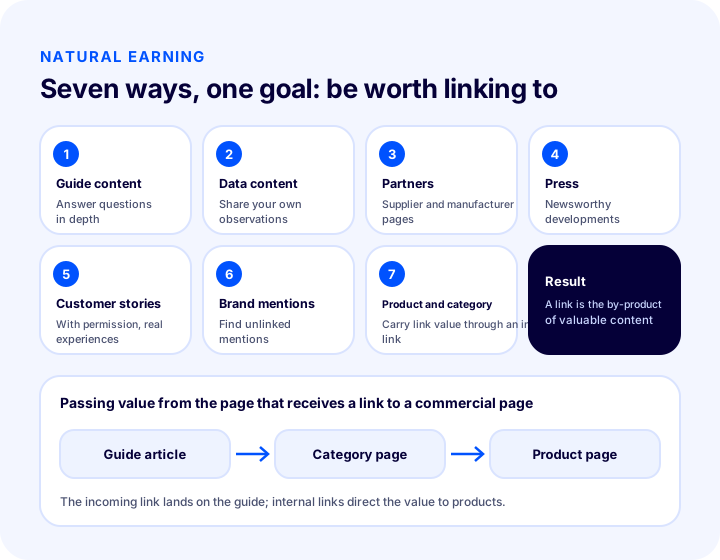
The basic way to earn natural backlinks is to create pages people want to link to and to make sure those pages reach the right people. In e-commerce, this happens through guide and data content, business partners, press, customer stories, brand mentions and strong product or category pages.
Choosing the right path for you depends on your product range, your team's capacity and your target audience. The seven paths below complement one another.
1. Produce original guide content
People link to pages that answer a question well. Write in-depth, up-to-date guides on the questions your customers ask most and on “how to choose, how to use, how to care for” topics related to your product range. Such a page can become a reference that other writers cite. At the end of the guide, carry the value to your store by adding internal links to the relevant product and category pages.
When writing a guide, do not treat the topic superficially: building blocks such as a definition, steps, common mistakes, a comparison table and a Q&A section make the article more useful both for readers and for the people who might link to it. To decide which topics to write about, the e-ticarette anahtar kelime analizi article is a starting point.
2. Prepare data and research content
Observations drawn from your own data are content that others cannot find elsewhere: for example, a summary of which sizes are preferred more in your product range, which topics stand out in customer questions, or how things change with the seasons. What matters is to use only data you really have; do not invent a figure just to fill an article. In data content, briefly explain the method, show the results in a table or illustration, and give a clean, clear heading so that others can quote it.
This kind of content tends to be used as a source by industry writers and by people preparing comparisons. Even for a small store, observations drawn from product questions and customer returns can be valuable.
3. Make use of business partner and supplier pages
The organizations you already work with are the most natural sources of links. Your suppliers, manufacturers, distributors, and logistics and service partners may keep pages on their sites such as “points of sale”, “our partners” or “where to buy”. Being listed on these pages both reflects a real relationship and provides a relevant link.
Keep your approach polite and clear: say which product you sell, which of your pages you would like linked, and how this would benefit the other side. Industry associations, event organizers and local business networks offer similar opportunities. In these relationships, make sure no payment is made in return for the link; if payment is involved, the link must be given with the appropriate marker.
4. Earn press and editorial attention
A development that is genuinely newsworthy, such as a new product line, a notable social responsibility project or an observation that guides the industry, can find a place on news and magazine sites. Before sending a press release, ask yourself: does this news really mean something to the reader? A standard promotional text often gets no response; a concrete story, data or innovation attracts interest.
Reach out to editors and writers with short, personalized notes; provide ready images, product information and contact details. Responding quickly makes the relationship lasting.
5. Turn customer stories into links
When customers who use your product share their experience on their own sites or social profiles, natural links can arise. When preparing a customer story, get permission, rely on real information and make the story valuable for the customer's own audience too. Content showing usage examples, before-and-after comparisons and how the product makes the customer's work easier is suitable for this.
Customer reviews also carry indirect value: where people talk about your product, they mention your name too. For ways to increase reviews, see our article on customer reviews and ratings.
6. Turn unlinked brand mentions into links
Sometimes your brand is mentioned by name in an article, a forum or on a social network, but no link is given. This is an “unlinked mention,” and a polite note can turn it into a link. Track new mentions by searching for your brand name regularly. Thank the owner of the article, share the address of the right page and offer additional information if you like; do not be pushy.
Mentions also catch problems: situations such as incorrect information, an outdated address or a misspelled brand name can be corrected.
7. Increase the value of product and category pages
Backlinks mostly go to blog posts, yet the commercial value lies in the product and category pages. The way around this is to direct value through internal links: add meaningful links from the guide that receives links to the relevant category and product. In addition, some product pages can attract links on their own: if they include elements useful to others, such as a size chart, a user manual, a comparison or original product photos, they get cited as a source.
To make a product page one that others find worth linking to, see what an e-commerce product page should look like; to strengthen a category page, see category page SEO.
Okumanızı öneririzE-Ticaret için İçerik Pazarlamayı Kullanmanın 3 Etkili YoluWhat Should You Avoid When Earning Backlinks?
The methods to avoid are buying links, signing up to link farms or bulk directories, excessive reciprocal link exchange, generating comment and forum links with automated tools, and constantly filling anchor text with the same keyword. Search engine guidelines treat these as methods that try to influence rankings artificially, and they can both reduce the value of a link to zero and put the site at risk.
Let us briefly explain why each method is problematic:
| Method | Why is it problematic? | A better option |
|---|---|---|
| Buying links | Links given for payment and left unmarked go against the guidelines | For sponsored placements, have the link given with the appropriate marker; put the real investment into content |
| Link farms and bulk directories | Sites built only to hand out links, with no readers | Build relationships with relevant sites that have real readers |
| Excessive link exchange | The “you scratch my back, I'll scratch yours” pattern is noticed | Natural, mutual mentions with real business partners |
| Automated comment and forum links | Usually irrelevant, low-value and often blocked links | Answers that genuinely contribute and are on topic |
| Repeating the same anchor text | Creates an unnatural pattern | Variety using the brand name, the page topic and descriptive phrases |
| Links from bulk, irrelevant sources | No topical fit, does not bring readers | Few but relevant and trustworthy sources |
The appeal of shortcuts is that results look fast; however, these links are often not lasting. One day their value may drop to zero, your site may be associated with low quality, and cleaning up may take a long effort. If, after careless bulk sign-ups, you notice irrelevant links flooding your site, document these links and, if necessary, submit a “do not count these” notice using the tools the search engine provides. Most natural sites receive unwanted links from time to time; search engines usually ignore them on their own, so there is no need to panic.
How Do You Monitor Your Backlink Profile?
Monitoring your link profile means regularly checking which pages link to your site and which links have been newly added or lost. The reports that search engines offer to site owners and link analysis tools serve this purpose; at its simplest, looking once a month is a sufficient start.
While monitoring, look for answers to these questions:
- Which of our pages are receiving links? Usually the home page and a few guide articles stand out. If product and category pages receive very few links, it is time to support them with internal links.
- Who is linking to us? The topic and nature of the source sites show the health of the profile.
- How are the anchor texts distributed? If brand names, page topics, generic phrases and bare URLs are mixed, that is natural.
- Are any links disappearing? A link may have been removed or the target page may no longer exist. In the second case, you can recover it with a redirect.
- Is there a sudden spike? An unexpected number of new links in a short time may come from a natural news mention or a campaign, but it can also be an unwanted bulk of links. Check the source.
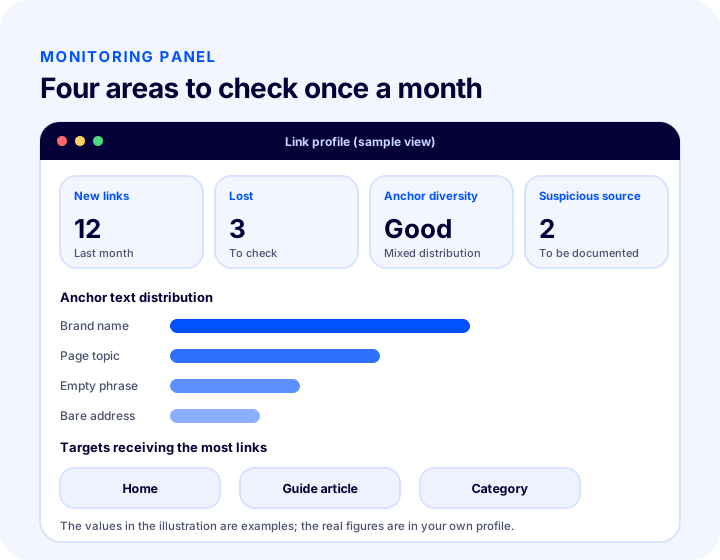
The values in the illustration are for explanation only; your own profile will show your real numbers. What matters is seeing the direction and the reasons: which content attracted links, which links disappeared, and which pages receive no links at all.
| Area to monitor | What to look at? | What is done? |
|---|---|---|
| New links | Is the source relevant and trustworthy? | Thank good sources and create similar content |
| Lost links | Was the link removed, or did the target page change? | If the target broke, set up a redirect and write politely to the source |
| Anchor text distribution | Is the same wording repeated again and again? | Encourage variety in your own content |
| Target pages | Which pages receive links? | Pass the value on to products and categories with internal links |
| Suspicious sources | Are there irrelevant, bulk, foreign-language or meaningless sites? | Document them; if the problem is big, report it through the search engine’s tool |
What Is a Broken Link Opportunity?
A broken link opportunity works both ways: a link pointing to your page is wasted when that page’s address changes, which is a loss; but finding links to pages that no longer exist on other sites and suggesting your own relevant page in their place is a way to gain links.
Recover your own broken links
You may have deleted a product page, changed a category’s address or removed an article. If other sites link to those pages, visitors land on an error page and the link’s value is lost. The fix is simple: find the addresses that still receive external links but no longer exist, and set up a 301 redirect to the closest equivalent. You can find the redirect logic in what is a 301 redirect, and how an error page can help visitors in what is a 404 page.
Turn other sites’ broken links into opportunities
On relevant sites, you can find articles that link to pages that no longer open. In that case, send the author a short, polite note saying the link is broken and suggesting your relevant content instead. The note should not just be helpful but genuinely appropriate: your chance of a response rises if your suggestion is a useful page similar to the topic the broken link covered.
- Find pages related to your topic that contain links.
- Identify the broken links on those pages.
- Check what the broken link used to cover.
- If your site has a page covering the same topic, suggest it; if not, prepare such content.
- Write the author a short, polite note and don’t be pushy.
Common Mistakes in Backlink Work
The most common mistake in backlink work is looking for links before the content is ready. If there is no page worth linking to, even the best plan won’t deliver results. Other common mistakes are:
- Asking only for links to the home page. Attract links to different pages, especially to useful guides.
- Sending standard bulk emails. Messages that aren’t personalized are easily deleted.
- Forcing the anchor text. Don’t try to push your own keyword into someone else’s sentence.
- Thinking short-term. Natural links take time; a profile built up patiently lasts.
- Ignoring on-page problems. Even if links arrive, you won’t get results if the page is slow or faulty.
- Not monitoring. Without knowing what works, effort is repeated and losses go unnoticed.
- Crossing legal and ethical limits. Failing to label paid links or spamming comments damages trust.
Backlink Checklist
The list below gives a summary so you can run your link work regularly. We also provide the same items as a table.
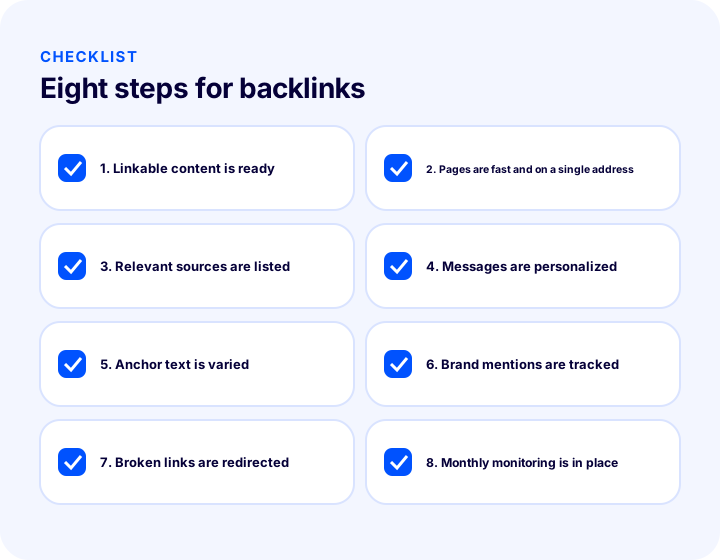
| Step | Question |
|---|---|
| 1. Linkable content | Does my site have a guide, data or tool that others would cite? |
| 2. Basic soundness | Do my pages load fast, live at a single address and redirect correctly? |
| 3. Relevant sources | Have I listed partners, suppliers and publications related to my field? |
| 4. Personal approach | Are my messages personalized and beneficial for the recipient? |
| 5. Natural anchor text | Are my link texts varied and appropriate to the context? |
| 6. Brand mentions | Do I regularly track unlinked mentions? |
| 7. Broken links | Have my addresses that received links but no longer open been redirected? |
| 8. Monthly monitoring | Do I check new, lost and suspicious links once a month? |
Preparing for Backlink Work with Faprika
Backlinks are earned outside your store, but their value is determined by the infrastructure inside it. The SEO settings in the Faprika control panel include several items that help you keep the pages that receive links in good shape. According to the SEO settings training in the Help Center, title and description information can be edited for products and categories, and the canonical address can be set; this gives the page that receives links a single, clear address.
The plan feature comparison includes the row “301 / 302 / 410 Panel / Managing URL Records”. Tools like this are used to redirect an old address that receives external links to a suitable target when you change or remove a page’s address. The same comparison also includes rows such as “Canonical / H Tag Management / Robots / Sitemap”, “Bulk Automatic SEO/Meta Information Update” and “SEO Reports”. Which management tools each plan includes may vary by plan; for the current scope, see the e-commerce plans page.
The link itself is earned through content; the store-side job is to preserve the permanent, clear addresses of the pages that receive links. To set up the address structure correctly from the start, see how should URL structure be; to improve how pages appear in search results, see how to write a title tag and how to write a meta description. For how your page will look when shared, what is an Open Graph tag will help.
Frequently Asked Questions
What is a backlink?
A backlink is a link from a page on another site to a page on your site. Search engines treat these links as a sign that your page is considered trustworthy and useful by other sites. The value of a link depends on the quality of the source and its topical fit.
Does the number of backlinks matter, or their quality?
Quality matters more. A single link from a relevant, trustworthy page can be worth more than many links from unrelated, weak sources. Topical fit, the trustworthiness of the source and the natural placement of the link are what decide.
What is the difference between dofollow and nofollow?
Dofollow is the default situation in which a link is followed and evaluated normally; nofollow is a link carrying a marker that asks that it not be counted as an endorsement. The sponsored marker is used for paid links and the ugc marker for user-generated links. A healthy profile can contain every type of link.
E-commerce sites: how do they earn backlinks naturally?
By producing original guides and data content, appearing on partner and supplier pages, attracting press attention with newsworthy developments, sharing customer stories, turning unlinked brand mentions into links, and keeping product and category pages at a quality others would want to link to.
Is it safe to buy backlinks?
No. Links given in exchange for payment and not marked as such go against search engine guidelines and can put the site at risk. Purchased links are not permanent either. If an advertising placement is to be made, the link should be given with the sponsored marker; investing mainly in content is safer.
How often should I check my link profile?
Checking once a month is a good starting point for most stores. Look at new and lost links, the anchor text distribution, target pages and suspicious sources. An extra check is useful after a major campaign or press release.