
Contents 13 sections
- What Is a Featured Snippet?
- Why Does a Featured Snippet Matter?
- What Are the Featured Snippet Formats?
- For Which Searches Does an Answer Box Appear?
- How Do You Write a Page for a Featured Snippet?
- Where Is a Featured Snippet Applied on E-Commerce Pages?
- Why Might You Not Get Into a Featured Snippet, or Lose It?
- What Is the Difference Between a Featured Snippet, a Meta Description, and Structured Data?
- What Are Common Mistakes When Targeting a Featured Snippet?
- How Do You Track Featured Snippet Success?
- Featured Snippet Checklist
- Answer-Focused Page Management with Faprika
- Frequently Asked Questions
A customer types “how to do product care” or “how to read a size chart” into the search box. At the very top of the results page, before all the links, they see a small box that gives the answer to the question directly. The box contains a few sentences, a list, or a table, and below it the address of the page that gave the answer. A page that has made it into this box has shown your store's name and information to the visitor even before anyone clicks.
In this guide, we answer what a featured snippet is from an e-commerce perspective: the definition of the answer box, also known as position zero, its paragraph, list, and table formats, which questions trigger this box, how to write a page in a question-and-answer structure, its application on product, category, and blog pages, why the box does not appear or disappears, measurement, and common mistakes. At the end, there is information about Faprika and a six-question FAQ.
What Is a Featured Snippet?
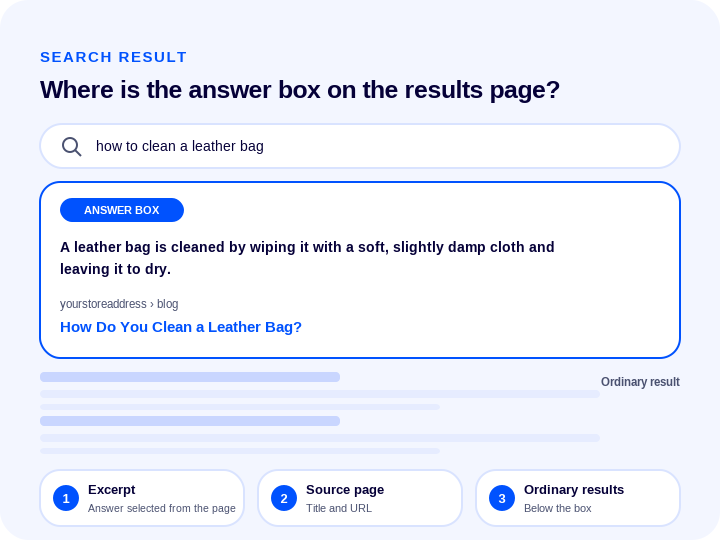
A featured snippet is a summary that the search engine shows for a query in a separate box above the results list, quoting the answer from a web page. Because of its place in the ranking, it is also called “position zero” or the “answer box.”
The box has three parts: the excerpt containing the answer to the question, the title and URL of the page the excerpt was taken from, and sometimes related questions. You do not write the excerpt; the search engine selects the appropriate section from your page's content and puts it in the box. That is why you “get into” or “are selected for” a featured snippet; it is not a feature you turn on or off in your page's settings.
It should not be confused with the two-line description you see in an ordinary search result. That description is the page's meta description or a short excerpt chosen from the page, and it appears in every result; the answer box, by contrast, appears separately above the list only for certain queries and certain pages. For details on writing meta descriptions, see the how to write a meta description guide; unlike that guide, this article covers how to build the answer in the body of the page.
We recommend readingHow to Write a Meta DescriptionWhy Do Featured Snippets Matter?
Featured snippets matter for three reasons: they can move your page to the most visible spot in the results list, they present your store to visitors as the site that knows the answer to this question, and the habit of writing clear answers benefits every reader of the page. A warning is needed here as well: getting into the box cannot be guaranteed, and the box may change over time.
Visibility: you are seen before the click
The answer box sits at the very top of the results page. Visitors can read the answer there; those who want more detail click the link in the box. In either case, your store's name and information appear in the first frame. No one can say in advance in which direction the click count of a page in the box will change; that is why the effect needs to be tracked in your own search performance reports.
Trust: the impression of a brand that knows the answer
Pre-purchase questions such as “how do I return an item”, “how do I care for the product” and “which size is right” are asked in the middle of the buying decision. A store that gives a clear answer to these questions on the results page establishes itself in the customer's mind as a store that knows the subject.
AI assistants: the same writing style, the same benefit
Turning the question into a heading and giving a short, clear answer right beneath it is the most suitable format not only for the search box but also for AI assistants quoting from your page. The effort spent on this writing style is therefore not tied to a single surface.
| Benefit | How does it arise? | Point to watch |
|---|---|---|
| Visibility | The answer is shown in the box above the results list | Getting into the box is not guaranteed |
| Trust | The store becomes the source that answers the pre-purchase question | The answer must be accurate and up to date |
| AI citation | A question heading and a short answer are suitable for quoting | The answer must be understandable on its own |
| Page quality | A clearly written page is also easier for visitors to read | Text should not be padded for the sake of the box |
What Are the Featured Snippet Formats?
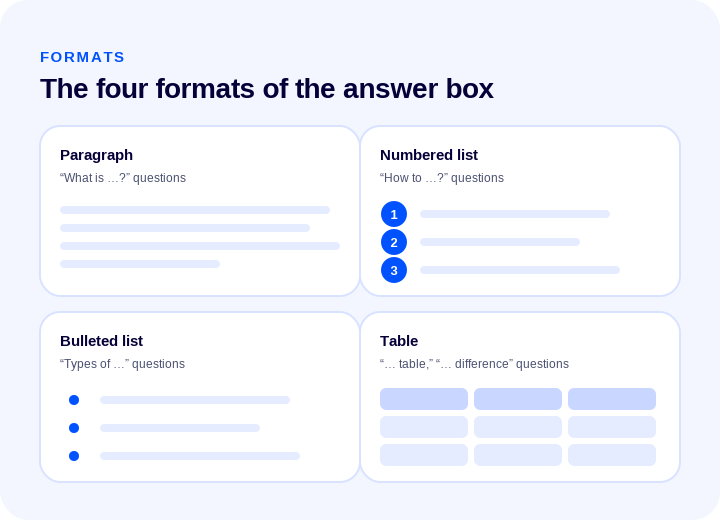
A featured snippet appears in four formats: paragraph, numbered list, bulleted list and table. Which one appears depends on the type of question; “what is” questions mostly call for a paragraph, “how to” questions for a numbered list, “best” and “types of” questions for a bulleted list, and comparison and measurement questions for a table.
1. Paragraph format
A short definition or explanation paragraph goes into the box as it is. It is the most common format for “what is”, “why” and “what does it mean” questions. Right below the heading, write a paragraph that sums up the answer in one or two sentences; leave the details to the following paragraphs.
2. Numbered list format
Sequential steps can be shown in the box as a numbered list. “How to”, “how to return” and “how to measure” questions trigger this format. If the steps are written on the page as a real numbered list, the search engine recognizes the order easily.
3. Bulleted list format
It is used for items whose order does not matter: “types of”, “examples of”, “features of”, “best methods”. Each item should be short and understandable on its own; items with long sentences may not fit in the box and may be cut off.
4. Table format
Comparison, measurement and feature questions can be answered in table format. In e-commerce, size charts, shipping options and material comparisons are the natural territory of tables. The table should be built with a real table tag on the page, not added only as an image; text inside an image cannot be read as text.
| Format | Question type that triggers it | How to write it on the page? |
|---|---|---|
| Paragraph | “What is …?”, “Why …?” | A short, clear definition under the heading |
| Numbered list | “How to …?” | A real numbered list, each step short |
| Bulleted list | “Types of …”, “best …” | A real bulleted list, each item independent |
| Table | “… comparison”, “… table” | A real table with clear column headings |
Which Searches Trigger an Answer Box?
The answer box mostly appears for searches that expect a question or a clear answer: patterns such as “what is”, “how to”, “why”, “when”, “which” and “what is the difference” are typical examples. A box does not appear for every question, and the decision to show it rests entirely with the search engine.
In e-commerce, these patterns turn up in two places. The first is pre-purchase questions: how a product is used, which size to choose, return and delivery terms. The second is general shopping-related information questions: the types of a product group, care methods, material differences. The first is directly close to buying intent; the second draws those looking for information to your store.
Looking at search intent makes it easier to choose which questions to target. Questions written with informational intent are more prone to the answer box; for searches written with purchase intent, such as “price” and “buy”, product and category pages come to the fore. To see the intent types in detail, see the what is search intent guide; to find long searches in question form, see the what is a long-tail keyword article.
Recommended readingWhat Is Search Intent?| Question pattern | E-commerce example | Suitable format |
|---|---|---|
| “What is …?” | What is a leather care kit? | Paragraph |
| “How to …?” | How do you clean a leather bag? | Numbered list |
| “… types” | What are the types of thermos? | Bulleted list |
| “… table”, “… difference” | Shoe size chart, the difference between steel and glass bottles | Table |
| “When …?” | When can a return be made? | Paragraph or list |
How to Write a Page for a Featured Snippet?
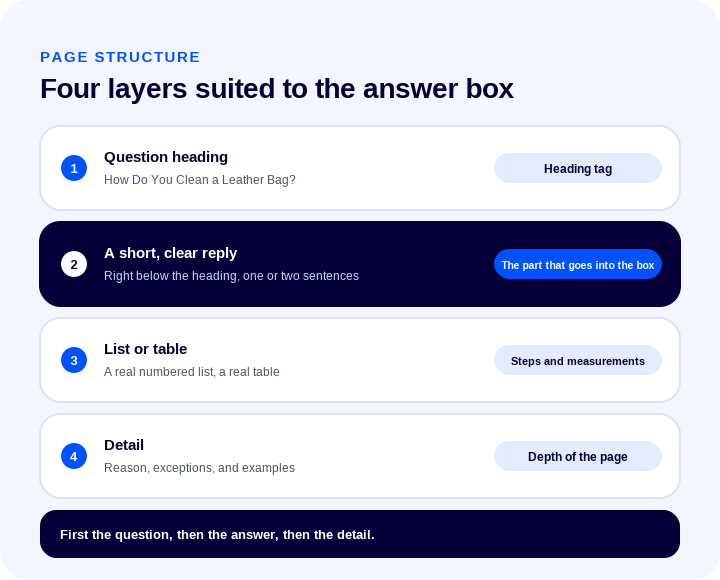
For a featured snippet, write the page in a question-and-answer structure: make the question a heading, put a short, clear answer right below it, and then move on to the details. Build lists and tables with real list and table tags, and keep the answer understandable even when read without its heading.
1. Choose the question and focus on a single question
Let each section answer a single question. If several questions are mixed in the same section, the search engine has difficulty working out which part belongs to which question. Write the question in the words the customer uses; put it in the heading the way it is typed into the search box.
2. Make the question a heading
The question should be written with a subheading tag; plain bold text is not enough. Heading tags form the skeleton of the page and state clearly which question the answer belongs to. For heading structure, see the heading section of the what is on-page SEO guide.
3. Write the short, clear answer right below it
Let the first paragraph right below the heading answer the question directly: first the answer, then the reasoning. Do not begin with introductory sentences such as “This topic is very important, let's take a look”. The answer should be understandable on its own even when taken out of context. If the key phrase from the question appears in the first sentence, the answer becomes more distinct.
4. Make the steps a real numbered list
If you are describing a sequential process, write the steps with a numbered list tag. Let each step be a short action sentence; leave the explanation to a separate paragraph under the step. Writing the steps inside a paragraph as “first do this, then do that” makes it harder for the search engine to recognize the list.
5. Give the comparison in a real table
For a size, measurement, duration or feature comparison, build a real table; let the column headings be clear. Do not add the table as an image, because text inside an image cannot be read as text. Keep the wording in the cells short.
6. Put the detail below the answer
Although the part that goes into the box is short, the value of the page lies in the detail. Below the short answer, write the reasons, exceptions and examples. That way, when the visitor coming from the box enters the page, they find the depth they were looking for and stay in your store.
Below is a short example of how the question-and-answer structure looks in the page source. The heading in the example is in question form and gives a direct answer right beneath it; the steps are a real numbered list.
<h2>Deri Çanta Nasıl Temizlenir?</h2>
<p>Deri çanta, yumuşak ve hafif nemli bir bezle silinip
kurumaya bırakılarak temizlenir; sert kimyasallar kullanılmaz.</p>
<ol>
  <li>Çantayı boşaltın ve toz alın.</li>
  <li>Nemli bezle yüzeyi silin.</li>
  <li>Doğal ortamda kurumaya bırakın.</li>
</ol>
<p>Örnek adres: https://magazaadresiniz/blog/deri-canta-temizligi</p>Where Is Featured Snippet Writing Applied on E-Commerce Pages?
Featured snippet writing is applied most often in blog posts, in the guide sections of category pages, in the question-and-answer sections of product pages, and in help or FAQ pages. The question each page type can answer is different.
Blog articles
“What is” and “how to” questions are the natural territory of blog posts. Let each H2 be a question, with a short definition beneath it followed by the detail. This article itself is built with this structure. You can read how to plan blog posts in the what is content clustering guide.
Category pages
The short guide section added beneath a category page can answer the basic questions about the category: “how do I choose the right size”, “what are the types of this product group”. This section does not replace the product list; it complements it. To build category pages as a whole, see the how to do category page SEO article.
Product pages
The question-and-answer section on a product page should be made up of questions customers actually ask: size, care, use, delivery. Each question is written as a heading or a bold question line, and each answer as a short paragraph. For the general structure of a product page, the e-commerce how should a product page be article will help you.
Help and FAQ pages
Return, delivery and payment questions suit the answer box because each question has a single answer. Group the questions, and let the answer to each question be understandable on its own. To plan an FAQ page, see the how to prepare an e-commerce site FAQ page article.
Recommended readingHow to Create an FAQ Page for an E-Commerce Site| Page type | Question it can answer | Recommended format |
|---|---|---|
| Blog post | What is, how to, why | Paragraph and numbered list |
| Category page | How to choose, what are the types | Bulleted list and table |
| Product page | Size, care, use, delivery | Short paragraph and table |
| Help and FAQ page | Returns, payment, delivery | Question heading and short paragraph |
Why Might You Not Get Into a Featured Snippet, or Lose It?
The reasons for not getting into the box, or for losing it after getting in, are generally these: the page does not answer the question clearly, the structure is broken, the page is not visible enough in search, or another page answers the same question more clearly. The box is not a guaranteed reward but a constantly changing selection.
The answer is not clear or comes too late
If the question is in the heading but the answer comes three paragraphs later, the search engine cannot find a clear part to quote. Move the answer right below the heading.
The structure is not built with real tags
If a list, numbered steps or a table are written only visually (for example with dash characters at the start of lines, or as an image), the search engine may not recognize it as a list or table. Use real list and table tags.
The page is not visible enough in search
The box is mostly chosen from pages that already appear well for the query. If the page is not indexed, crawling is blocked, or the page is weak, the answer box does not come either. For indexing problems, see why is my page not indexed; for crawl blocks, see what is robots.txt.
Directives that restrict quoting
If the page contains a directive that restricts the display of quotes (for example a meta robots value asking that the page not be quoted), the page is not taken into the answer box. If you did not add this directive deliberately, check the page's source code.
A competitor's page gives a clearer answer
Another page that gives a shorter, clearer and better-structured answer to the same question may take the box. In such a case, simplifying the answer, filling in the missing detail and answering the question more directly points the way.
What Is the Difference Between a Featured Snippet, a Meta Description and Structured Data?
The three are different things: you write the meta description, you add the structured data, whereas the featured snippet is an excerpt the search engine chooses from the page content. The existence of one is not a guarantee of another.
| Item | Who defines it? | Where does it appear? | What does it depend on? |
|---|---|---|---|
| Meta description | You write it | In the page's source code | On your page preparation |
| Structured data | You add it | In the page's source code | On your page preparation; display is not guaranteed |
| Featured snippet | The search engine chooses it | In the box above the results list | On the clarity of the answer in the page content and on the query |
Structured data tells the machine clearly what the page is; but it is neither a separate route to getting into the answer box nor a guarantee of it. If the page has a frequently asked questions section, adding question-and-answer data may be useful, but what matters most is the visible text on the page. For the general logic of structured data, see the what is structured data article. For the role of the title tag, the how to write a title tag article will help.
We recommend readingWhat Is Structured Data?What Are the Common Mistakes When Targeting Featured Snippets?
The most common mistakes are giving the answer late, not making the question a heading, writing the list visually, cramming every question onto one page, lengthening the text to get into the box, and not keeping the answer up to date.
- Giving the answer late: Writing a long introduction after the heading makes the part to be quoted get lost inside the page.
- Not making the question a heading: If the question is written as plain text, it becomes unclear which question the answer belongs to.
- Making the list or table a visual: Text inside an image cannot be read as text; use a real list and table.
- Cramming every question onto one page: Answering many different topics on one page scatters the page's focus; let each page stay true to its own topic.
- Padding the text for the sake of the box: The goal is not to get into the box but to answer the question well. Needlessly lengthened text tires the visitor too.
- Not keeping the answer up to date: If return terms, delivery details or measurements change, the page must change too; an answer that gives outdated information damages trust.
- Giving a short, vague answer: “It depends” is not an answer on its own; also write what it depends on.
- Assuming pages without questions are ready for the answer box: A page that never asks the question and only lists products is not a candidate for the answer box; for that page, targeting a place in the results list is more realistic.
How to Track Featured Snippet Success
You track success by monitoring the impressions, clicks and average position that the page or query receives in search performance reports. The report may not tell you directly whether you made it into the answer box, so you also need to search the target queries yourself from time to time.
For tracking, follow these steps: collect the target questions in a list, identify the page for each question, compare the change in impressions and clicks for these pages at regular intervals, and try the query yourself in the search box. Make changes one at a time so you can tell which edit had an effect. To learn how to read the reports, see the article how to read an SEO report.
Featured Snippet Checklist
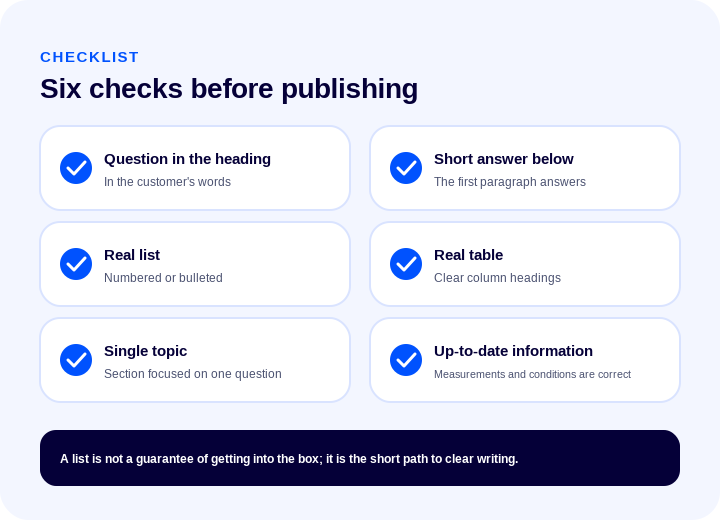
Before publishing a page, check these six items; it is the same as the list in the image.
- Question in the heading: The question is written in the customer’s own words and with a heading tag.
- Short answer right below: The first paragraph answers the question directly and can be understood on its own.
- A real list: Steps are written with a numbered list tag, items with a bulleted list tag.
- A real table: The comparison is built with a table tag and the column headings are clear.
- One topic: The page and the section focus on a single question.
- Up-to-date information: Measurements, durations and terms are current and consistent with the store application.
This list is not a formula that guarantees ranking; it is a short way to make sure the page’s answer is clear, readable and consistent.
Answer-Focused Page Management with Faprika
Faprika’s plan feature comparison includes rows such as “Canonical / H Tag Management / Robots / Sitemap”, “Bulk Automatic SEO/Meta Information Update” and “Taxonomy / Rich Snippets / Breadcrumb”. Managing heading tags, setting up question headings at the right level and updating SEO information in bulk are the topics these rows cover. Which feature is included in which plan, and to what extent, may vary by plan; for the current scope, see the e-commerce plans page.
The SEO Settings guide in the Faprika Help Center explains SEO settings for every section, from products to blogs. When editing product descriptions and catalog fields, the Catalog Management guide will help, and for image and media settings the Media Settings Management guide. The plan comparison also has an “SEO Reports” row; the scope of this row should also be checked per plan.
For setting up title, description and address settings together across the store, see the guide how to configure e-commerce SEO settings, and for showing pages correctly in the hierarchy, the article what is breadcrumb. Getting into the answer box does not depend on a single setting; but editing and keeping up to date, from the Faprika admin panel, pages written in a question-and-answer structure is the practical side of the approach this article describes.
Frequently Asked Questions
What is a featured snippet?
A featured snippet is a summary that the search engine shows in a separate box above the results list in response to a question, quoting the answer from a page. It is also known as “position zero” or the “answer box.” The search engine chooses the excerpt; it is not a feature you turn on or off in a page's settings.
Can getting into a featured snippet be guaranteed?
No. Whether you get into the answer box and how long you stay there is the search engine's decision. Turning the question into a heading and giving a short, clear answer right below it, and building lists and tables with real tags, increases your chance of being selected but does not make the outcome certain.
In which formats does it appear?
It appears in four formats: paragraph, numbered list, bulleted list, and table. “What is” questions are generally answered in paragraph format, “how to” questions in numbered list format, “types of” questions in bulleted list format, and comparison and measurement questions in table format.
Are the meta description and the featured snippet the same thing?
No. You write the meta description, and it may be used as the description in an ordinary result. A featured snippet is an excerpt the search engine selects from the page content and appears in a separate box above the results list. One does not guarantee the other.
Does structured data get you into a featured snippet?
No, not by themselves. Structured data tells machines what a page is and can be useful for frequently asked questions, but the deciding factor for getting into the answer box is visible, clear, well-structured text on the page.
How should a page be written for a featured snippet?
Write the question with a heading tag, put a short paragraph that answers the question directly right below it, give steps as a numbered list and comparisons as a table, and leave the detail below the answer. Keep each section focused on a single question and keep the information up to date.